Phia Nam Industrial Park - Lao cai
- Investor: Management Board of Industrial Parks of Lao Cai Province
- Price: 30 USD/m2
- Area: 455 Ha
LAO CAI, VIETNAM 2026
Vietnam’s China Gateway for Border Trade, Industry, Logistics, Tourism & Northwest Growth
TTTFIC GLOBAL INVESTMENT PROFILE 2026
Lao Cai has entered a fundamentally new phase of development.
Under Vietnam’s 2025 administrative restructuring, the entire former provinces of Lao Cai and Yen Bai were consolidated into a new Lao Cai Province.
This merger created much more than a larger mountainous province.
It connected:
Vietnam–China border trade
+
the Kunming–Lao Cai–Hanoi–Hai Phong economic corridor
+
mineral and deep-processing industries
+
hydropower and industrial infrastructure
+
Sa Pa and Fansipan
+
Mu Cang Chai and Nghia Lo
+
Thac Ba Lake
+
agro-forestry production
+
a larger labor, consumer and tourism market.
The result is one of northern Vietnam’s most diversified inland investment platforms.
Lao Cai should therefore no longer be evaluated simply as a border province.
It is increasingly becoming a:
BORDER + INDUSTRY + LOGISTICS + TOURISM + RESOURCE + REGIONAL-CONNECTIVITY ECONOMY.
The new Lao Cai Province was established through the consolidation of:
former Lao Cai Province
and:
former Yen Bai Province.
Following the merger, the province has:
of natural area and an official population of:
It is one of Vietnam’s largest provinces by land area.
Following commune-level restructuring, Lao Cai has:
including:
89 communes
and:
10 wards.
The province borders:
Lai Chau Province
Son La Province
Phu Tho Province
Tuyen Quang Province
and:
Yunnan Province, China.
The international border with China extends for approximately:
The merger produces several important investment synergies.
Former Lao Cai contributed:
China border access
Lao Cai International Border Gate
Kim Thanh cargo gateway
Sa Pa
Fansipan
Tang Loong industrial platform
apatite, copper and mineral processing
cross-border logistics
and:
international tourism.
Former Yen Bai contributed:
Mu Cang Chai
Nghia Lo
Thac Ba Lake
large forestry and cinnamon areas
agro-processing
additional industrial land
hydropower
and:
a larger domestic economic and labor base.
Together, these create a province with a much more balanced investment structure.
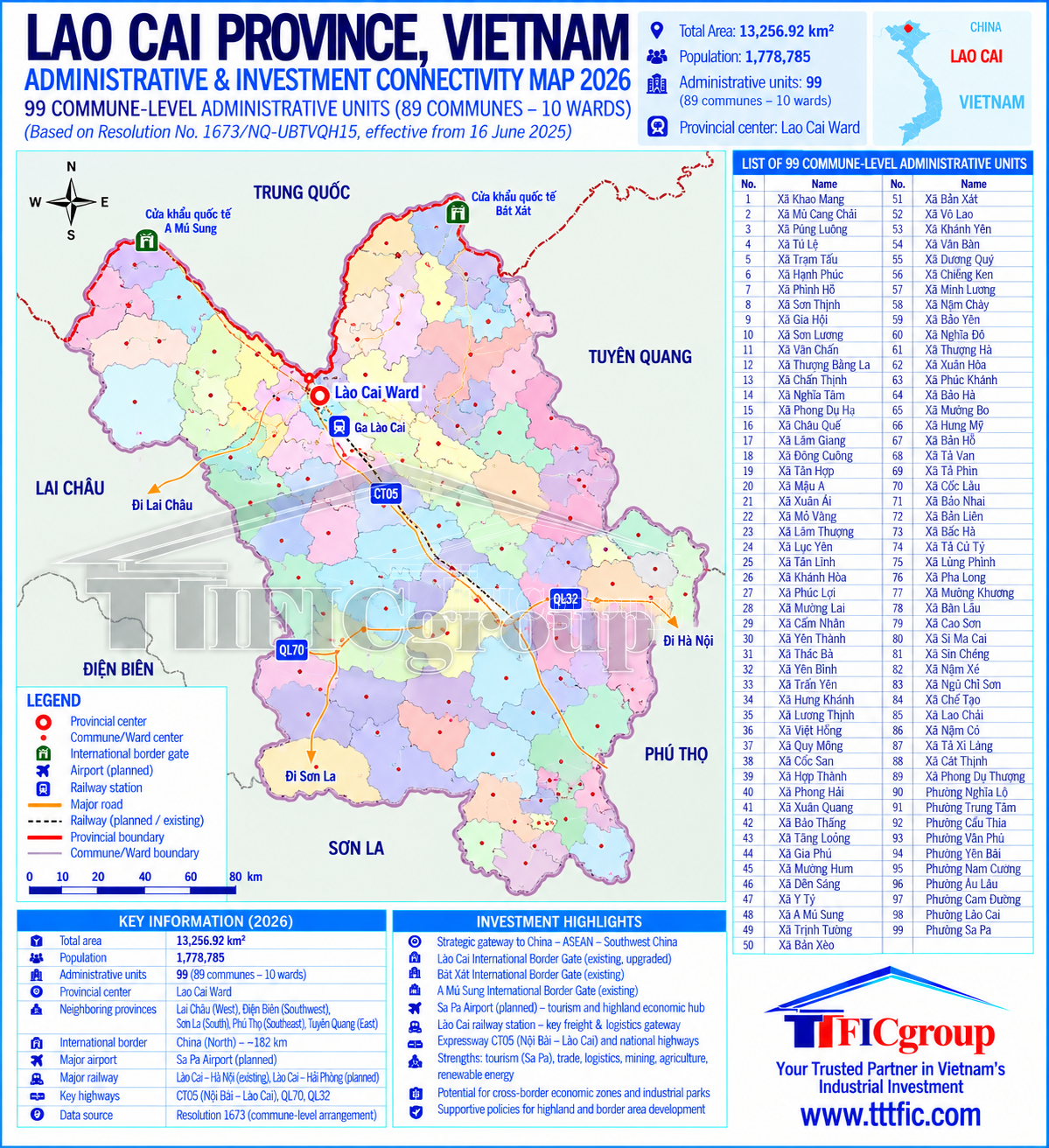
The merger of Lao Cai and Yen Bai became effective under Resolution No. 202/2025/QH15.
The new provincial political and administrative center is located in the former Yen Bai City area.
This creates an unusual two-pole development structure.
Centered around:
Lao Cai
Cam Duong
Bat Xat
the China border
and:
Sa Pa.
Its strengths are:
border trade
logistics
tourism
mining
industrial processing
and international connectivity.
Centered around the former Yen Bai economic area, including:
Yen Bai urban area
Thac Ba
Van Yen
Nghia Lo
Mu Cang Chai
and surrounding production corridors.
Its strengths include:
agro-forestry
tourism
hydropower
manufacturing
urban services
and:
regional connectivity.
This dual-pole structure is one of the most important post-merger characteristics of the new province.
The merger substantially increased Lao Cai’s economic scale.
Official provincial reporting places the 2025 economic scale of the new province at approximately:
with GRDP per capita above:
The average GRDP growth rate for 2021–2025 was approximately:
Final reporting for 2025 showed:
ranking Lao Cai among the stronger-growing local economies in northern Vietnam.
The approximate 2025 economic structure was:
Agriculture, forestry & fisheries: 16.0%
Industry & construction: 37.3%
Services: 39.2%
with the remainder represented by product taxes less subsidies.
This is a relatively balanced economic structure.
Unlike many mountain provinces, Lao Cai possesses meaningful scale across:
and:
Lao Cai’s China border remains the province’s most significant international commercial advantage.
The province connects directly with Yunnan, one of southwestern China’s principal regional economies.
Key border infrastructure includes:
primarily supporting passengers, tourism and cross-border movement.
the province’s principal road freight gateway.
Cross-border trade supports:
agricultural exports
fresh fruit
industrial inputs
fertilizer
machinery
chemicals
consumer goods
and:
regional distribution.
In 2025, the total value of imports, exports and border trade through Lao Cai’s border gates reached approximately:
Exports included products such as:
yellow phosphorus
durian
and:
dragon fruit
while imports included:
fruit and vegetables
fertilizer
chemicals
and industrial inputs.
This demonstrates that Lao Cai is not merely a border checkpoint.
It is a functioning international trade economy.
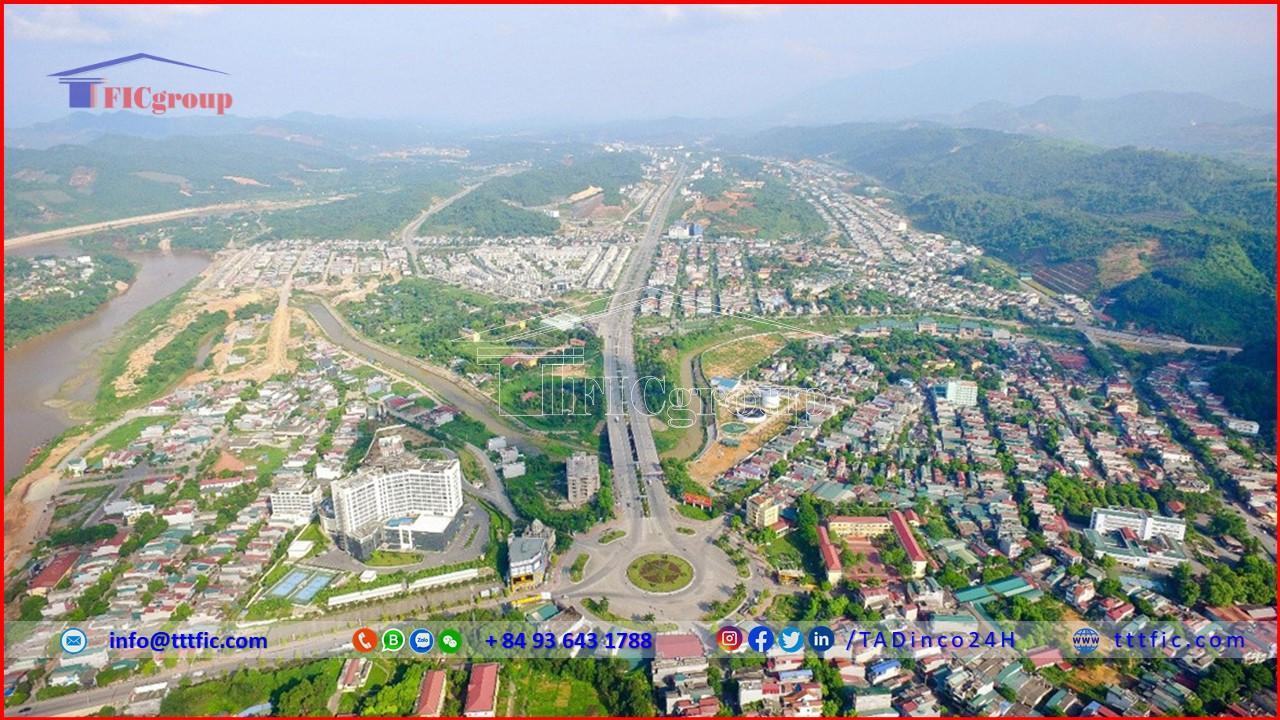
Lao Cai sits at the northern gateway of one of Vietnam’s most strategically important international economic corridors:
KUNMING
→ LAO CAI
→ HANOI
→ HAI PHONG
→ INTERNATIONAL SEAPORT.
This creates a land–sea connectivity model linking:
with:
and:
The corridor supports:
international transit
agricultural trade
industrial inputs
manufacturing
logistics
and:
regional supply chains.
For TTTFIC, this is central to the province’s investment thesis.
Lao Cai is not only a destination market.
It is a:
GATEWAY MARKET.
One of the most important infrastructure projects affecting Lao Cai is the new:
LAO CAI–HANOI–HAI PHONG RAILWAY.
The National Assembly approved the project under Resolution No. 187/2025/QH15.
The line is planned to extend approximately:
from the rail connection at the China border to:
The project uses:
and is designed to carry both:
passengers
and:
freight.
The estimated investment is approximately:
The project aims for completion no later than 2030 under the approved investment policy.
Its strategic significance for Lao Cai is considerable.
If delivered successfully, it can create a direct modern rail chain:
→ LAO CAI
→ HANOI REGION
→ HAI PHONG PORT.
Potential beneficiaries include:
logistics operators
industrial manufacturers
agricultural exporters
mineral processors
warehousing
and:
cross-border distribution centers.
However:
Investors should model present logistics using current infrastructure and treat the new railway as a future catalyst until operational.
Lao Cai already benefits from the:
NOI BAI–LAO CAI EXPRESSWAY.
This route connects the province with:
Hanoi
Noi Bai International Airport
and Vietnam’s wider northern highway system.
Further upgrades to the Yen Bai–Lao Cai section and related strategic roads have remained infrastructure priorities.
The merger also places the entire former Yen Bai corridor inside the same province.
This matters because a larger portion of the Hanoi–Lao Cai transport chain is now administratively internal to one province.
For logistics and industrial investors, improved internal connectivity can strengthen:
labor mobility
supplier access
tourism circuits
agricultural collection
and:
regional distribution.
Border trade becomes more valuable when it is supported by logistics services.
Lao Cai’s next investment opportunity therefore extends beyond customs clearance.
Potential growth sectors include:
bonded warehousing
cold storage
cross-docking
truck terminals
customs-support services
digital logistics
agricultural inspection
traceability
distribution centers
and:
intermodal rail–road logistics.
The province has also prioritized smart-border and logistics systems.
In 2026, national logistics authorities identified Lao Cai as the international land-border gateway, while Hai Phong plays the complementary role of international maritime gateway within the same economic corridor.
That relationship could become increasingly important as the new standard-gauge railway develops.
Industry is an established component of Lao Cai’s economy.
In 2025, industrial production value exceeded:
and manufacturing’s share within the industrial structure increased while mining’s relative share declined.
This represents an important transition.
The province’s long-term industrial strategy should move from:
toward:
Official reporting indicates:
with occupancy above:
along with:
with occupancy above:
This gives post-merger Lao Cai a materially larger industrial footprint than the former province alone.
The Tang Loong industrial area remains one of northern Vietnam’s most important mineral-processing locations.
The broader industrial system includes activities linked to:
apatite
phosphorus
fertilizers
chemicals
copper
and other mineral-related industries.
The older TTTFIC profile already correctly recognized minerals as one of Lao Cai’s major economic strengths, including apatite, copper and iron.
But the new Profile must go beyond simply listing minerals.
The investment question is:
TTTFIC therefore favors development models involving:
deep processing
industrial chemistry
higher-value materials
industrial recycling
energy efficiency
and:
environmental modernization.
Lao Cai possesses a nationally significant mineral-resource base.
Important resources include:
apatite
copper
iron
rare and non-ferrous minerals
construction materials
and other mineral deposits.
However, resource ownership alone does not create an investable project.
TTTFIC applies the following status logic:
≠ COMMERCIAL RESERVE
≠ MINING RIGHT
≠ OPERATING MINE
≠ PROCESSING LICENSE
≠ INVESTABLE PROJECT.
Any investor must verify:
mineral planning
license status
resource quality
environmental obligations
energy requirements
tailings and waste management
water use
transportation economics
and:
downstream market demand.
This is particularly important in environmentally sensitive mountain regions.
Post-merger Lao Cai has a meaningful, although still relatively modest, FDI base.
By late 2025, the province reported:
with registered capital of more than:
from:
Two new FDI projects were recorded in 2025, focused on areas including:
manufacturing
technical infrastructure
transport
and:
factory development.
This confirms that Lao Cai is already an international-investment destination, but it is not yet a high-density multinational manufacturing cluster.
Its strongest FDI propositions remain:
border trade
industrial processing
mineral-linked manufacturing
tourism
logistics
agro-forestry processing
and:
infrastructure.
Sa Pa remains Lao Cai’s strongest international tourism brand.
It combines:
Fansipan
Hoang Lien landscapes
highland climate
ethnic cultures
rice terraces
trekking
luxury accommodation
and:
major tourism infrastructure.
Sa Pa alone received approximately:
during the first nine months of 2025, with tourism and service revenue of approximately:
This demonstrates that Sa Pa is no longer an emerging tourism market.
It is already a mature destination economy.
The investment opportunity therefore needs to move beyond simply adding hotel rooms.
Future opportunities include:
premium resorts
wellness
high-end experiential travel
MICE
gastronomy
branded residences
professional destination management
and:
international-quality tourism services.
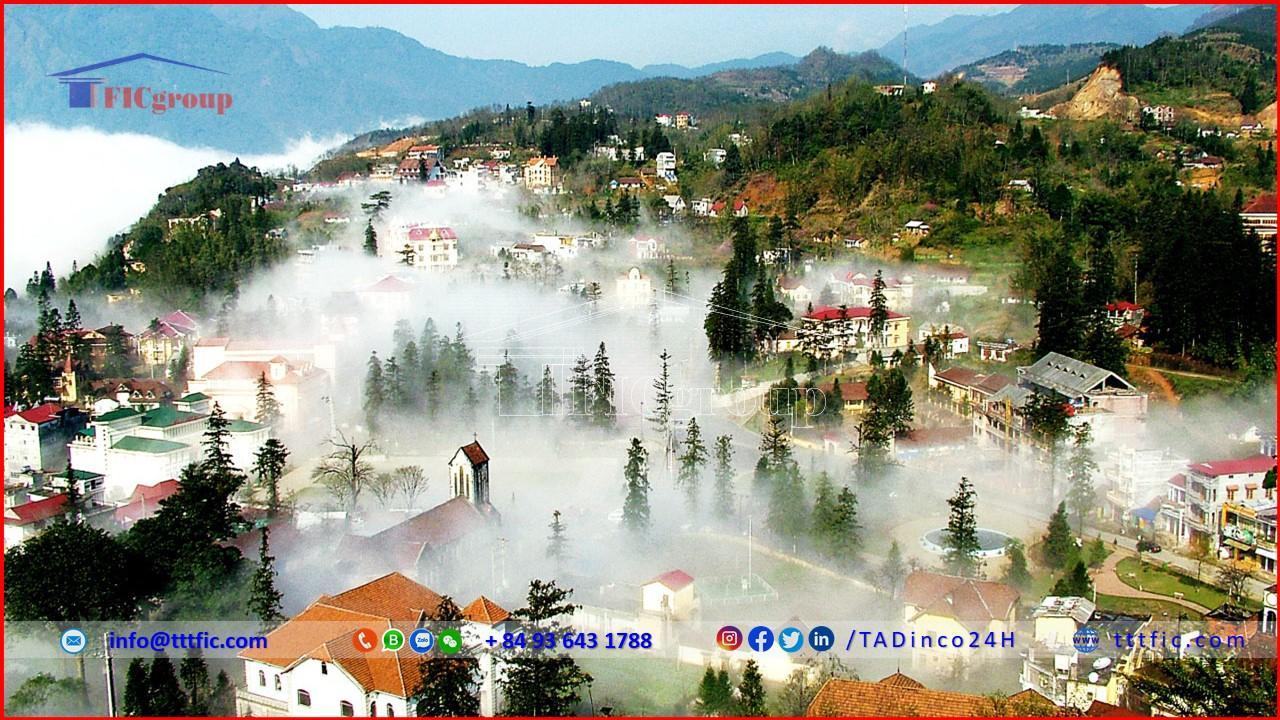
The merger fundamentally changed Lao Cai’s tourism portfolio.
The new province now combines:
with:
and:
In 2025, the enlarged Lao Cai received:
with total tourism receipts of approximately:
The province had approximately:
and around:
This puts Lao Cai among Vietnam’s largest provincial tourism economies.
The former Yen Bai territory adds substantial tourism depth.
Mu Cang Chai’s terraced rice landscapes have become one of northern Vietnam’s most recognizable highland tourism products.
Potential investments include:
boutique resorts
eco-lodges
wellness
adventure tourism
photography tourism
and:
premium rural experiences.
Nghia Lo adds:
Thai ethnic culture
Muong Lo landscape
community tourism
food culture
and:
wellness potential.
Thac Ba creates opportunities involving:
lake tourism
eco-resorts
water recreation
nature tourism
and:
second-destination circuits.
Post-merger Lao Cai can therefore build multi-day routes instead of depending on a single Sa Pa stay.
Sa Pa Airport remains one of the most strategically important planned aviation projects for the province.
The project has long been intended to improve direct air accessibility to Lao Cai and the Northwest.
For investment analysis, however, its status must remain precise.
Until operational, international visitors and corporate travelers continue to rely primarily on:
Noi Bai International Airport
plus:
road or rail connectivity.
The airport should therefore be treated as a future catalyst rather than a present-day infrastructure advantage.
The merger also creates a much larger and more diversified agricultural economy.
Major products include:
tea
cinnamon
rice
fruit
medicinal plants
cold-water fish
livestock
vegetables
and:
specialty mountain products.
Former Yen Bai contributes one of Vietnam’s strongest cinnamon-producing regions, particularly around the former Van Yen area.
Former Lao Cai contributes:
tea
temperate vegetables
medicinal plants
cold-water aquaculture
and:
China-facing agricultural trade.
This creates a compelling value chain:
→ PROCESS
→ BRAND
→ CERTIFY
→ BORDER / DOMESTIC MARKET
→ EXPORT.
The former Yen Bai territory materially strengthens Lao Cai’s forestry base.
Cinnamon is particularly important.
The opportunity is not limited to raw bark.
Higher-value investment can include:
essential oils
food ingredients
cosmetics
pharmaceutical inputs
extracts
branded consumer products
and:
internationally certified supply chains.
Similarly, sustainable forestry can support:
wood processing
engineered wood
furniture components
biomass
and:
non-timber forest products.
TTTFIC favors a transition from:
toward:
Both former Lao Cai and former Yen Bai possess significant hydropower resources.
Hydropower has historically supported:
industrial development
rural electrification
and:
regional energy supply.
The enlarged province therefore has a sizeable energy base.
But project-level analysis remains essential.
TTTFIC distinguishes:
from:
Industrial investors must verify:
substation capacity
grid reliability
voltage
connection distance
and:
future demand.
TTTFIC identifies the following priority clusters.
Warehousing, customs services, distribution, cold chain and cross-border logistics.
Fruit, specialty agriculture, packing, certification and cold-chain exports.
Minerals, chemicals, materials and selected manufacturing.
Future terminals, distribution, intermodal facilities and industrial sites.
Sa Pa, Mu Cang Chai, Nghia Lo, Bac Ha, Y Ty and Thac Ba.
Cinnamon, tea, medicinal plants, timber and specialty foods.
Higher-value downstream production subject to strict environmental and legal controls.
Sites within established or developing parks where infrastructure is confirmed.
Engineering, maintenance and energy-related support.
The larger post-merger population supports retail, logistics, services and selected urban development.
Without the merger, Lao Cai’s investment identity was already strong:
After the merger, it becomes substantially broader.
Former Yen Bai adds:
This changes the investment model from a relatively narrow border province into a diversified Northwest economic platform.
The combined province can now build multiple investment chains.
Yunnan → Border Gate → Logistics → Hanoi / Hai Phong
Mineral → Deep Processing → Rail / Road → Export Market
Cinnamon / Timber → Processing → Branding → Export
Sa Pa → Bac Ha → Mu Cang Chai → Nghia Lo → Thac Ba
This is genuine merger synergy.
TTTFIC applies TTMS™-style control logic to Lao Cai because many of its most important opportunities depend on future infrastructure or regulated resources.
Every investment thesis should distinguish:
Border gates, existing industrial parks, existing road infrastructure, operating hotels, established mines and operating factories.
Railway preparation, airport development, industrial expansion and new logistics infrastructure.
Projects and capacity identified in official planning but not yet physically delivered.
Minerals, land, tourism landscapes and agricultural resources that still require project-specific commercial validation.
An opportunity with verified:
land
legal status
infrastructure
utilities
environmental feasibility
market demand
and:
commercial structure.
This distinction prevents investment marketing from becoming investment misrepresentation.
Construction and road logistics can be more expensive than in lowland industrial provinces.
Cross-border trade remains sensitive to:
customs regulation
plant quarantine
commodity eligibility
and:
China-side policy.
The reduction in durian exports during parts of 2025 demonstrated this risk.
The new railway and airport projects should not be priced into investment assumptions as though they are already operational.
Mining and chemical processing require strong environmental management.
Sa Pa remains dominant, creating both opportunity and destination-management pressure.
Mountain regions are exposed to:
landslides
flash floods
heavy rainfall
and infrastructure disruption.
Investors must verify wastewater, emissions, hazardous waste and industrial-environment infrastructure at individual sites.
The province has a larger population after merger, but population is geographically dispersed.
These risks should influence site selection from the beginning.
Approximately 182 km of border with Yunnan creates a permanent international-trade advantage.
Border-gate trade reached approximately USD 3.19 billion in 2025.
The approved Lao Cai–Hanoi–Hai Phong railway can eventually connect the China border directly to Lach Huyen.
Seven operating industrial parks and a broader industrial-cluster system provide a real production platform.
Apatite, copper and other minerals support downstream-processing opportunities.
More than 10 million visitors and approximately VND 46 trillion of tourism receipts in 2025 create scale.
Sa Pa remains one of Vietnam’s most internationally recognized highland destinations.
Mu Cang Chai, Nghia Lo, Thac Ba and forestry significantly diversify the province.
67 active FDI projects with more than USD 1.08 billion in registered capital provide an established international-investment base.
Few inland mountain provinces combine:
border trade + industry + tourism + minerals + agro-forestry + logistics at this scale.
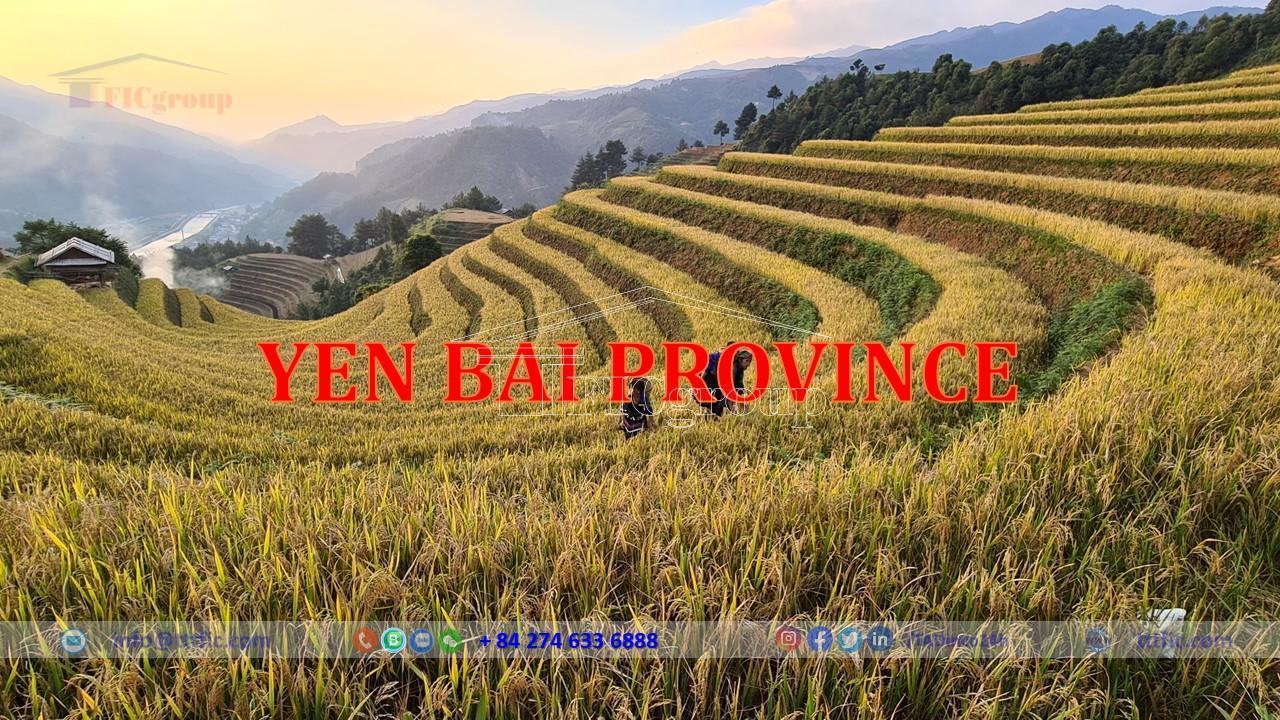
Lao Cai’s greatest strength is no longer any one individual asset.
It is connectivity between assets.
The border provides:
The industrial system provides:
The expressway provides:
The planned standard-gauge railway can provide:
Sa Pa and Mu Cang Chai provide:
Yen Bai’s forestry and agriculture provide:
Together, these produce a more powerful equation:
CHINA
Lao Cai is therefore increasingly relevant not simply because it is “close to China.”
It is relevant because it can become the northern interface between:
and:
That is the real investment proposition.
TTTFIC Group supports international investors evaluating Lao Cai through:
Province, corridor and site-selection analysis.
Evaluation of China-facing trade and logistics opportunities.
Identification of suitable industrial parks, factories and warehouses.
Assessment of project geography, infrastructure and regulatory dependencies.
Sa Pa, Mu Cang Chai, Nghia Lo, Thac Ba and emerging destination opportunities.
IRC, ERC and associated procedures.
Planning, infrastructure, land and transaction-status review.
Power, water and industrial-infrastructure analysis.
Land, factories, warehousing and built-to-suit requirements.
Structured engagement with relevant authorities and project stakeholders.
Commercial negotiation, documentation and transaction coordination.
Assistance from market entry through project implementation and operations.
The new Lao Cai is no longer simply the Lao Cai of:
Sa Pa + border gate + minerals.
The 2025 merger fundamentally expanded the economic geography.
Today, Lao Cai combines:
CHINA BORDER TRADE
with:
A LARGER INDUSTRIAL PLATFORM
plus:
SA PA + MU CANG CHAI + THAC BA TOURISM
plus:
MINERAL + FORESTRY + AGRICULTURAL RESOURCES
and:
FUTURE STANDARD-GAUGE RAIL CONNECTIVITY TO HAI PHONG.
Its strategic development chain can increasingly become:
→ LAO CAI BORDER
→ LOGISTICS
→ INDUSTRY
→ HANOI
→ HAI PHONG
→ GLOBAL MARKET.
At the same time:
→ BAC HA
→ MU CANG CHAI
→ NGHIA LO
→ THAC BA
→ HIGH-VALUE TOURISM ECONOMY.
And:
→ PROCESSING
→ BRANDING
→ LOGISTICS
→ EXPORT.
This makes Lao Cai one of the strongest examples in Vietnam of how administrative consolidation can create new investment logic rather than merely a larger map.
The province should not be viewed only as the end of Vietnam’s northern transport corridor.
It should increasingly be viewed as:
THE INTERNATIONAL LAND GATEWAY AT THE BEGINNING OF THE VIETNAM–CHINA–HAI PHONG ECONOMIC CHAIN.
LAO CAI, VIETNAM 2026
TTTFIC GROUP
TTTFIC Group supports international manufacturers, logistics companies, industrial investors, tourism developers, agricultural processors and institutional investors evaluating opportunities in Lao Cai Province and across Vietnam.
Our approach combines:
Explore Vietnam. Compare Locations. Invest with Intelligence.
34 Provinces & Cities. One Updated Investment Intelligence Platform.
Table of contents