Gilimex Thua Thien Hue Industrial Park - Thua Thien Hue
- Investor: Gilimex Industrial Park Joint Stock Company
- Price: 0 USD/m2
- Area: 0 Ha
HUE CITY, VIETNAM
Where Central Vietnam’s North–South Corridor, Deep-Sea Logistics and Knowledge Economy Converge
TTTFIC GLOBAL INVESTMENT PROFILE 2026
Investment Intelligence | Industrial Location Strategy | Market Entry | Industrial Real Estate
Hue is undergoing one of the most important economic repositionings in Central Vietnam.
Effective January 1, 2025, the former Thua Thien Hue Province became Hue City, a centrally governed municipality of Vietnam. Following the nationwide commune-level administrative restructuring, Hue now operates with 40 commune-level administrative units, comprising 21 wards and 19 communes.
The municipality covers approximately 4,947.11 km² and has a population of approximately 1.236 million people.
For international investors, however, Hue’s significance extends far beyond its new administrative status.
Its investment proposition is built around the convergence of:
Central Vietnam Location
North–South Economic Corridor
Chan May Deep-Sea Port
Chan May–Lang Co Economic Zone
Phu Bai International Airport
Industrial Development
Healthcare, Education & Research
Green Growth & Knowledge Economy
Hue should therefore not be evaluated simply as a heritage and tourism destination.
It should increasingly be evaluated as a specialized investment gateway in Central Vietnam capable of combining industrial development, logistics, human capital, healthcare, innovation and quality of life within one integrated economic territory.
HUE — WHERE CENTRAL VIETNAM’S NORTH–SOUTH CORRIDOR, DEEP-SEA LOGISTICS AND KNOWLEDGE ECONOMY CONVERGE.
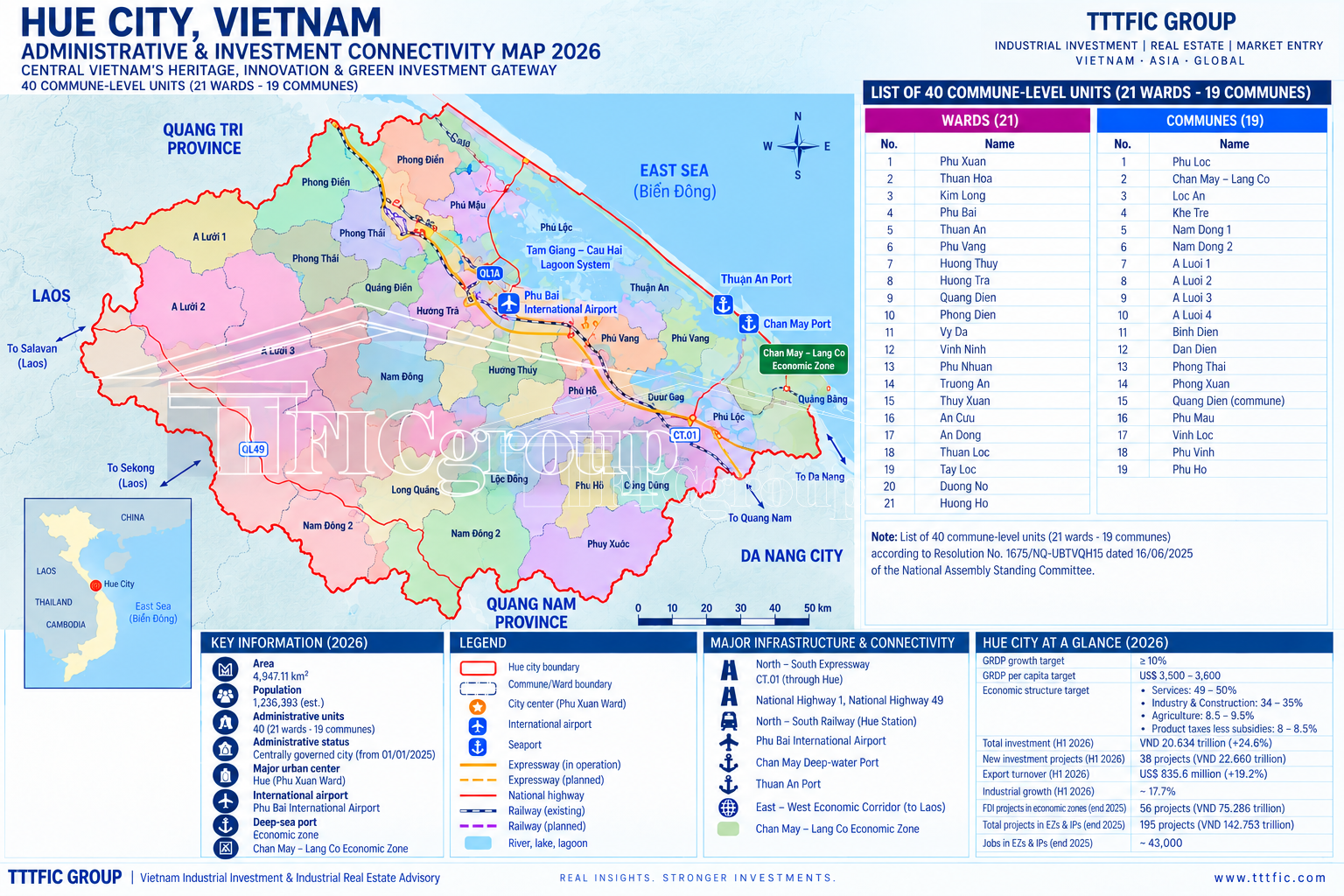
Hue’s transformation into a centrally governed municipality represents more than an administrative change.
It creates a new institutional platform for long-term metropolitan, infrastructure and investment development.
Administrative status: Centrally governed municipality
Natural area: approximately 4,947.11 km²
Population: approximately 1,236,393
Commune-level administrative units: 40
Wards: 21
Communes: 19.
Unlike many other province-level jurisdictions reorganized in 2025, Hue was not created through a provincial merger.
Its transformation began earlier: the former Thua Thien Hue Province became Hue City on January 1, 2025, followed by commune-level restructuring under Vietnam’s new two-tier local-government model.
For investors, all site-selection, licensing, industrial-zone and administrative references should therefore use:
rather than:
Thua Thien Hue Province
Hue occupies a strategic position along Vietnam’s central coastline between Northern and Southern Vietnam.
Its geography provides access to three distinct economic directions:
Hue lies directly on Vietnam’s principal national economic axis connecting:
Hanoi → North Central Vietnam → Hue → Da Nang → Central Vietnam → Ho Chi Minh City
The western part of Hue reaches Vietnam’s international border with Laos, creating potential connectivity toward:
Laos → Thailand → Mekong Subregion
Its eastern coastline provides maritime access through Chan May Port, connecting Central Vietnam to regional and international shipping routes.
This creates an unusually diversified location proposition:
Few locations in Central Vietnam combine all five within the same province-level jurisdiction.
Hue’s economic structure is evolving beyond its traditional dependence on culture, tourism and public services.
The city’s 2026 socioeconomic plan targets:
with targeted GRDP per capita of:
and an economic structure in which:
Services: 49–50%
Industry & Construction: 34–35%
Agriculture: 8.5–9.5%
Product Taxes less Subsidies: 8–8.5%.
This structure is important for investors.
Hue is not attempting to become a mass-manufacturing economy at the expense of its urban, environmental and cultural assets.
Its emerging model is more balanced:
That balance forms an important part of the city’s long-term investment proposition.
Industrial development is becoming a more important growth engine.
In the first seven months of 2025, Hue reported industrial growth of approximately 17.7%, while automobile production increased sharply from a relatively low base. Exports reached approximately US$835.6 million, up nearly 24% year-on-year.
The strategic opportunity is not to replicate the industrial models of Bac Ninh, Hai Phong or the southern manufacturing belt.
Hue can instead build competitive specialization around:
Automotive and components
Electronics
Precision engineering
Supporting industries
Food processing
Advanced materials
Healthcare and medical technologies
Pharmaceuticals
Information technology
Digital services
Renewable energy
Green manufacturing
Port-related industries
Logistics
R&D and innovation
This allows Hue to pursue industrial growth without abandoning the environmental and cultural characteristics that differentiate the city.
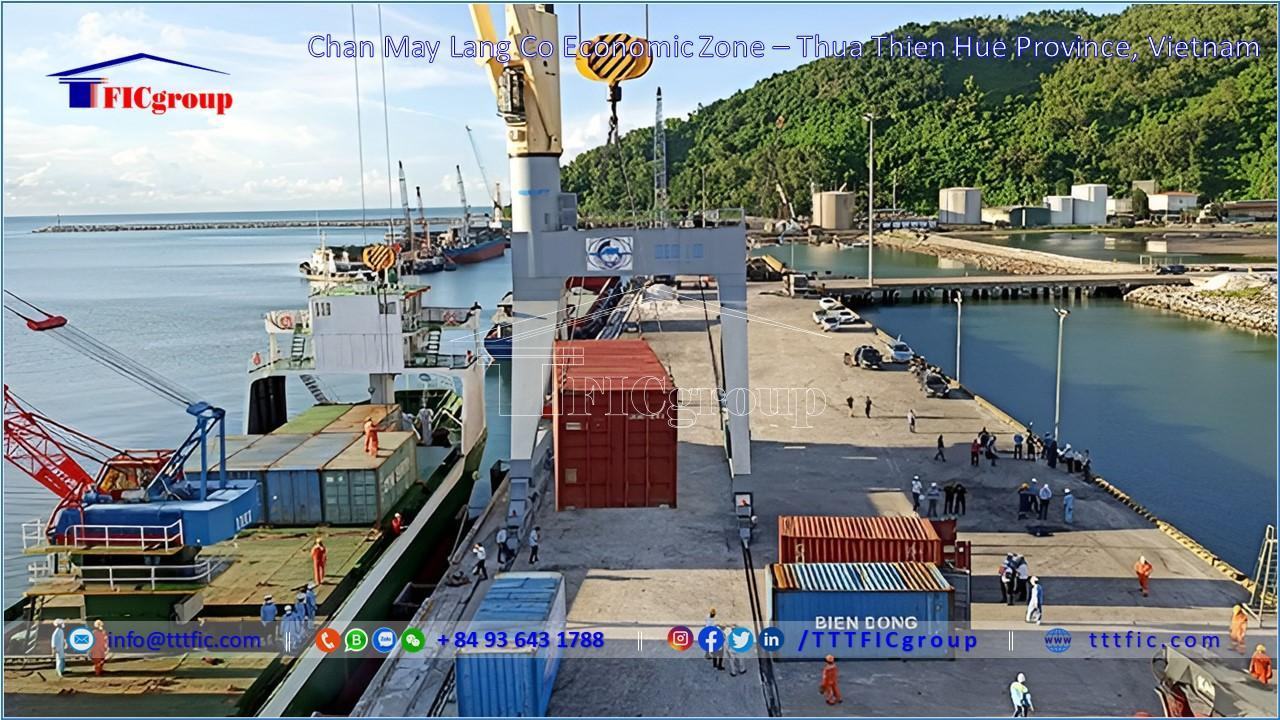
For industrial investors, the Chan May–Lang Co Economic Zone is one of the most important assets in Hue’s investment geography.
Located between the urban centers of Hue and Da Nang, the economic zone combines:
Industrial development
Deep-sea port infrastructure
Logistics
Urban development
Commercial services
and other investment functions.
Hue authorities continue to identify Chan May–Lang Co as one of the city’s principal development engines for industry, seaport, logistics, services and urban development.
Its location provides access to:
National Highway 1
North–South transport corridors
Chan May Port
Da Nang economic region
Phu Bai International Airport
Central Vietnam markets
and wider East–West connectivity.
For TTTFIC, Chan May–Lang Co should therefore be evaluated as an:
INTEGRATED INDUSTRIAL–PORT–LOGISTICS PLATFORM
rather than merely a coastal economic zone.
Chan May Port gives Hue something strategically important:
The port sits between Hue and Da Nang and is positioned as an important maritime gateway associated with the Chan May–Lang Co Economic Zone.
Hue’s official investment information describes Chan May deep-water port as the closest East Sea maritime gateway associated with the East–West Economic Corridor.
For industrial investors, port access can support:
Containerized cargo
Project cargo
Industrial equipment
Raw materials
Bulk and break-bulk cargo where operationally applicable
Export manufacturing
Port-related logistics
Warehousing
Distribution
The strategic industrial equation becomes:
FACTORY → LOGISTICS → CHAN MAY PORT → INTERNATIONAL MARKETS
However, TTTFIC does not treat the existence of a nearby port as proof that every project has an optimal maritime solution.
Project-level analysis must verify:
Cargo type
terminal capability
vessel requirements
shipping services
frequency
container availability
road access
handling cost
customs process
and total door-to-port logistics cost.
That distinction is essential for institutional-quality site selection.
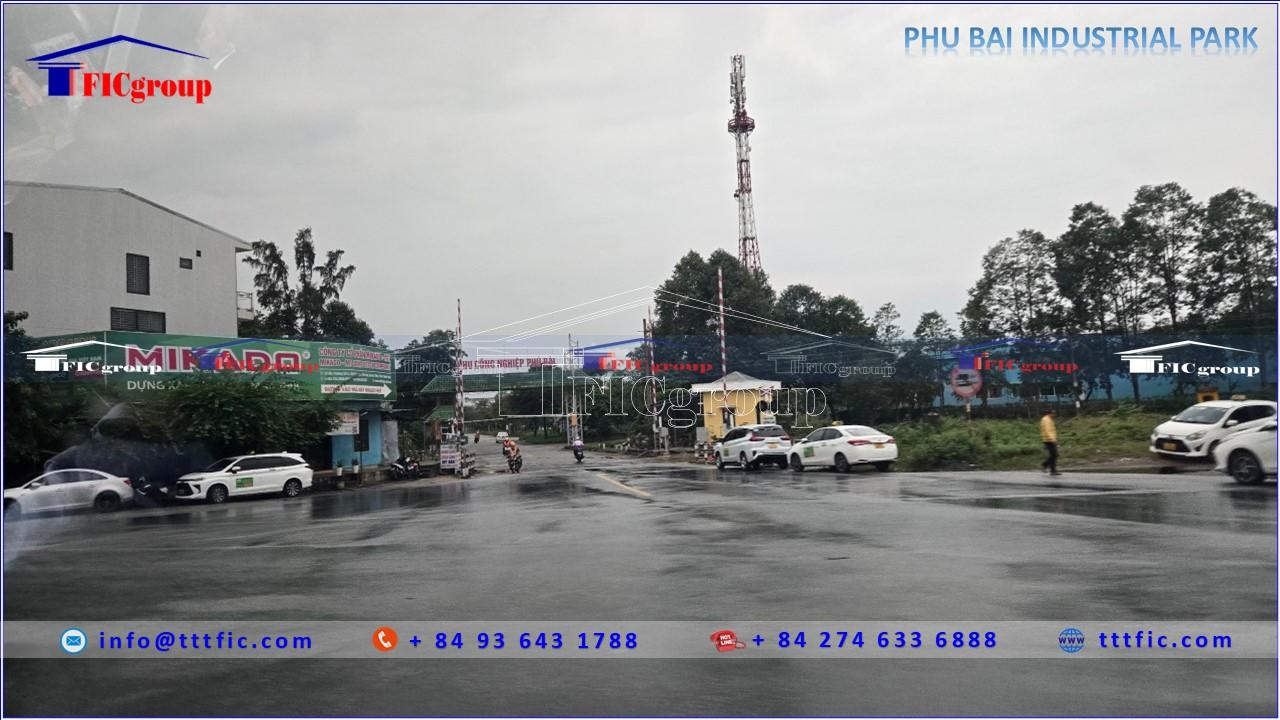
Hue’s industrial platform includes established industrial areas as well as new industrial development within and outside Chan May–Lang Co.
Important industrial locations include the broader ecosystems associated with:
and future industrial developments under the city’s updated planning framework.
Phong Dien, for example, remains an active industrial development priority, with authorities in 2026 continuing infrastructure development and investment attraction.
Meanwhile, industrial expansion inside Chan May–Lang Co continues. In July 2026, authorities were consulting on the 1:2,000 zoning plan for Industrial Park No. 5 within the economic zone.
This is important because it demonstrates that Hue’s industrial geography is still expanding rather than being limited to its legacy industrial parks.
The scale of investment already operating within Hue’s economic zones and industrial parks provides useful evidence of the city’s industrial base.
At the end of 2025, Hue’s Economic and Industrial Zone Authority reported:
with total registered capital of approximately:
including:
with registered FDI capital of approximately:
Enterprises in these zones generated approximately US$2 billion in import-export turnover, approximately VND 50 trillion in revenue and supported around 43,000 jobs.
This is an important distinction.
Hue is not merely proposing an industrial future.
An operating industrial and FDI platform already exists.
The opportunity is to scale and upgrade it.
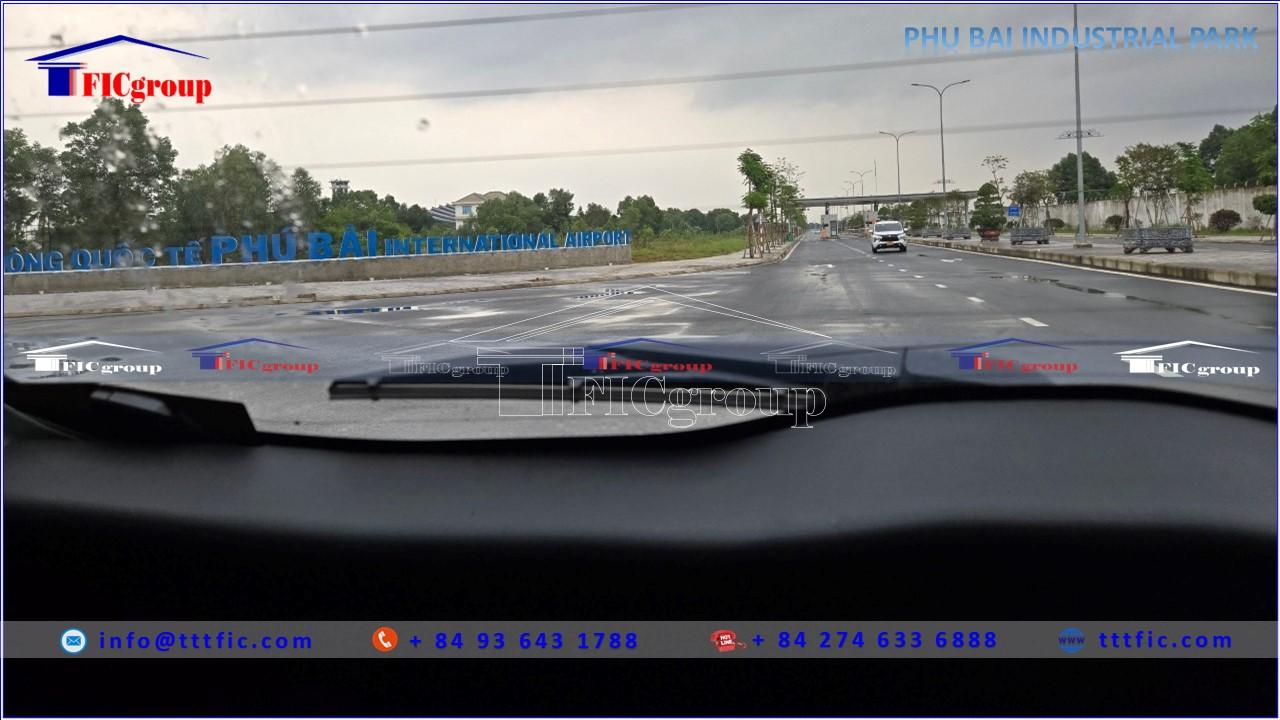
Phu Bai International Airport provides Hue with direct aviation infrastructure.
Current planning identifies Phu Bai as a 4E airport, with planned capacity reaching approximately:
For industrial investment, the airport is relevant beyond passenger tourism.
It supports:
Executive mobility
Engineering and technical teams
Foreign investor access
High-value business travel
Time-sensitive economic activities
and the wider integration of Hue with Vietnam and international markets.
Airport-related cargo suitability must nevertheless be verified separately for each supply chain.
Hue sits directly on Vietnam’s principal North–South transport spine.
Its strategic road network connects the city toward:
Quang Tri and Northern Vietnam
Da Nang and Southern Central Vietnam
National Highway 1
North–South Expressway
Chan May–Lang Co
Phu Bai International Airport
and western border areas.
This allows industrial locations to participate in the larger Central Vietnam manufacturing and logistics system rather than depending exclusively on the local market.
For investors, the relevant question is therefore not simply:
How far is the factory from Hue?
It is:
How efficiently can the factory connect to suppliers, customers, airports, seaports and national distribution corridors?
The North–South railway passes through Hue, providing another layer of national connectivity.
Together with road, port and airport infrastructure, this creates a multimodal framework:
For certain manufacturing and logistics operations, multimodal optionality can improve supply-chain resilience.
TTTFIC therefore evaluates transport infrastructure not as isolated assets but as an integrated logistics system.
Hue’s western territory shares an international border with Laos.
This creates a strategic dimension absent from many coastal industrial markets.
The long-term opportunity is broader connectivity between:
Vietnam
Laos
Thailand
and the wider Greater Mekong Subregion.
Combined with Chan May’s maritime position, this creates the possibility of an East–West logistics architecture:
MEKONG SUBREGION → LAOS → CENTRAL VIETNAM → CHAN MAY → EAST SEA
The commercial viability of any specific corridor must, however, be assessed using actual border-gate status, permitted cargo movements, road standards, transit procedures and logistics costs.
TTTFIC therefore distinguishes between:
geographic connectivity
and
commercially executable logistics connectivity.
One of Hue’s greatest advantages is proximity to Da Nang.
Rather than viewing the two cities solely as competitors, international investors should consider their complementary functions.
Industrial expansion
Chan May port
Healthcare
Education
Research
Heritage economy
Green development
Large metropolitan services
International business
Technology
Regional aviation
Logistics
Professional services
Together, the two cities can function as a larger Central Vietnam economic ecosystem.
Chan May–Lang Co sits strategically between them.
For certain projects, this creates an investment proposition stronger than either location considered independently.
Hue has long served as an important healthcare center for Central Vietnam.
The existing profile correctly identifies institutions such as Hue Central Hospital and Hue University of Medicine and Pharmacy, but simply listing hospitals understates their investment relevance.
For TTTFIC, the strategic opportunity lies in converting healthcare capability into an investment ecosystem supporting:
Medical technology
Medical devices
Diagnostics
Pharmaceuticals
Biotechnology
Clinical research
Digital health
Healthcare education
Specialized healthcare services
This can become one of Hue’s distinctive high-value economic clusters.
Few industrial locations can combine manufacturing, a major medical ecosystem, universities and quality-of-life advantages within the same city.
Hue’s educational ecosystem is another strategic asset.
The old profile correctly recognized Hue as a major education center and identified Hue University as a central institution.
The investment question is how this academic platform can support:
Engineering talent
Medical professionals
Scientists
IT professionals
R&D
Innovation
Digital transformation
Industry–university collaboration
Entrepreneurship
For high-value investors, access to talent can be more important than the lowest industrial land price.
Hue therefore has an opportunity to compete for projects where:
HUMAN CAPITAL + QUALITY OF LIFE + RESEARCH CAPABILITY
matter as much as factory cost.
Hue has developed a strong reputation within Vietnam for digital government, smart-city applications and digital transformation.
The next investment opportunity is to convert that institutional capability into a broader economic platform involving:
Software
Digital services
AI applications
Health technology
Smart manufacturing
Industrial automation
Data services
R&D
Innovation centers
This creates an opportunity for Hue to position itself not only as a manufacturing destination but as a location where physical industry and the digital economy can increasingly intersect.
Hue’s environmental assets are not merely tourism resources.
They can become part of an investment strategy.
The city has the potential to attract industries aligned with:
Energy efficiency
Renewable energy
Low-carbon manufacturing
Circular economy
Environmental technology
Sustainable materials
Green buildings
Responsible industrial development
For multinational manufacturers facing increasingly demanding ESG requirements, environmental quality and access to credible sustainability solutions can become important site-selection factors.
Hue’s opportunity is therefore not to industrialize at any cost.
It is to build:
HIGHER-VALUE, LOWER-IMPACT INDUSTRIAL GROWTH
while protecting the cultural and environmental assets that make the city distinctive.
TTTFIC™ methodology requires investment profiles to identify material risks, not only advantages.
Hue experiences significant rainfall and is exposed to:
Typhoons
Flooding
Heavy rainfall
Coastal weather events
Landslide risk in mountainous areas
Climate-change impacts
The old profile describes the area’s high rainfall and historical flood exposure.
For industrial investment, this information must be converted into actionable due diligence.
Before site acquisition or factory construction, investors should assess:
Historical flood elevation
Site platform elevation
Stormwater drainage
Access-road resilience
Roof wind-load design
Emergency power
Business continuity
Supplier redundancy
Insurance requirements
Climate adaptation
This is a key TTMS™ principle:
Industrial land availability alone does not establish project feasibility.
Before TTTFIC recommends a location, the following must be verified at site level:
Electricity capacity
Substation capacity
Power redundancy
Water capacity
Wastewater-treatment capacity
Permitted discharge parameters
Fire-fighting infrastructure
Environmental compatibility
Road load and width
Container access
Ground conditions
Flood elevation
Telecommunications
Expansion capacity
This is especially important for:
Electronics
Automotive
Food processing
Medical manufacturing
Data infrastructure
High-load factories
and environmentally regulated industries.
Qualifying investments in Hue may be eligible for incentives under Vietnam’s national investment, tax, customs, high-tech, supporting-industry and location-based frameworks.
Potential categories can include:
Corporate income tax incentives
Tax exemption/reduction periods
Import-duty exemptions for qualifying equipment
Land-related incentives
Economic-zone incentives
High-tech incentives
R&D incentives
Supporting-industry incentives
Location-based incentives
Projects within Chan May–Lang Co Economic Zone may be subject to specific economic-zone incentive frameworks depending on the project and applicable legislation.
But TTTFIC does not treat incentives as automatic.
PROJECT → SECTOR → TECHNOLOGY → LOCATION → INVESTMENT SCALE → LEGAL ELIGIBILITY → INCENTIVE CONFIRMATION
Only after this chain has been verified should an incentive be incorporated into the investor’s financial model.
Hue offers several distinct categories of industrial and investment real estate:
Industrial land
Ready-built factories
Ready-built warehouses
Built-to-suit factories
Port-related industrial facilities
Logistics centers
Warehousing
Operating factory acquisitions
Industrial M&A
Economic-zone development
High-tech facilities
Healthcare and life-science facilities
Data and digital infrastructure
Urban-industrial development
Renewable-energy projects
The correct location depends on the investor’s operating model.
A port-dependent manufacturer may prioritize Chan May.
A project requiring established industrial infrastructure may evaluate Phu Bai, Phong Dien or other existing industrial areas.
A healthcare or R&D investment may prioritize access to Hue’s urban knowledge ecosystem.
A logistics investor may prioritize the interface between port, expressway and industrial areas.
There is therefore no universal “best industrial park in Hue.”
There is only:
THE BEST-FIT LOCATION FOR A SPECIFIC INVESTMENT PROJECT.
TTTFIC identifies strong long-term potential for:
1. Automotive & automotive components
2. Electronics & electrical equipment
3. Precision engineering
4. Supporting industries
5. Medical devices
6. Pharmaceuticals
7. Biotechnology
8. Healthcare technology
9. Information technology
10. Digital services
11. R&D and innovation
12. Food & agricultural processing
13. Advanced materials
14. Renewable energy
15. Green manufacturing
16. Environmental technology
17. Port-related industries
18. Logistics & warehousing
19. Built-to-suit industrial facilities
20. Industrial real estate and factory M&A
Under a TTMS™-style decision framework, Hue should not be marketed equally to every investor.
| Investor Requirement | Hue Strategic Fit |
|---|---|
| Port-oriented manufacturing | HIGH — subject to cargo/terminal verification |
| Central Vietnam distribution | HIGH |
| Healthcare / MedTech | HIGH |
| Education / R&D | HIGH |
| Green manufacturing | HIGH |
| IT / Digital economy | HIGH |
| Specialized industrial production | HIGH |
| North–South market access | HIGH |
| Laos / East–West connectivity | STRATEGIC — route-specific verification required |
| Mass low-cost manufacturing | PROJECT-DEPENDENT |
| Heavy water-intensive industry | SITE-SPECIFIC DUE DILIGENCE REQUIRED |
| Highly pollution-sensitive industries | STRICT ENVIRONMENTAL SCREENING REQUIRED |
| Global maritime export | VIABLE — shipping solution must be verified |
This is the difference between marketing a location and advising an investment decision.
Centrally governed municipality
Strategic Central Vietnam location
Chan May deep-sea port
Chan May–Lang Co Economic Zone
Phu Bai International Airport
North–South connectivity
International border with Laos
Strong healthcare ecosystem
Strong university and research platform
Green-development positioning
Flood and climate resilience
Actual port service compatibility
Project-specific industrial land availability
Utility capacity
Environmental eligibility
Labor requirements
Supplier depth
Distance to major customer clusters
Economic-zone incentive eligibility
Logistics cost versus Da Nang and other Central Vietnam alternatives
STRATEGIC FIT → SITE FIT → TECHNICAL FIT → LEGAL FIT → COMMERCIAL FIT → RISK VALIDATION → INVESTMENT DECISION
This is the TTMS™ discipline TTTFIC applies to industrial location advisory.
Positioned on the national North–South economic axis.
Chan May provides direct maritime infrastructure within the municipality.
Chan May–Lang Co combines industrial, port, logistics, urban and service development.
Phu Bai provides direct aviation connectivity and is planned for further expansion.
Hue’s economic zones and industrial parks already host substantial domestic and foreign investment.
Healthcare, universities and research institutions provide a differentiated talent platform.
Investors can access a broader Central Vietnam metropolitan and industrial ecosystem.
International-border geography creates longer-term connectivity toward Laos and the Mekong region.
Environmental quality and renewable-energy opportunities support ESG-oriented investment strategies.
Hue offers something increasingly important for senior international personnel and knowledge-intensive companies:
a distinctive living environment combined with business infrastructure and industrial access.
Hue’s opportunity lies in specialization.
Hai Phong possesses greater maritime industrial scale.
Bac Ninh possesses deeper electronics supply-chain concentration.
Hanoi possesses greater corporate and technology scale.
Ho Chi Minh City possesses vastly greater metropolitan market depth.
Hue should not attempt to imitate them.
Its competitive advantage lies in combining assets that are rarely found together:
That combination creates a different type of investment destination.
But potentially one of Central Vietnam’s most balanced locations for specialized, high-value and sustainable investment.
TTTFIC Group supports international manufacturers, institutional investors and industrial companies throughout the investment lifecycle in Hue and across Vietnam.
Our services include:
Industrial Location Strategy
Industrial Park & Economic Zone Selection
Industrial Land Sourcing
Ready-Built Factory & Warehouse Leasing
Built-to-Suit Factory Solutions
Operating Factory Acquisition
Industrial M&A
FDI Market Entry
IRC/ERC Coordination
Environmental & Fire-Safety Coordination
Industrial Legal Coordination
Factory Design & Build
Technical Site Due Diligence
Utility Verification
Logistics Analysis
Investment Incentive Assessment
Commercial Negotiation
Transaction Management
Post-Investment Support
TTTFIC does not simply identify available property.
We determine whether an investment location is:
and
That is the difference between industrial brokerage and institutional investment advisory.
TTTFIC™ INVESTMENT DECISION PRINCIPLE
INVEST IN HUE. CONNECT CENTRAL VIETNAM. BUILD FOR THE FUTURE.
Table of contents