Tac Cau Industrial Park - An Giang
- Investor: Economic Zone Management Board of An Giang Province
- Price: 50 USD/m2
- Area: 68 Ha
Vietnam’s Mekong–Gulf of Thailand Gateway for Agriculture, Marine Economy, Tourism, Energy, Industry & Cross-Border Trade
TTTFIC GLOBAL INVESTMENT PROFILE 2026 — PROFILE #27
An Giang Province, Vietnam 2026 is emerging as a major Mekong Delta investment platform connecting agriculture, aquaculture, industrial parks, cross-border trade with Cambodia, the Gulf of Thailand, Phu Quoc tourism, energy, ports and logistics. This profile examines the province’s post-merger investment geography, industrial infrastructure, growth corridors and sector opportunities.
MEKONG DELTA + PHU QUOC + GULF OF THAILAND + CAMBODIA BORDER + AGRICULTURE + AQUACULTURE + FOOD PROCESSING + TOURISM + RENEWABLE ENERGY + CEMENT & MATERIALS + INDUSTRIAL PARKS + PORTS + APEC 2027
Vietnam has changed. So has its investment map.
The An Giang of 2026 is fundamentally different from the province that existed before Vietnam’s administrative restructuring.
On July 1, 2025, former An Giang Province and former Kien Giang Province were consolidated into the new An Giang Province.
The merger created the largest province in the Mekong Delta by both natural area and population, with approximately:
9,888.91 KM²
and:
4.95 MILLION PEOPLE.
More importantly, it combined two complementary economic geographies.
Former An Giang contributed:
RICE + PANGASIUS + CHAU DOC + BORDER TRADE + CAMBODIA CONNECTIVITY + SPIRITUAL TOURISM + AGRICULTURAL PROCESSING.
Former Kien Giang contributed:
PHU QUOC + GULF OF THAILAND + PORTS + ISLANDS + MARINE ECONOMY + AQUACULTURE + CEMENT + ENERGY + RACH GIA + HA TIEN.
Together, they create:
AGRICULTURE + INDUSTRY + SEA + ISLANDS + INTERNATIONAL TOURISM + ENERGY + BORDER TRADE + LOGISTICS.
The new investment geography can be understood as:
MEKONG PRODUCTION BASE
↓
LONG XUYEN / CHAU DOC
↓
BORDER GATE ECONOMY
↓
RACH GIA / HA TIEN
↓
GULF OF THAILAND
↓
PHU QUOC / KIEN HAI / THO CHAU
↓
INTERNATIONAL TOURISM & MARITIME ECONOMY.
This is no longer simply an agricultural province.
IT IS A MEKONG–BORDER–MARITIME–ISLAND ECONOMY.
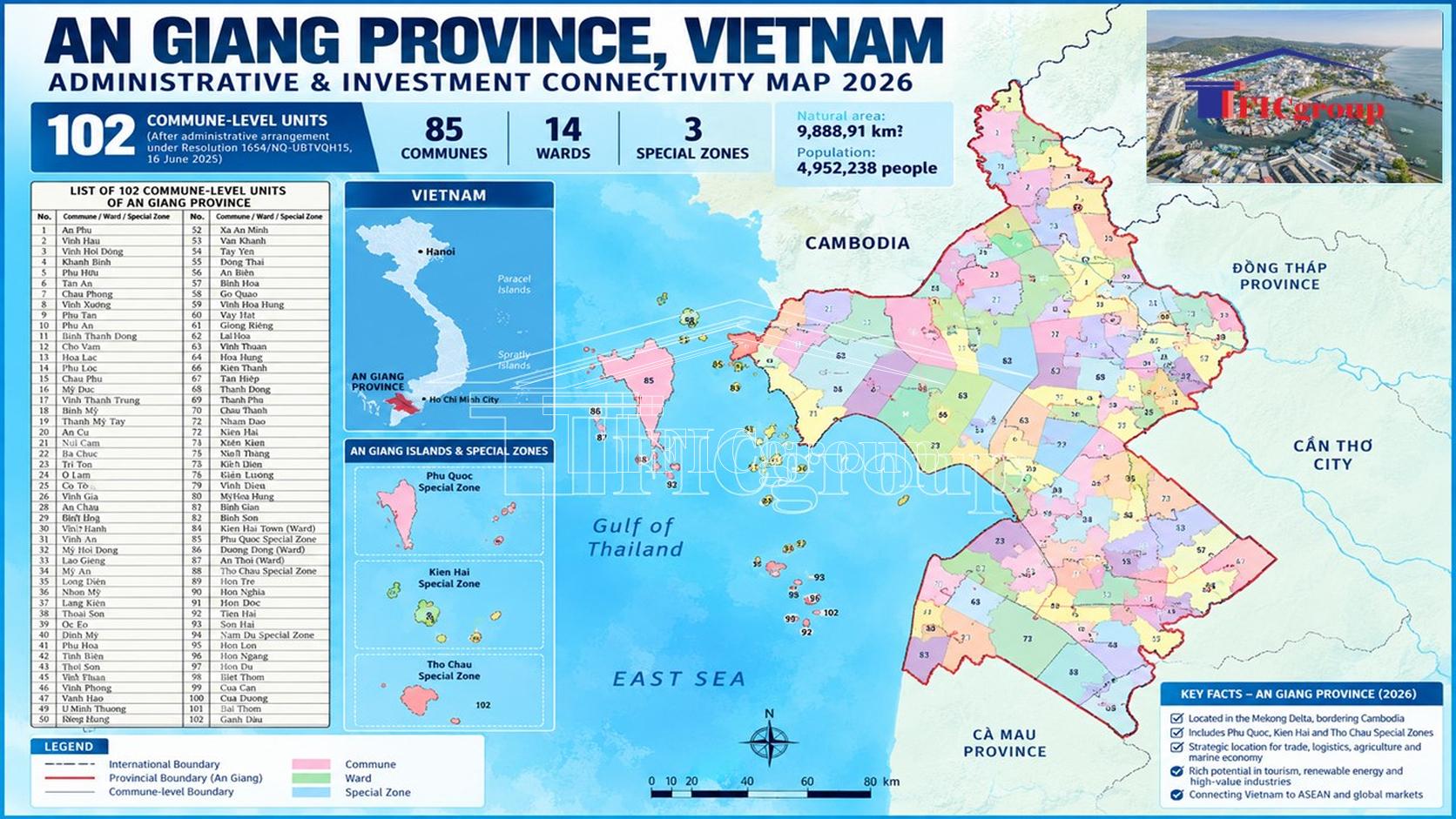
The new An Giang combines:
Official provincial information identifies more than 200 km of coastline, over 148 km of land border with Cambodia, three international border gates — Tinh Bien, Vinh Xuong and Ha Tien — as well as three main border gates and one auxiliary border gate.
The province therefore possesses a geographic structure unusual even within Vietnam:
RIVER + BORDER + COAST + SEA + ISLAND.
For investors, that creates multiple independent but increasingly connected economic platforms.
Following the administrative restructuring, An Giang has:
102 COMMUNE-LEVEL ADMINISTRATIVE UNITS
comprising:
The three Special Zones are:
PHU QUOC SPECIAL ZONE
KIEN HAI SPECIAL ZONE
THO CHAU SPECIAL ZONE.
The province borders:
This fundamentally changes An Giang’s international investment position.
The old province primarily looked toward:
MEKONG DELTA + CAMBODIA.
The new province simultaneously looks toward:
MEKONG DELTA + CAMBODIA + GULF OF THAILAND + INTERNATIONAL MARITIME ECONOMY.
TTTFIC views the new An Giang as four major economies operating within one province.
Rice + Aquaculture + Pangasius + Food Processing + Agricultural Logistics.
Chau Doc + Tinh Bien + Vinh Xuong + Ha Tien + Cambodia Trade.
Ports + Marine Economy + Fisheries + Islands + Energy + Logistics.
Tourism + Aviation + Hospitality + MICE + Retail + Entertainment + Real Estate + International Events.
The merger connects all four.
That is the central investment thesis of Profile #27.
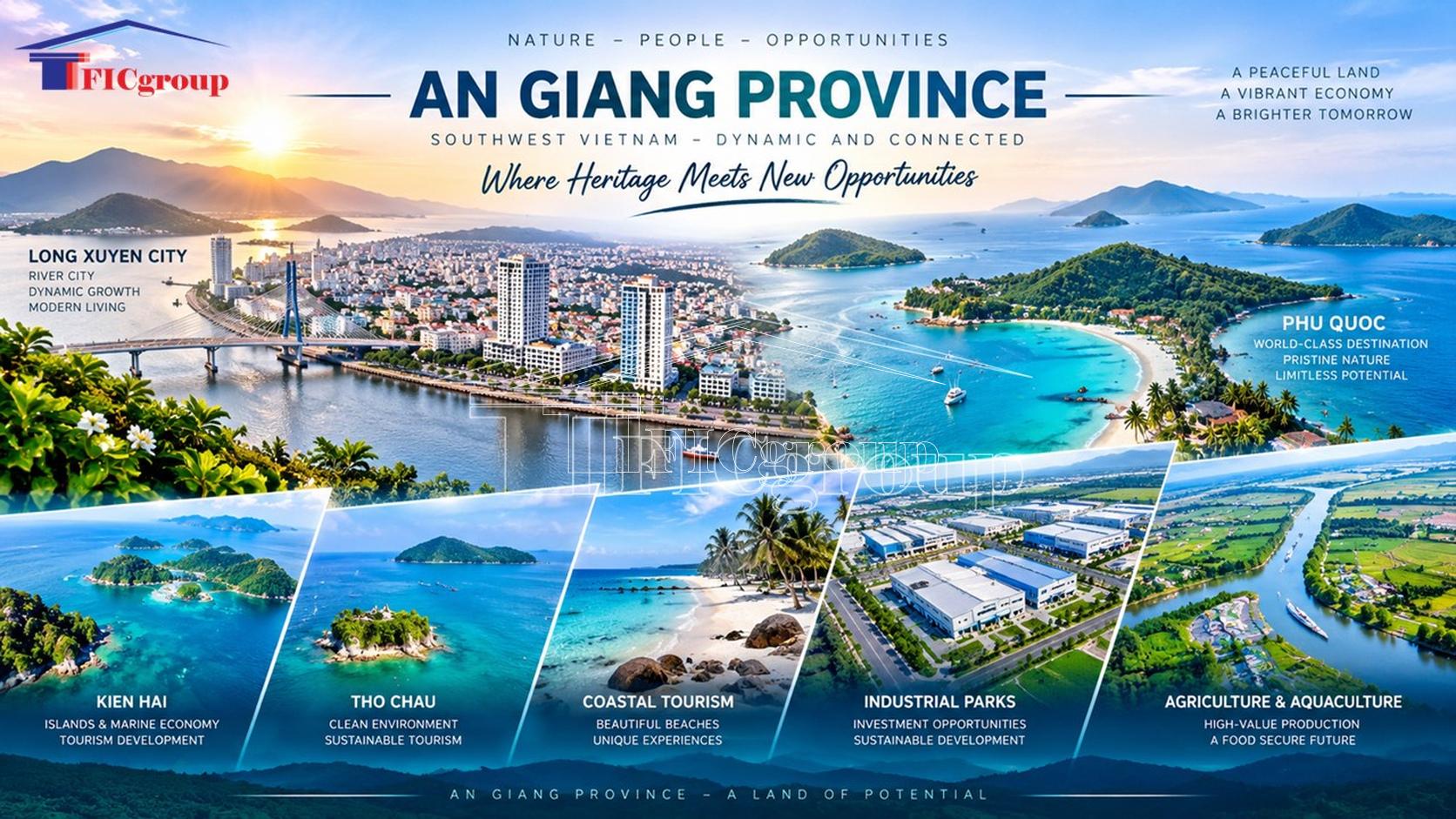
The post-merger province recorded GRDP growth of approximately:
8.39% IN 2025,
the highest growth rate in the Mekong Delta according to provincial reporting.
Tourism reached approximately:
24.1 MILLION VISITORS
in 2025, while international visitor growth was particularly strong.
In the first six months of 2026, provincial economic growth reached:
8.83%,
ranking first in the Mekong Delta for the reporting period.
The province’s 2026 industrial strategy targets industrial production value exceeding:
VND 134 TRILLION,
while merchandise exports are targeted at approximately:
USD 2.753 BILLION.
The important structural change is clear:
AGRICULTURE REMAINS THE FOUNDATION.
But future growth is increasingly being diversified through:
TOURISM + INDUSTRY + MARINE ECONOMY + INFRASTRUCTURE + ENERGY + LOGISTICS + SERVICES.
Phu Quoc is one of the most important assets created within the new An Giang investment geography.
It is no longer simply a tourism island.
Phu Quoc increasingly combines:
INTERNATIONAL TOURISM
AVIATION
HOSPITALITY
ENTERTAINMENT
MARITIME ECONOMY
INTERNATIONAL EVENTS
URBAN INFRASTRUCTURE
GLOBAL INVESTMENT.
The 2025 administrative restructuring formally established:
PHU QUOC SPECIAL ZONE.
This gives An Giang something few Vietnamese provinces possess:
A GLOBALLY RECOGNIZED ISLAND DESTINATION INSIDE A LARGE AGRICULTURAL, INDUSTRIAL AND BORDER ECONOMY.
Phu Quoc will host the APEC 2027 Leaders’ Week.
This is accelerating a major infrastructure cycle.
The government and province are implementing projects involving:
By September 2026, the province had allocated more than VND 13.6 trillion in 2026 public-investment capital to APEC-related projects.
This investment cycle should not be viewed solely as preparation for a one-time international event.
Its longer-term significance is:
AIRPORT + ROADS + POWER + WATER + DIGITAL INFRASTRUCTURE + INTERNATIONAL FACILITIES.
These assets can continue supporting Phu Quoc after APEC 2027.
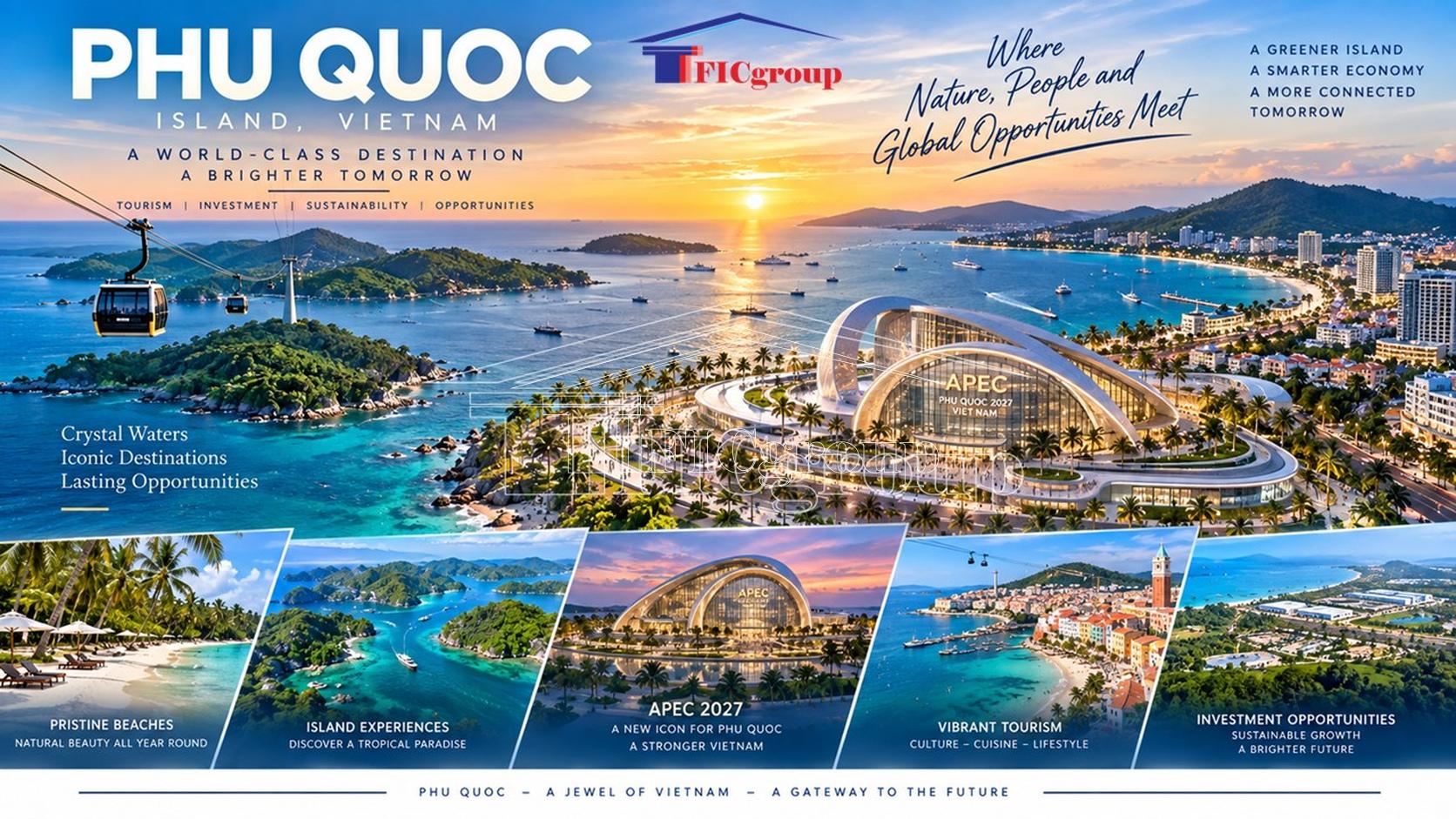
Phu Quoc International Airport is undergoing major expansion.
By mid-2026, significant construction progress had been achieved on:
The second runway is approximately:
3,300 METERS LONG
and:
45 METERS WIDE,
with major pavement works already completed by mid-2026.
The airport expansion strengthens Phu Quoc’s potential for:
AIRPORT EXPANSION ≠ COMPLETED EXPANSION
INTERNATIONAL AIRPORT ≠ INTERNATIONAL AIR-CARGO HUB
Actual cargo capability must be verified separately.
Rapid development creates equally rapid demand for reliable electricity.
Major grid projects in 2026 include:
The North Phu Quoc 110kV line extends approximately 20.7 km, while the South Phu Quoc line extends approximately 19.93 km.
For international investors, this matters because tourism growth, urban development, airports, resorts, data infrastructure and commercial services all require reliable electricity.
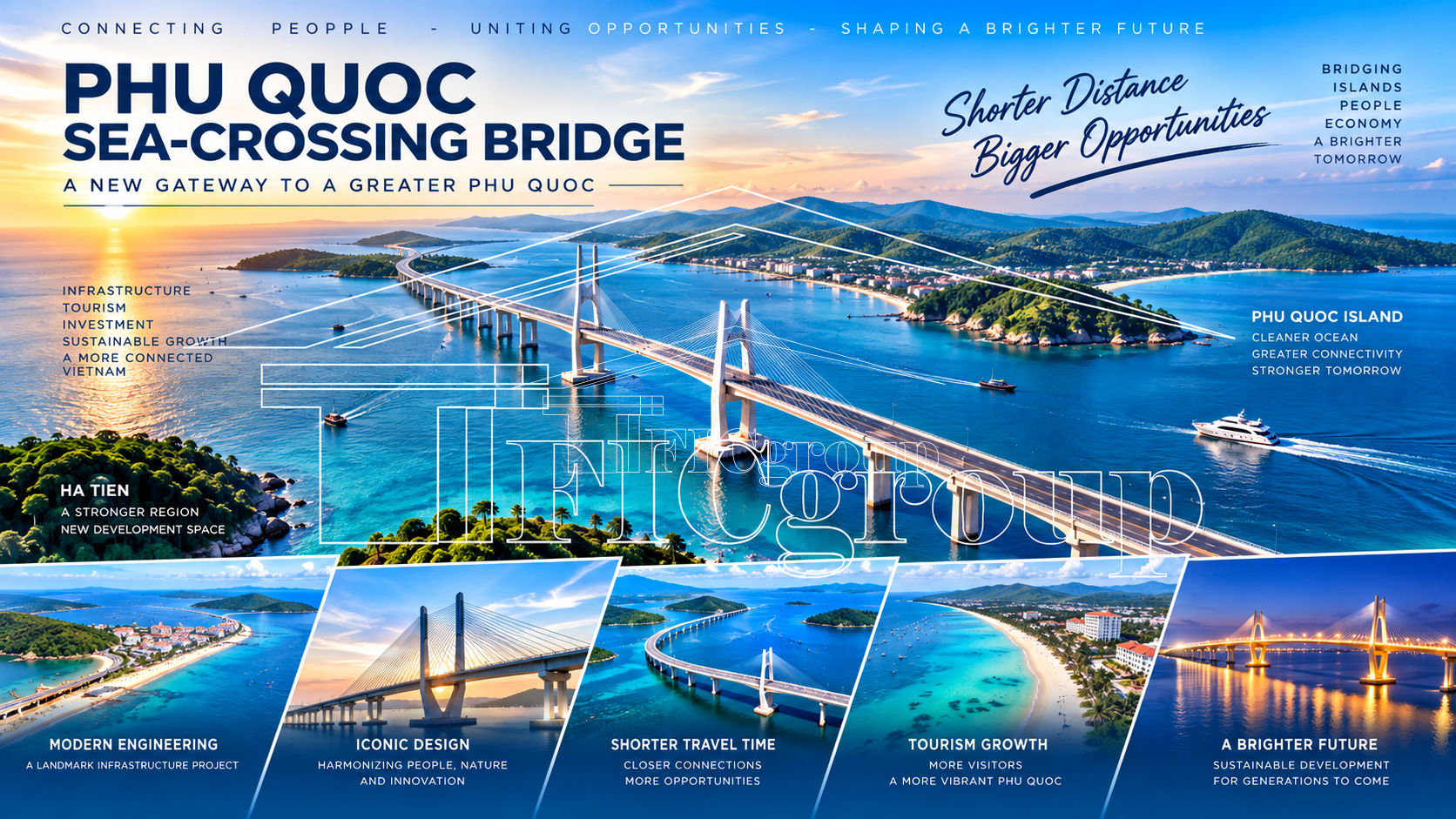
Ha Tien is the closest major mainland gateway to Phu Quoc.
The distance across the sea is approximately 40–45 km, and ferry/high-speed-vessel services currently provide the principal direct surface connection.
Major marine-access infrastructure is also being developed around Ha Tien.
However, TTTFIC makes an important status distinction:
HA TIEN SEA-CROSSING ROAD PROJECT ≠ HA TIEN–PHU QUOC ROAD BRIDGE.
The Ha Tien master plan includes sea-crossing routes associated with port, urban and maritime development, but this should not be interpreted as confirmation that a continuous road or bridge from mainland Ha Tien directly to Phu Quoc is currently under construction.
LONG-TERM PLANNING ≠ APPROVED PROJECT
APPROVED PROJECT ≠ UNDER CONSTRUCTION
HA TIEN SEA-CROSSING INFRASTRUCTURE ≠ PHU QUOC FIXED ROAD CONNECTION
This distinction protects investors from confusing future infrastructure concepts with current transportation reality.
Ha Tien occupies a strategic position between:
CAMBODIA
GULF OF THAILAND
PHU QUOC
MEKONG DELTA.
The Ha Tien Border Gate Economic Zone includes commercial and logistics functions such as:
This creates potential for:
The new An Giang possesses more than 148 km of land border with Cambodia.
Its international border gates include:
TINH BIEN
VINH XUONG
HA TIEN.
This provides access toward Cambodian markets and broader regional trade corridors.
Potential sectors include:
The border economy is particularly important because it complements rather than duplicates the province’s maritime economy.
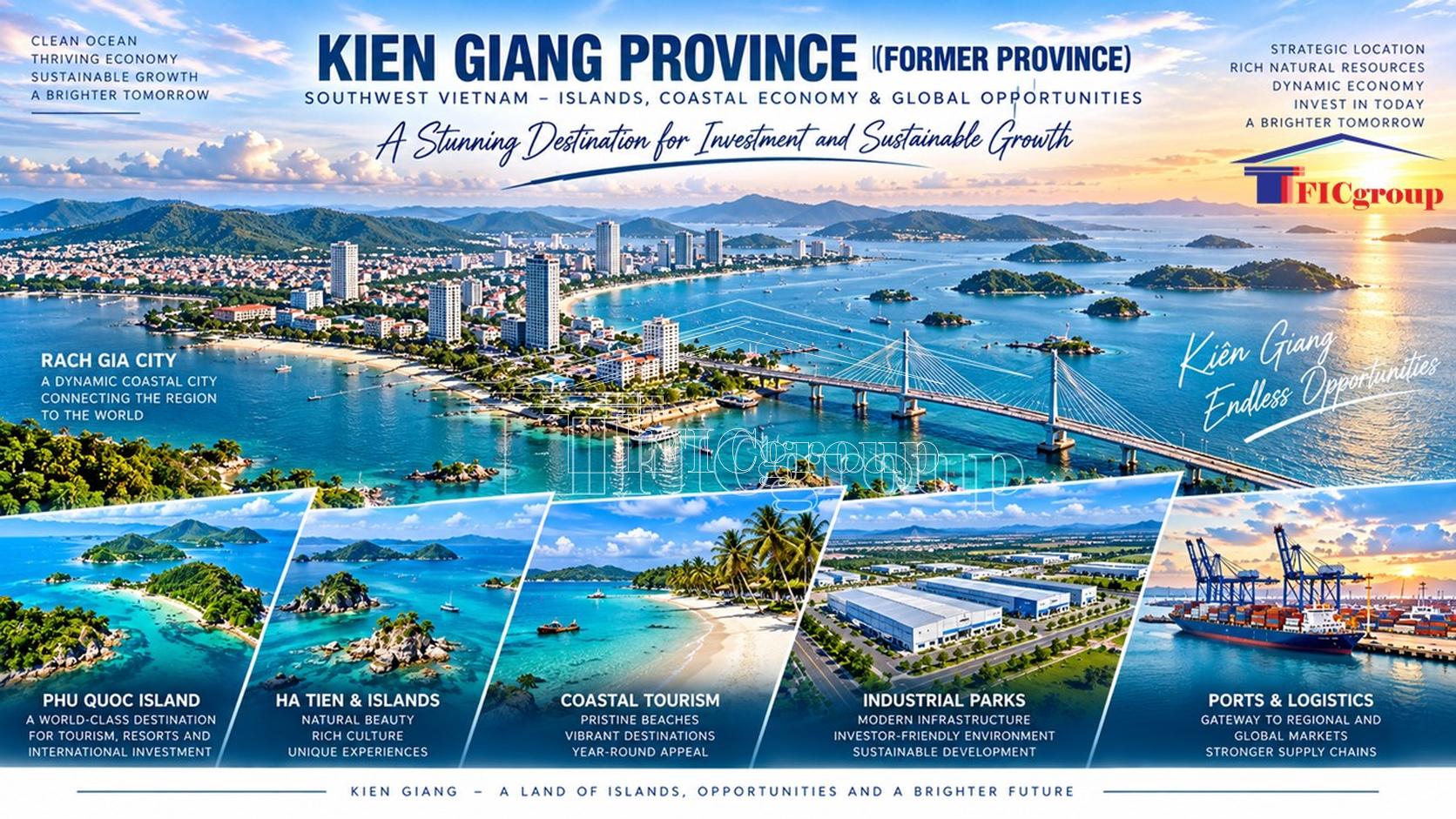
The post-merger industrial system combines the Industrial Parks of former An Giang and former Kien Giang.
Important established and developing industrial locations include:
Binh Hoa is one of the established industrial anchors of former An Giang.
The park covers approximately:
132 HECTARES
with technical and environmental infrastructure developed for manufacturing activities.
Target industries include:
New manufacturing investment continued to be approved at Binh Hoa in 2026.
Another established industrial location supporting manufacturing and processing activities.
An important industrial location within the western border-oriented economy.
In 2026, centralized wastewater-treatment infrastructure was under development, with a planned capacity of approximately 750 m³/day.
Located in the former Kien Giang industrial geography, Thanh Loc has a planned area of approximately:
251.98 HECTARES,
developed in two phases.
Its target sectors include:
Located near Ha Tien, Thuận Yen has approximately:
133.95 HECTARES.
Its location provides access toward:
The project continues to offer industrial-infrastructure and secondary-investment opportunities.
Xeo Ro represents an important future processing and marine-oriented industrial platform.
The broader complex covers approximately:
311.85 HECTARES,
including approximately 210.54 ha designated for the Industrial Park.
Target industries include:
These assets are at different development stages.
Therefore:
LISTED IP ≠ OPERATING IP.
PLANNED IP ≠ ESTABLISHED IP
ESTABLISHED IP ≠ COMPLETED INFRASTRUCTURE
OPERATING IP ≠ AVAILABLE LAND
Every industrial site must be verified individually.
Industrial Clusters (ICs) are particularly important in An Giang because of the province’s enormous agricultural and aquaculture production base.
Current official reporting shows some variation depending on planning/reporting cut-off.
One provincial 2026 report identifies:
47 INDUSTRIAL CLUSTERS
covering approximately:
2,225 HECTARES,
with eight clusters having substantially completed infrastructure and leasing industrial land.
Another July 2026 provincial industrial survey reported 44 planned ICs covering more than 2,254 ha, with 12 established ICs and 8 operating ICs.
A subsequent investment-support policy communication refers to 47 planned ICs exceeding 2,155 ha, with 10 having completed key establishment/planning/investment procedures.
Because the province is still harmonizing the two former provincial planning systems, TTTFIC does not collapse these reporting dates into one artificial number.
DIFFERENT REPORTING CUT-OFFS ≠ DATA ERROR.
For site-selection work, TTTFIC verifies the current legal status of each IC individually.
An Giang’s IC network can connect raw-material regions directly with processing.
The model is:
RICE FIELD
↓
INDUSTRIAL CLUSTER
↓
MILLING / PROCESSING
↓
PACKAGING
↓
LOGISTICS
↓
EXPORT.
For aquaculture:
FARM
↓
COLD CHAIN
↓
PROCESSING
↓
VALUE-ADDED SEAFOOD
↓
EXPORT.
This makes Industrial Clusters especially relevant for:
Agriculture remains one of the foundations of the new An Giang economy.
In 2025, the province produced more than:
8.8 MILLION TONS OF RICE,
while total fisheries output exceeded:
1.6 MILLION TONS.
For 2026, the province is targeting approximately 8.8 million tons of rice and 1.66 million tons of fisheries output.
This scale creates investment opportunities extending far beyond primary agriculture.
An Giang is participating at major scale in Vietnam’s one-million-hectare high-quality, low-emission rice program.
By 2026, the province reported more than:
183,000 HECTARES
associated with the program.
This creates opportunities in:
The future model should move from:
RICE PRODUCTION
to:
HIGH-QUALITY RICE + PROCESSING + TRACEABILITY + LOW EMISSIONS + GLOBAL BRAND.
The merger combines two different aquatic economies.
Former An Giang contributes:
FRESHWATER AQUACULTURE + PANGASIUS.
Former Kien Giang contributes:
MARINE FISHERIES + COASTAL AQUACULTURE + ISLAND ECONOMY.
Together:
FRESHWATER + BRACKISH WATER + MARINE ECONOMY.
Investment opportunities include:
In the first half of 2026, the province had approved high-tech marine-farming investment for five enterprises covering more than 2,900 ha of sea area, with investment exceeding VND 1.1 trillion.
The former Kien Giang territory adds an important heavy-industry and construction-material dimension to the new province.
The Kiên Luong–Hon Chong area has long been associated with:
The new An Giang therefore contains industrial assets associated with the Ha Tien cement industry as well as other cement and materials operations.
Provincial logistics planning identifies specialized ports serving:
A current environmental filing also identifies a Ha Tien cement grinding facility with designed output of:
1 MILLION TONS PER YEAR.
This creates an industrial chain of:
LIMESTONE → CEMENT / CLINKER → PORT → CONSTRUCTION MARKET.
However:
LIMESTONE RESOURCE ≠ AVAILABLE MINING RESERVE
RESOURCE ≠ LICENSE
CEMENT PLANT ≠ AVAILABLE INVESTMENT PROJECT
Project-level environmental and mining status must be verified separately.
The former Kien Giang territory adds significant coastal and island energy potential to the new An Giang.
The province’s geography creates opportunities for:
This opportunity becomes increasingly important as industrial development, tourism and Phu Quoc’s urban economy increase electricity demand.
But TTTFIC applies strict status control:
RENEWABLE-ENERGY POTENTIAL ≠ APPROVED PROJECT.
APPROVED PROJECT ≠ UNDER CONSTRUCTION.
INSTALLED CAPACITY ≠ AVAILABLE GRID CAPACITY.
Energy-intensive investors must verify actual:
The merger gives An Giang access to a much broader port and maritime system.
Important nodes include:
Rach Gia passenger port serves as an important mainland maritime gateway connecting to islands including:
This creates a logistics system combining:
RIVER TRANSPORT + ROAD + PORT + SEA + ISLAND.
Rach Gia plays an important role as a mainland urban, administrative, commercial and maritime-service center.
Its strategic functions include:
In the new provincial geography, Rach Gia can increasingly function as:
THE MAINLAND SERVICE GATEWAY TO THE GULF OF THAILAND ECONOMY.
Tourism in An Giang is not limited to Phu Quoc.
The Chau Doc–Nui Sam area represents one of Southern Vietnam’s important spiritual-tourism destinations.
Its religious, cultural and pilgrimage economy creates demand for:
This gives the province two fundamentally different tourism engines:
PHU QUOC = INTERNATIONAL ISLAND TOURISM.
CHAU DOC / NUI SAM = SPIRITUAL & CULTURAL TOURISM.
The Seven Mountains area adds another tourism geography involving:
Combined with Ha Tien and Phu Quoc, the province can develop multi-destination itineraries linking:
CHAU DOC → NUI SAM → SEVEN MOUNTAINS → TINH BIEN → HA TIEN → PHU QUOC.
This is a much stronger tourism proposition than either former province possessed independently.
TTTFIC sees three major tourism gateways.
International tourism + Resorts + Aviation + MICE + Entertainment.
Coastal tourism + Border trade + Cambodia + Island gateway.
Spiritual tourism + Culture + Cambodia + Mekong.
Together:
INTERNATIONAL TOURISM + SPIRITUAL TOURISM + BORDER TOURISM + ECO-TOURISM + MARINE TOURISM.
The merger creates the possibility of a broader logistics architecture.
The economic flow can increasingly become:
AGRICULTURAL PRODUCTION
↓
PROCESSING
↓
LONG XUYEN / RACH GIA LOGISTICS
↓
PORT / BORDER GATE
↓
CAMBODIA / DOMESTIC MARKET / INTERNATIONAL MARKET.
For maritime activities:
MAINLAND
↓
HA TIEN / RACH GIA
↓
PHU QUOC / KIEN HAI / THO CHAU
↓
GULF OF THAILAND.
This creates opportunities in:
Major transport investments are reshaping An Giang.
Important corridors include:
The investment effect is potentially substantial.
Historically, distance and logistics have constrained parts of the Mekong Delta.
New infrastructure can progressively reduce this disadvantage.
ROAD UNDER CONSTRUCTION ≠ OPERATING ROAD
PLANNED EXPRESSWAY ≠ COMPLETED EXPRESSWAY
Investment decisions must use actual commissioning dates and real logistics times.
The merger creates an unusually complementary economy.
RICE + PANGASIUS + BORDER TRADE + CHAU DOC + SPIRITUAL TOURISM + AGRICULTURAL PROCESSING.
PHU QUOC + SEA + ISLANDS + PORTS + TOURISM + CEMENT + ENERGY + MARINE ECONOMY.
Together:
LAND + RIVER + BORDER + COAST + SEA + ISLAND.
The opportunity is to connect these assets.
RICE → PROCESSING → PORT → EXPORT.
AQUACULTURE → COLD CHAIN → SEAFOOD → GLOBAL MARKET.
LIMESTONE → CEMENT → PORT → CONSTRUCTION MARKET.
BORDER → LOGISTICS → CAMBODIA.
HA TIEN → MARITIME GATEWAY → PHU QUOC.
PHU QUOC → INTERNATIONAL TOURISM → SERVICES → GLOBAL INVESTMENT.
Rice, fruit, food, feed and higher-value agricultural products.
Pangasius, marine farming, seafood, cold chain and value-added processing.
Industrial infrastructure and secondary manufacturing.
Localized processing close to raw-material areas.
Wind, solar, storage and grid-support solutions, subject to legal and grid verification.
Value-added materials linked to the Kien Luong–Hon Chong industrial geography.
Agricultural, seafood, border and maritime logistics.
Cambodia-facing trade and warehousing.
Hospitality, MICE, entertainment and international services.
Ports, aquaculture, island services and maritime logistics.
Chau Doc, Nui Sam, Seven Mountains and cultural destinations.
International services and infrastructure opportunities created by Phu Quoc’s accelerated investment cycle.
Before recommending any An Giang location, TTTFIC verifies:
LAND
LEGAL STATUS
PLANNING
SITE CLEARANCE
FDI ELIGIBILITY
INDUSTRY ELIGIBILITY
POWER
WATER
WASTEWATER
ENVIRONMENT
FIRE SAFETY
LABOR
RAW MATERIALS
ROAD ACCESS
PORT ACCESS
AIRPORT ACCESS
BORDER-GATE ACCESS
LOGISTICS
INCENTIVES
COMMERCIAL TERMS
IMPLEMENTATION TIMELINE
Former An Giang and former Kien Giang planning systems are still being integrated.
Legacy documents may therefore use old administrative names.
PLANNED IP ≠ OPERATING IP
and:
OPERATING IP ≠ AVAILABLE LAND.
Current official sources use different IC totals depending on reporting and planning cut-off.
Investors should verify each project individually.
Flooding, salinity, coastal conditions and climate change require project-specific assessment.
Rapid investment creates significant opportunity but also:
Renewable-energy potential does not automatically mean grid availability.
Environmental, mining and resource licenses require careful due diligence.
Investors should not treat conceptual or planned mainland–island connectivity as operating infrastructure.
The new An Giang combines:
4.95 MILLION PEOPLE
MEKONG AGRICULTURE
8.8 MILLION TONS OF RICE
AQUACULTURE
CAMBODIA BORDER
GULF OF THAILAND
PHU QUOC
THREE SPECIAL ZONES
INTERNATIONAL AIRPORT
PORTS
INDUSTRIAL PARKS
INDUSTRIAL CLUSTERS
CEMENT & MATERIALS
RENEWABLE ENERGY POTENTIAL
SPIRITUAL TOURISM
APEC 2027.
The strategic advantage is not any one of these assets.
IT IS THEIR COMBINATION WITHIN ONE PROVINCE.
TTTFIC sees An Giang as a multi-node investment platform.
Agriculture + Aquaculture + Processing + Industrial Parks + Logistics
Border Trade + Cambodia + Spiritual Tourism + Logistics
Administration + Services + Logistics + Maritime Gateway + Airport
Cement + Materials + Ports + Border Trade + Marine Economy + Energy
International Tourism + Aviation + MICE + Hospitality + Services + APEC 2027
Islands + Marine Economy + Fisheries + Tourism + Strategic Maritime Geography
These nodes create several distinct investment strategies.
FARM → PROCESSING → LOGISTICS → EXPORT.
FARM / SEA → COLD CHAIN → PROCESSING → GLOBAL MARKET.
AN GIANG → BORDER GATE → CAMBODIA.
RAW MATERIAL → INDUSTRIAL CLUSTER / INDUSTRIAL PARK → VALUE-ADDED PRODUCT.
RACH GIA / HA TIEN → PORT → ISLANDS → GULF OF THAILAND.
CHAU DOC → HA TIEN → PHU QUOC.
PHU QUOC → INTERNATIONAL AIRPORT → APEC → GLOBAL TOURISM & SERVICES.
TTTFIC Group | Vietnam Industrial Investment & Business Advisory
The new An Giang cannot be evaluated as one homogeneous investment market.
A rice-processing investor requires a different location strategy from a Phu Quoc hospitality investor.
A cement or materials project requires different infrastructure from a seafood processor.
A Cambodia-oriented logistics operator requires different site-selection criteria from a marine-farming investor.
TTTFIC therefore begins with the investor’s operating model.
Our process is:
INVESTOR REQUIREMENTS
↓
INDUSTRY & MARKET ANALYSIS
↓
REGIONAL LOCATION STRATEGY
↓
INDUSTRIAL PARK / INDUSTRIAL CLUSTER / FACTORY / PROJECT SCREENING
↓
LAND & LEGAL DUE DILIGENCE
↓
UTILITIES & ENVIRONMENTAL ANALYSIS
↓
LABOR & RAW-MATERIAL ANALYSIS
↓
ROAD / PORT / AIRPORT / BORDER LOGISTICS
↓
COMMERCIAL NEGOTIATION
↓
IRC / ERC & REGULATORY COORDINATION
↓
DESIGN & BUILD
↓
OPERATION.
TTTFIC supports:
TTTFIC does not recommend a location simply because land is available.
We evaluate whether it is:
LEGALLY + TECHNICALLY + LOGISTICALLY + COMMERCIALLY + OPERATIONALLY SUITABLE
for the investor.
The 2025 merger fundamentally changed An Giang.
Former An Giang contributed:
MEKONG AGRICULTURE + RICE + PANGASIUS + CHAU DOC + BORDER TRADE + SPIRITUAL TOURISM.
Former Kien Giang contributed:
PHU QUOC + GULF OF THAILAND + PORTS + ISLANDS + CEMENT + ENERGY + MARINE ECONOMY + INTERNATIONAL TOURISM.
Together, they create something neither province possessed independently:
A MEKONG–BORDER–MARITIME–ISLAND INVESTMENT PLATFORM.
The opportunity is integration.
RICE → PROCESSING → EXPORT.
PANGASIUS → VALUE-ADDED SEAFOOD → GLOBAL MARKET.
SEA → AQUACULTURE → PROCESSING → EXPORT.
LIMESTONE → MATERIALS → PORT → MARKET.
RENEWABLE ENERGY → INDUSTRY + ISLAND ECONOMY.
CAMBODIA BORDER → TRADE + LOGISTICS.
HA TIEN → MARITIME GATEWAY.
PHU QUOC → INTERNATIONAL TOURISM + AVIATION + SERVICES + APEC.
The old An Giang was primarily known for agriculture, aquaculture and border trade.
The new An Giang represents something substantially broader:
AGRICULTURE + AQUACULTURE + INDUSTRY + ENERGY + CEMENT + PORTS + BORDER TRADE + MARINE ECONOMY + ISLANDS + INTERNATIONAL TOURISM.
For international investors, the question is therefore no longer simply:
“Why An Giang?”
The more important question is:
“WHICH PART OF THE NEW AN GIANG BEST CONNECTS OUR BUSINESS TO RAW MATERIALS, INDUSTRIAL INFRASTRUCTURE, CAMBODIA, THE MEKONG DELTA, THE GULF OF THAILAND AND INTERNATIONAL MARKETS?”
That is the question TTTFIC Group is designed to help investors answer.
TTTFIC VIETNAM INVESTMENT INTELLIGENCE PLATFORM 2026
TTTFIC Group | Vietnam Industrial Investment & Business Advisory
FDI INVESTORS — CONTACT TTTFIC GROUP
Vietnam Nationwide + Thailand
Tel / WhatsApp: +84 936 431 788
Email: marketing@tttfic.com
Table of contents