WHA INDUSTRIAL ZONES THANH HOA
- Investor: WHA Group
- Price: $90/sqm/50 years
- Area: 179 ha
THANH HOA PROVINCE, VIETNAM 2026
Vietnam’s North-Central Industrial, Deep-Water Port, Manufacturing & Multi-Corridor Growth Platform
TTTFIC GLOBAL INVESTMENT PROFILE 2026
NGHI SON + DEEP-WATER PORT + REFINERY + INDUSTRY + THO XUAN + LABOR + SAM SON + EXPRESSWAYS + LAOS + NEXT-GENERATION MANUFACTURING
Thanh Hoa Vietnam is no longer simply a large North-Central province positioned between Hanoi and Central Vietnam.
It is increasingly developing into a diversified industrial and investment platform built around deep-water maritime infrastructure, refinery and petrochemicals, heavy industry, manufacturing, industrial parks, aviation, expressways, tourism, agriculture, a large labor force and westward connectivity toward Laos.
At the center of this transformation is Nghi Son Economic Zone — one of Vietnam’s major integrated industrial, energy and maritime investment platforms.
But Nghi Son is only one part of the story.
A second industrial axis is emerging around Tho Xuan Airport – Lam Son – Sao Vang, where aviation connectivity, industrial land and technology-oriented manufacturing can support a different generation of investment.
The provincial urban and service center provides administration, education, commerce and workforce.
Sam Son has evolved into a major coastal tourism and consumer-economy center attracting millions of visitor arrivals annually.
Across the province, industrial parks, industrial clusters and smaller manufacturing facilities are progressively extending production beyond the traditional large industrial centers and into labor-rich communities.
To the west, roads toward the Laos border create another strategic dimension.
The result is not a single industrial location.
It is an emerging multi-node, multi-corridor provincial economy.
The investment logic can increasingly be understood as:
↕
↔ THO XUAN – LAM SON – SAO VANG
↔ WESTERN THANH HOA – LAOS
↓
↓
↓
For international manufacturers and site-selection teams evaluating Industrial Parks in Vietnam, Thanh Hoa deserves to be considered not simply as a lower-cost alternative location, but as an increasingly sophisticated industrial economy in its own right.
Thanh Hoa occupies a strategic position in Vietnam’s North Central region, approximately 150 kilometers south of Hanoi.
Unlike many provinces whose investment proposition depends primarily on one industrial corridor, Thanh Hoa combines mountains, midlands, a large delta, coastline, international border connectivity, industrial cities, tourism centers and a major economic zone.
The province has approximately:
Thanh Hoa was not merged with another province in the 2025 provincial-level reorganization.
However, its commune-level administrative system was extensively reorganized under Vietnam’s two-tier local-government model.
This distinction matters.
does not mean:
The province is undergoing a much larger economic transformation driven by industrialization, infrastructure, urban development, investment and the geographical expansion of manufacturing.
Thanh Hoa today combines:
DEEP-WATER PORT
REFINERY & PETROCHEMICALS
HEAVY INDUSTRY
INDUSTRIAL PARKS
MANUFACTURING
AIRPORT
EXPRESSWAYS
LARGE LABOR FORCE
LAOS CONNECTIVITY
TOURISM & CONSUMER ECONOMY
This combination defines the modern investment case for Thanh Hoa Vietnam.
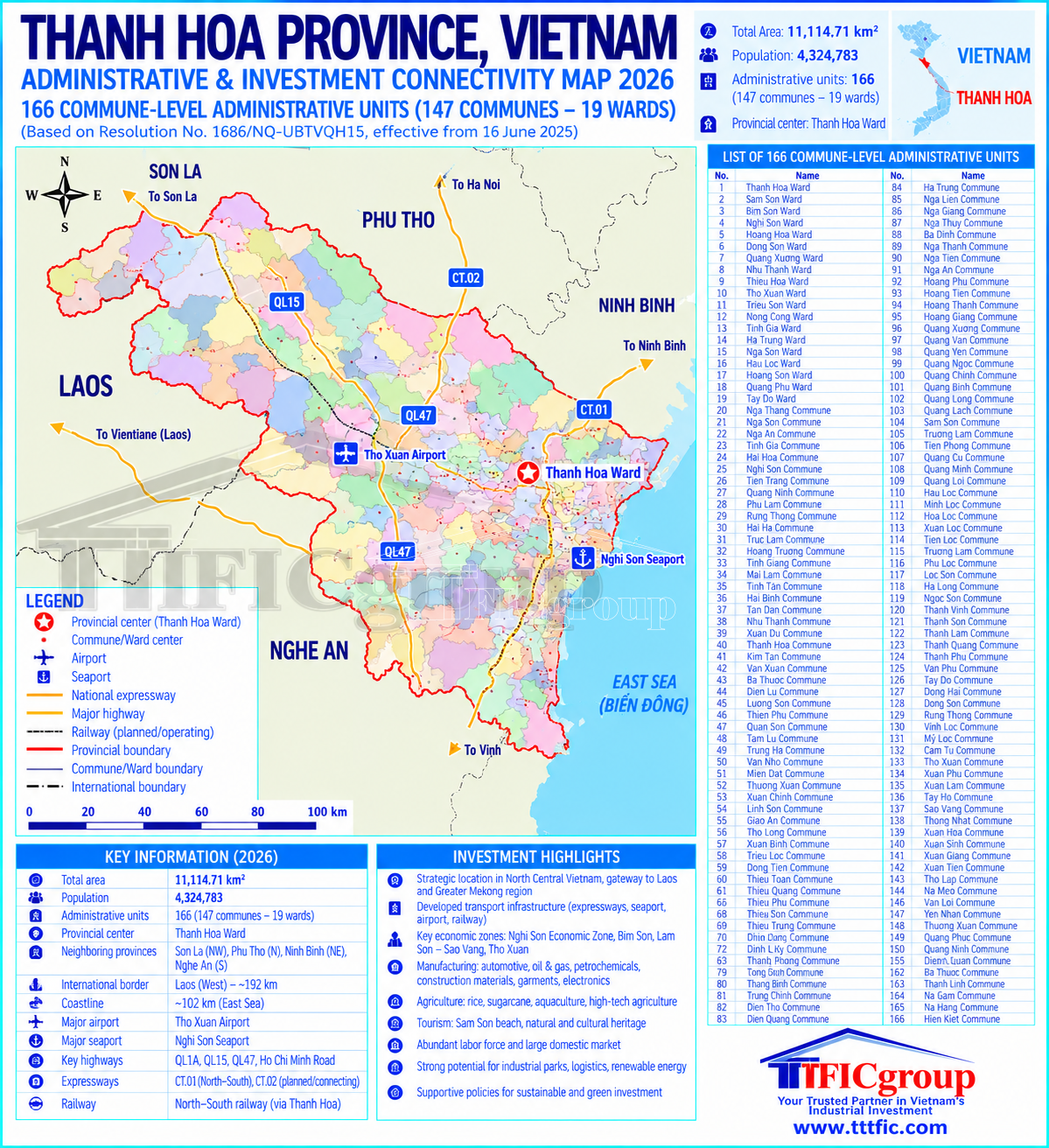
Thanh Hoa remains an independent province following Vietnam’s 2025 provincial reorganization.
Its current geography connects several major economic systems.
To the north are Ninh Binh, Phu Tho and Son La.
To the south is Nghe An.
To the west is the Lao People’s Democratic Republic.
To the east is the Gulf of Tonkin.
This places Thanh Hoa at the intersection of:
The province therefore has both domestic corridor value and international gateway potential.
Following the 2025 administrative reorganization, Thanh Hoa has 166 commune-level units comprising 147 communes and 19 wards.
For investors, legacy district-level addresses and older planning documents should therefore be reconciled against the current administrative structure during legal and land due diligence.
Thanh Hoa has developed into one of the largest provincial economies in North Central Vietnam.
By 2025, provincial GRDP was estimated at approximately:
VND 333.6 TRILLION
The economic structure has shifted substantially toward industry and construction.
Industry and construction accounted for approximately 47.9% of GRDP in 2025, compared with approximately 13.25% for agriculture, forestry and fisheries.
This is important.
Thanh Hoa should no longer be analyzed primarily as an agricultural province with several large factories.
Industrialization has become structural.
The province’s growth platform now includes:
In 2025, the provincial industrial production index continued to record strong growth.
Thanh Hoa also attracted more than one hundred new direct-investment projects during the year, including FDI projects.
The investment pipeline continues to expand into 2026.
The more important question for international investors is therefore shifting from:
to:
Thanh Hoa already possesses an FDI base of a scale that distinguishes it from many emerging industrial provinces.
International capital is visible in:
The most important concentration remains Nghi Son Economic Zone.
By late 2025, Nghi Son Economic Zone had attracted hundreds of domestic projects and more than twenty FDI projects, with cumulative registered FDI capital exceeding USD 12 billion.
This is significant not only because of the amount of capital.
It demonstrates that Thanh Hoa is capable of hosting:
At the same time, Thanh Hoa’s next phase should not depend only on megaprojects.
The emerging opportunity is to deepen the industrial ecosystem through:
The next stage can therefore follow the logic:
→ SUPPLIERS
→ SUPPORTING INDUSTRIES
→ LOCALIZATION
→ INDUSTRIAL SERVICES
→ TECHNOLOGY
→ HIGHER VALUE ADDED
Thanh Hoa’s industrial transformation is entering a new phase.
The province is no longer attracting only individual manufacturing projects.
It is increasingly attracting international industrial infrastructure developers capable of bringing their own global investor networks, operating standards and industrial ecosystems into the province.
Two important examples are Sumitomo Corporation of Japan and WHA Group of Thailand.
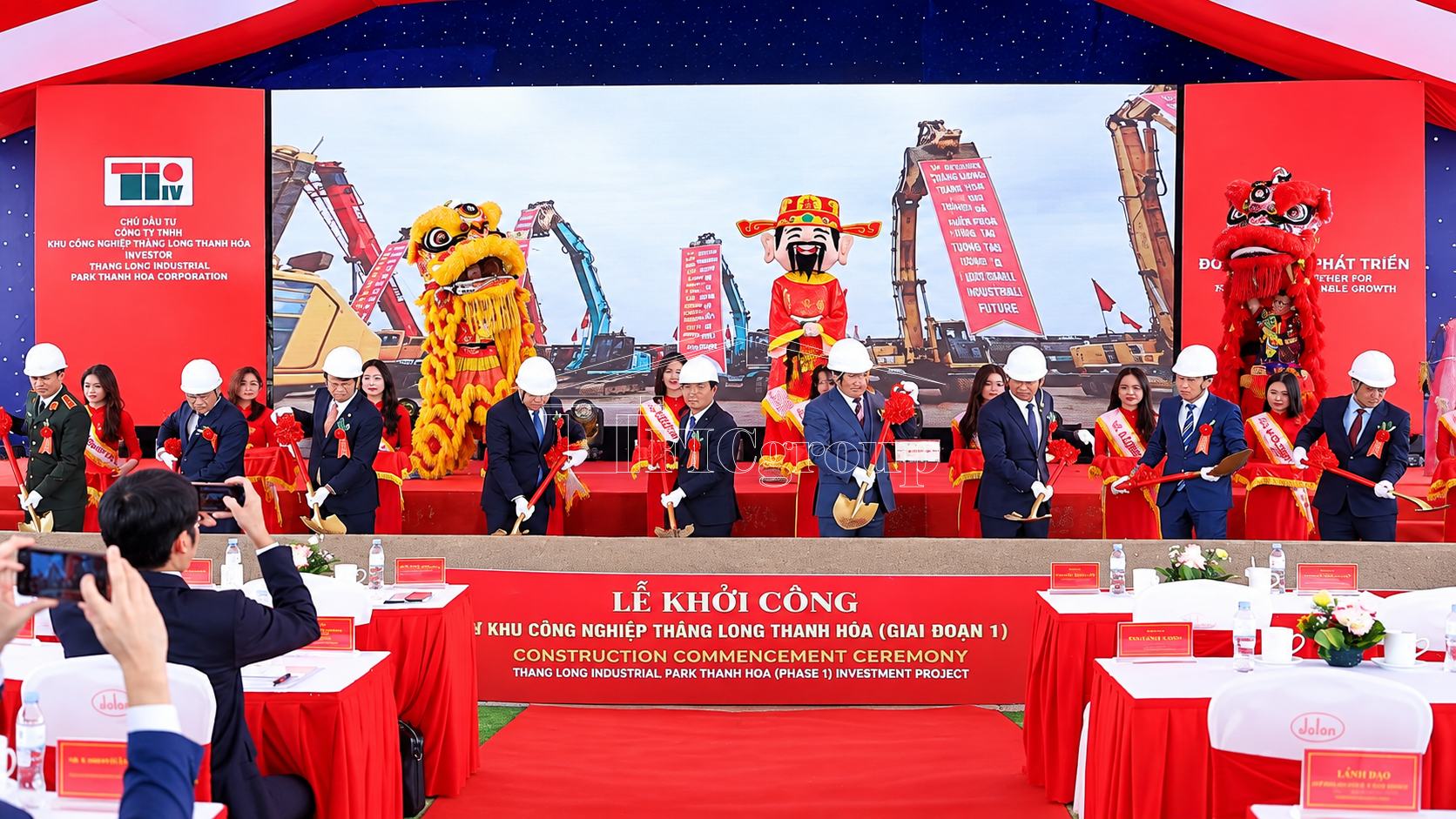
Sumitomo Corporation has established a significant new presence in Thanh Hoa through the development of Thang Long Thanh Hoa Industrial Park – Phase 1.
The project covers approximately 167 hectares with total investment of nearly VND 3 trillion, or approximately USD 115 million.
The industrial park is being developed with a strong orientation toward:
Its significance extends beyond the physical size of the project.
Sumitomo is one of Japan’s major diversified trading and investment groups and has extensive experience in industrial-park development and international manufacturing networks.
Its entry into Thanh Hoa sends an important signal:
The project also strengthens Thanh Hoa’s ability to compete for investors that might previously have concentrated primarily on traditional northern industrial provinces.
Thailand’s WHA Group is developing a separate but equally important industrial platform in Thanh Hoa.
WHA Smart Technology Industrial Zone 1 has entered development, while additional WHA industrial-zone projects are progressing through different stages of planning, approval and investment preparation.
WHA’s Thanh Hoa strategy is oriented toward:
WHA has also announced additional industrial-development proposals across Thanh Hoa, significantly expanding its potential long-term development footprint in the province.
OPERATING DEVELOPER ≠ FULLY OPERATING INDUSTRIAL PARK
MOU ≠ APPROVED PROJECT
APPROVED PROJECT ≠ COMPLETED INFRASTRUCTURE
Each WHA project must therefore be evaluated according to its actual development stage.
However, the broader strategic signal is already clear.
The presence of both Sumitomo and WHA represents more than two industrial-park investments.
It means that Thanh Hoa is beginning to attract industrial ecosystem builders.
These developers bring:
This could materially accelerate the province’s transition from a collection of industrial projects into a more integrated international manufacturing platform.

One of the defining industrial assets in Thanh Hoa is the Nghi Son Refinery and Petrochemical Complex.
The project represents approximately USD 9 billion in investment and has a designed processing capacity of approximately:
200,000 BARRELS PER DAY
or approximately:
10 MILLION TONS PER YEAR.
Its product portfolio includes petroleum fuels and petrochemical products such as polypropylene and other refinery outputs.
The refinery has implications extending beyond its own production.
It creates potential downstream opportunities in:
From an investment-intelligence perspective, the long-term value of a refinery is not simply refinery output.
It is the industrial ecosystem that can develop around it.
→ PETROCHEMICAL FEEDSTOCK
→ DOWNSTREAM MATERIALS
→ MANUFACTURING
→ PACKAGING / COMPONENTS
→ SUPPORTING INDUSTRIES
→ EXPORT
This downstream industrialization represents an important opportunity for the next generation of Nghi Son investment.
One of the most misunderstood characteristics of Nghi Son is its industrial geography.
Nghi Son Economic Zone contains a system of separately planned and numbered industrial zones, rather than one conventional industrial park.
The planning framework includes multiple industrial zones with different:
Official investment planning extends beyond Industrial Zone No.16 and includes additional numbered industrial areas.
Examples include industrial zones oriented toward:
Industrial Zone No.1 is positioned close to the refinery and Nghi Son Port and is particularly relevant to post-refinery and related industrial activities.
Industrial Zone No.3 is positioned near National Highway 1A, the North–South Expressway and railway infrastructure and is oriented toward industries including machinery, metal products, electrical and electronic equipment, precision machinery and vehicle components.
Industrial Zone No.16 has a planned area of approximately 430 hectares and prioritizes sectors including energy and agro-forestry processing.
Its infrastructure project is in development and site-clearance stages.
Industrial Zone No.17 is a much larger planned industrial area with a technology-oriented direction, including high-technology applications, R&D and associated innovation activities.
Additional industrial areas continue to form part of the wider Nghi Son planning and investment pipeline.
This creates substantial long-term industrial capacity.
But TTMS™ status discipline is essential.
TTTFIC therefore evaluates every Nghi Son industrial location individually before recommending it to an investor.
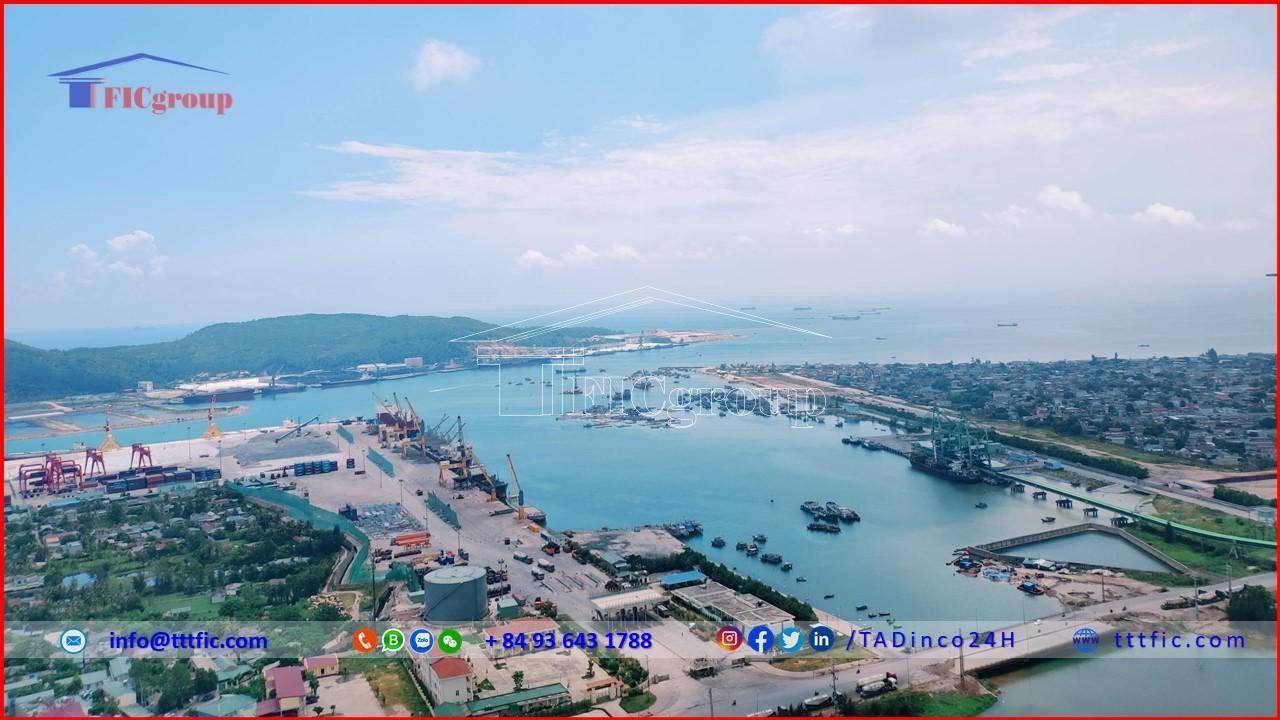
Nghi Son Port is one of Thanh Hoa’s most important structural investment advantages.
The port system supports major industrial projects and provides maritime access for:
For heavy industry and export-oriented manufacturing, port proximity can materially affect:
This creates a powerful relationship:
=
MULTIMODAL INDUSTRIAL LOGISTICS
Nghi Son also has longer-term strategic significance for westward economic corridors.
Its potential hinterland is not limited to Thanh Hoa.
Over time, improved east–west connectivity could strengthen the corridor:
→ WESTERN THANH HOA
→ THANH HOA INDUSTRIAL SYSTEM
→ NGHI SON
→ EAST SEA
→ GLOBAL SHIPPING
This should be treated as a strategic corridor opportunity rather than an assumption that all cross-border freight already operates efficiently through this route today.
The second major industrial geography of Thanh Hoa is forming inland around Tho Xuan – Lam Son – Sao Vang.
Tho Xuan Airport is a strategic aviation asset for the province.
Official planning provides for substantial long-term development, including international aviation capability.
The airport is also positioned within national aviation planning as an alternative airport supporting the wider northern aviation system.
This creates strategic optionality.
However, TTMS™ requires an important distinction:
and:
Investors should therefore evaluate current operations separately from planned future capacity.
Nevertheless, the combination of airport expansion, industrial development and urban growth creates the foundation for a potentially important inland investment node.
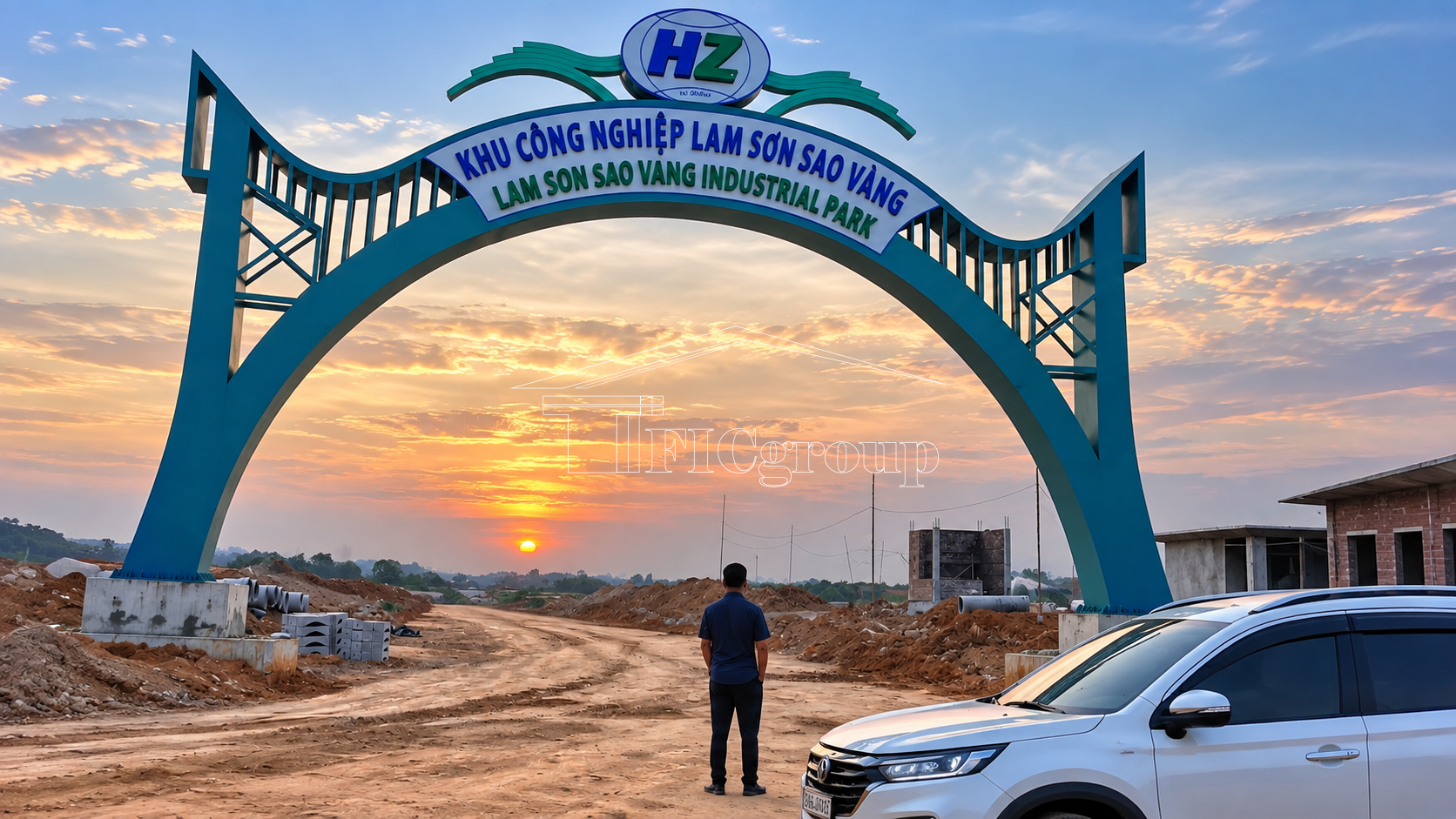
Lam Son–Sao Vang Industrial Park represents one of Thanh Hoa’s most important opportunities outside Nghi Son.
The industrial park is located approximately 2 kilometers from Tho Xuan Airport and has a planned area exceeding 573 hectares.
Its investment orientation includes modern manufacturing and technology-intensive industries such as:
This makes Lam Son–Sao Vang fundamentally different from Nghi Son.
Nghi Son’s historic strengths are:
Lam Son–Sao Vang can develop around:
The two should therefore be viewed as complementary industrial platforms.
NGHI SON
MARITIME INDUSTRIAL PLATFORM
↕
LAM SON – SAO VANG – THO XUAN
AVIATION / TECHNOLOGY-ORIENTED INDUSTRIAL PLATFORM
The development of both could materially diversify Thanh Hoa’s industrial structure.
Thanh Hoa’s future industrial strategy is increasingly moving beyond traditional heavy industry and labor-intensive manufacturing.
The combination of:
creates conditions for a new investment cycle centered on:
A number of large-scale technology and advanced-manufacturing opportunities are understood to be progressing through different stages of investment promotion, evaluation and commercial discussion.
Because some projects remain subject to confidentiality, planning, commercial negotiation or formal approval, they should not be presented as committed investments until publicly confirmed.
INVESTOR INTEREST ≠ MOU
MOU ≠ APPROVED INVESTMENT
LAND DISCUSSION ≠ LAND ALLOCATION
ANNOUNCED CAPITAL ≠ DISBURSED CAPITAL
Nevertheless, the direction of travel is increasingly visible.
From TTTFIC’s investment perspective, Thanh Hoa is positioning itself for a transition from:
toward a broader model:
HEAVY INDUSTRY + ADVANCED MANUFACTURING + ELECTRONICS + TECHNOLOGY + SUPPORTING INDUSTRIES.
If this investment pipeline materializes, the Tho Xuan–Lam Son–Sao Vang corridor could become one of North Central Vietnam’s most important next-generation manufacturing locations.
One of Thanh Hoa’s less visible investment strengths lies outside its largest industrial parks.
Manufacturing activity has progressively spread across the province through:
In many locations, factories operate closer to local labor pools rather than requiring workers to migrate toward one major industrial city.
This creates what TTTFIC describes as:
DISTRIBUTED MANUFACTURING
The model can provide advantages for selected industries:
→ FACTORY / INDUSTRIAL CLUSTER
→ LOCAL EMPLOYMENT
→ LOWER WORKER MIGRATION REQUIREMENT
→ SUPPLIER DEVELOPMENT
→ RURAL INDUSTRIALIZATION
This phenomenon is especially relevant to:
However, international investors must exercise greater due diligence outside established industrial parks.
A factory building located in a rural area is not automatically suitable for FDI manufacturing.
TTTFIC therefore verifies:
This distinction is essential.
Thanh Hoa’s investment economy is not exclusively industrial.
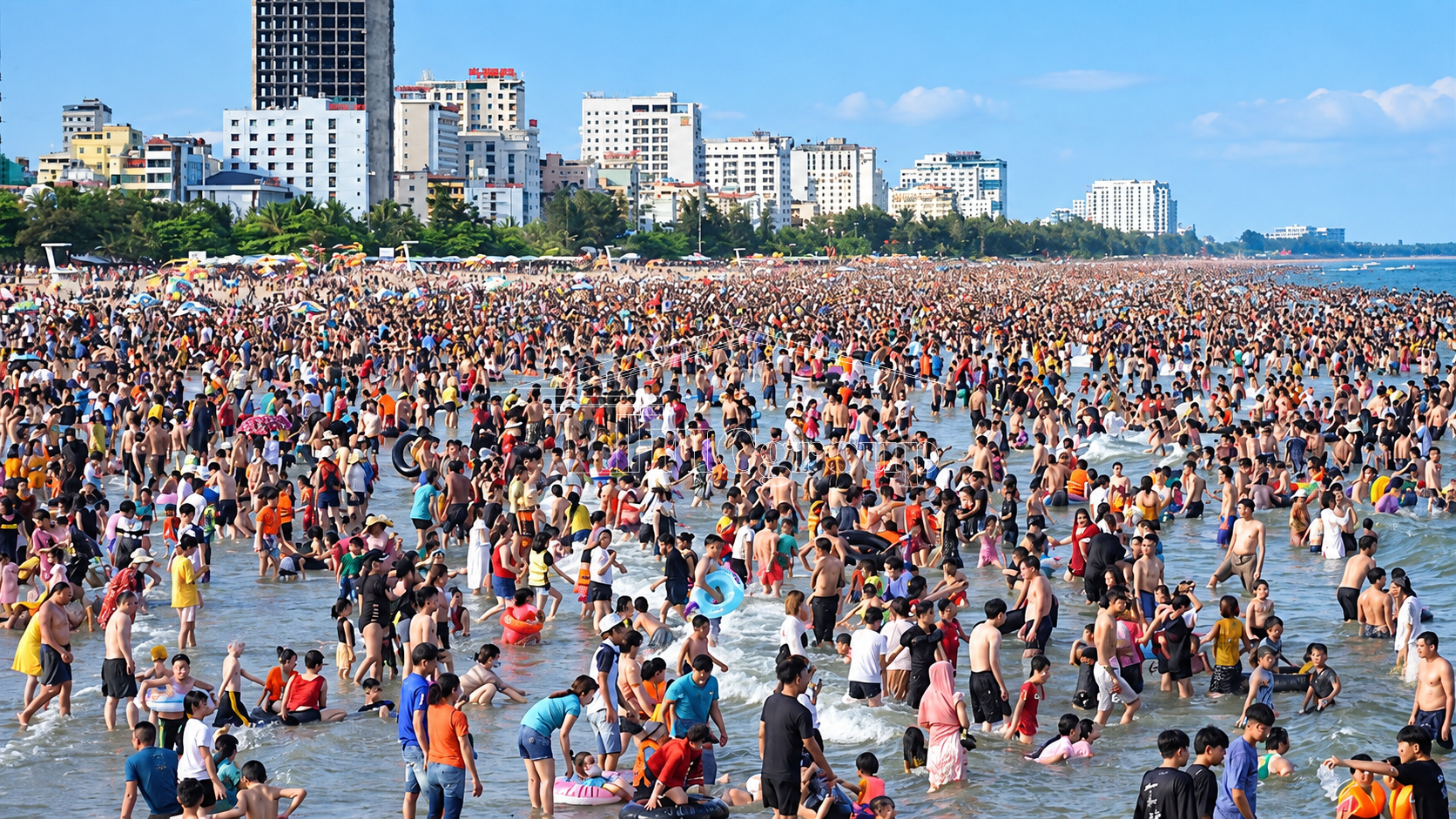
Sam Son is one of northern Vietnam’s highest-volume coastal tourism destinations.
In 2025 alone, Sam Son received approximately:
8.8 MILLION VISITOR ARRIVALS
with tourism revenue of approximately:
VND 17.48 TRILLION.
During peak summer periods, the concentration of visitors transforms the coastal area into a major seasonal consumer market.
The investment implications extend beyond hotels.
Sam Son generates demand for:
Large-scale tourism and urban investment has progressively transformed the physical character of the coastal area.
From TTTFIC’s perspective, Sam Son should therefore be understood as:
This provides another layer of diversification to Thanh Hoa’s investment economy.
Thanh Hoa possesses all five major transport modes:
This is an important structural advantage.
The North–South Expressway has significantly improved road connectivity between Thanh Hoa and:
For manufacturers, this expands the practical supplier and customer radius.
National Highway 1A remains a major industrial and commercial corridor.
The Ho Chi Minh Road strengthens connectivity through western Thanh Hoa and supports inland development.
The coastal transport axis supports connectivity among coastal economic, tourism and industrial areas.
Routes including National Highway 217 provide westward connectivity toward the Laos border.
The North–South railway passes through Thanh Hoa and provides another logistics option for selected cargo and passenger movements.
The combination creates:
ROAD + EXPRESSWAY + RAIL + PORT + AIRPORT
which materially strengthens Thanh Hoa’s site-selection proposition.
Western Thanh Hoa should not be treated merely as the mountainous hinterland of the province.
It possesses strategic potential related to:
The Na Meo international border-gate corridor provides a direct connection between Thanh Hoa and Laos.
Longer-term transport improvements could strengthen the economic relationship:
→ WESTERN THANH HOA
→ THO XUAN / CENTRAL THANH HOA
→ NGHI SON
→ EAST SEA
This creates potential for:
But investors must distinguish strategic corridor potential from current freight economics.
Road geometry, border procedures, cargo volumes, travel times and transport costs require project-specific verification.
Thanh Hoa’s population exceeds 4.3 million, with a labor force approaching 2.7 million people.
This is one of the province’s most important competitive advantages.
The value is not simply labor quantity.
Thanh Hoa has a long tradition of:
For decades, Thanh Hoa workers have participated in industrial labor markets throughout Vietnam.
As industrial investment expands within the province, more workers can potentially find employment closer to home.
This creates a powerful development cycle:
→ LOCAL FACTORIES
→ WORKFORCE RETENTION
→ SUPPLIER DEVELOPMENT
→ SKILLS ACCUMULATION
→ HIGHER-VALUE MANUFACTURING
→ DEEPER INDUSTRIALIZATION
However:
TTTFIC evaluates labor at the individual site level, including:
From TTTFIC’s perspective, Thanh Hoa offers several distinct investment themes.
Nghi Son Refinery creates opportunities for downstream manufacturing and supporting services.
Suitable areas of Nghi Son can support selected:
Lam Son–Sao Vang provides a different investment proposition oriented toward modern manufacturing and technology.
Thanh Hoa’s expanding anchor-investor base creates opportunities for:
The large labor pool and distributed manufacturing geography remain relevant to labor-intensive production.
Opportunities include:
Potential demand arises from:
New industrial parks and industrial clusters create opportunities for experienced infrastructure developers.
Future opportunities may include LNG and other power-sector investments subject to planning, licensing, grid and commercial feasibility.
Sam Son, Pu Luong and other destinations create differentiated tourism opportunities.
TTTFIC applies enhanced TTMS™ controls to Thanh Hoa because the province contains both mature industrial assets and a large pipeline of future developments.
Examples include:
New industrial, infrastructure and manufacturing assets entering operation must be evaluated individually for:
These include industrial infrastructure, factories, transport connections, energy and urban projects currently being implemented.
Status must be verified immediately before investment decisions.
This category includes:
Potential future catalysts include:
TTTFIC does not classify a project as investable merely because it appears in a master plan.
Before recommending a Thanh Hoa location, TTTFIC verifies:
Only after these controls should a location be treated as a genuine investment option.
Thanh Hoa’s scale creates opportunity — but also complexity.
Some locations are operating.
Some are under infrastructure development.
Some are undergoing site clearance.
Others remain planning-stage opportunities.
These categories must never be mixed.
Heavy industry, petrochemicals, chemicals, energy and metals can face stringent environmental requirements.
Project acceptance must be verified before land negotiations are treated as executable.
The presence of large power and water infrastructure does not guarantee unlimited capacity for every site.
A large workforce does not eliminate competition among major employers.
Labor analysis should be site-specific.
Smaller factory buildings can provide attractive economics but may present greater legal, environmental, fire-safety or infrastructure risk.
Planned airport, port, road or industrial capacity should not be included as current capacity in financial models.
Thanh Hoa is geographically large.
A location may be “in Thanh Hoa” while remaining far from Nghi Son Port, Tho Xuan Airport or a particular labor market.
Actual logistics must therefore be calculated from the project site.
Few provinces in Vietnam combine within one investment geography:
This diversification reduces dependence on any single economic sector.
Thanh Hoa can potentially serve investors seeking:
The most important mistake an international investor can make when evaluating Thanh Hoa is to see the province as simply:
That view is increasingly outdated.
TTTFIC sees Thanh Hoa developing toward a multi-node industrial system.
NODE I – NGHI SON
Deep-Water Port + Refinery + Petrochemicals + Energy + Heavy Industry + Industrial Zones + Logistics
NODE II – THANH HOA URBAN CORE
Administration + Services + Education + Commerce + Consumer Market + Workforce
NODE III – THO XUAN – LAM SON – SAO VANG
Airport + Technology + Electronics + Advanced Manufacturing + Future Aviation-Oriented Development
NODE IV – SAM SON
Tourism + Hospitality + Consumer Economy + Coastal Urban Development
NODE V – WESTERN THANH HOA
Laos + Forestry + Agriculture + Resources + Border Trade + Future Logistics
And connecting these nodes is a sixth layer:
DISTRIBUTED MANUFACTURING
Industrial clusters and factories spread across labor-rich communities.
The arrival of global industrial developers such as Sumitomo and WHA is an important inflection point. These groups do not simply build industrial land; they bring international tenants, supplier networks, operating standards and long-term industrial ecosystems. Their commitment to Thanh Hoa suggests that the province is increasingly being assessed not as a peripheral manufacturing location, but as a future platform for higher-value industrial investment.
TTTFIC therefore sees a plausible next stage in which Thanh Hoa evolves from a province dominated by heavy industry and labor-intensive manufacturing into a diversified industrial economy that also accommodates electronics, advanced manufacturing, technology-oriented suppliers and selected semiconductor-related activities. The timing and scale of that transition will depend on actual investor commitments, infrastructure delivery, labor capability and project execution.
This creates a much more sophisticated investment geography than a conventional single-industrial-park province.
The long-term model is:
→ INDUSTRIAL PARKS
→ SUPPLIERS
→ SMALLER FACTORIES
→ LOCAL LABOR
→ INDUSTRIAL CLUSTERS
→ LOGISTICS
→ TECHNOLOGY
→ LOCALIZATION
→ HIGHER VALUE ADDED
Thanh Hoa’s next industrial phase may therefore be less about creating one more megaproject and more about deepening the ecosystem around the infrastructure and anchor investments already established.
That is where TTTFIC sees some of the province’s most important future opportunities.
TTTFIC Group | Vietnam Industrial Investment & Business Advisory
Thanh Hoa presents enormous opportunity.
But precisely because the province offers so many different industrial geographies, choosing the wrong location can materially affect project performance.
A heavy-industrial project requiring maritime logistics should not be evaluated in the same way as an electronics project requiring skilled labor and airport connectivity.
A garment factory should not use the same site-selection model as a petrochemical downstream project.
A food processor should not use the same environmental and utility criteria as a logistics center.
This is where TTTFIC Group supports international investors.
TTTFIC does not simply send investors a list of industrial parks.
We build the investment case from the project backward.
PROJECT REQUIREMENTS
↓
LOCATION STRATEGY
↓
INDUSTRIAL SCREENING
↓
SITE VERIFICATION
↓
COMMERCIAL NEGOTIATION
↓
LEGAL & REGULATORY COORDINATION
↓
PROJECT IMPLEMENTATION
↓
OPERATION
TTTFIC Group can provide comprehensive support throughout this process.
TTTFIC helps investors understand:
TTTFIC screens locations according to actual project requirements, including:
TTTFIC can identify and compare industrial land across:
TTTFIC supports investors requiring:
Where existing inventory does not satisfy project requirements, TTTFIC can coordinate built-to-suit solutions.
TTTFIC supports investors throughout investment establishment and project implementation, including coordination related to:
Before investors commit substantial capital, TTTFIC can coordinate due diligence covering:
For Thanh Hoa projects, logistics can materially determine investment feasibility.
TTTFIC evaluates:
For energy-intensive manufacturing, TTTFIC assists in verifying:
TTTFIC evaluates:
TTTFIC can support negotiations relating to:
For new industrial facilities, TTTFIC can coordinate:
TTTFIC’s role does not necessarily end when the land or factory transaction closes.
International investors may continue to require support with:
Our objective is therefore not simply:
It is:
HELP THE INVESTOR BUILD A VIABLE INDUSTRIAL OPERATION IN VIETNAM.
Investors evaluating Thanh Hoa can also explore TTTFIC’s national Industrial Parks in Vietnam platform for comparison with alternative industrial locations throughout the country.
Thanh Hoa’s transformation cannot be explained by a single project.
Nghi Son changed the industrial scale of the province.
The refinery and petrochemical complex established a major industrial anchor.
The deep-water port created maritime connectivity.
Heavy industry, energy, steel, cement and manufacturing expanded around this platform.
The North–South Expressway brought Thanh Hoa closer to Hanoi and Vietnam’s northern industrial system.
Tho Xuan Airport created an aviation gateway.
Lam Son–Sao Vang introduced the possibility of a new technology-oriented industrial corridor.
Industrial clusters and smaller factories progressively extended manufacturing into labor-rich communities.
Sam Son developed into a major tourism and consumer economy.
Western Thanh Hoa provides another frontier toward Laos.
Together, these elements are creating something larger:
A PROVINCE-WIDE INDUSTRIAL ECONOMY.
The emerging investment structure can be summarized as:
HANOI → NINH BINH → THANH HOA → NGHE AN
NGHI SON INDUSTRY → NGHI SON DEEP-WATER PORT → GLOBAL MARKET
THO XUAN AIRPORT → LAM SON–SAO VANG → NEXT-GENERATION MANUFACTURING
LAOS → WESTERN THANH HOA → CENTRAL THANH HOA → NGHI SON → EAST SEA
SAM SON → THANH HOA → NGHI SON
LOCAL LABOR → INDUSTRIAL CLUSTERS → FACTORIES → SUPPLIERS → INDUSTRIAL VALUE CHAINS
This is why the modern investment case for Thanh Hoa Vietnam is substantially stronger and more complex than it was a decade ago.
The province should not attempt to become another Bac Ninh, another Hai Phong or another Ho Chi Minh City.
Its competitive advantage lies in combining characteristics that those locations do not necessarily possess within the same provincial geography:
PORT + HEAVY INDUSTRY + ENERGY + LAND + LABOR + AIRPORT + EXPRESSWAY + TOURISM + BORDER + INDUSTRIAL SCALE.
For international investors, the question is therefore no longer simply:
The more useful question is:
“WHERE IN THANH HOA DOES MY PROJECT CREATE THE STRONGEST COMPETITIVE ADVANTAGE?”
That is the question TTTFIC Group is designed to help investors answer.
TTTFIC VIETNAM INVESTMENT INTELLIGENCE PLATFORM 2026
TTTFIC Group | Vietnam Industrial Investment & Business Advisory
———————-
Team Marketing
Email: info@tttfic.com
Phone: +84 93 643 1788
Table of contents