Vung Ang Economic Zone - Ha Tinh
- Investor: GOV
- Price: 0 USD/m2
- Area: 22,781 Ha
HA TINH, VIETNAM 2026
Vietnam’s Deep-Water Industrial, Steel, Energy & Laos–Thailand Logistics Gateway
TTTFIC GLOBAL INVESTMENT PROFILE 2026
Ha Tinh has become one of Central Vietnam’s most strategically important heavy-industry and deep-water logistics provinces.
Unlike many provinces whose investment stories remain largely dependent on future planning, Ha Tinh already contains an operating combination of:
large-scale steel production
+
deep-water port infrastructure
+
automotive and electric-vehicle manufacturing
+
battery production
+
large-scale power generation
+
international border trade with Laos
+
North–South Expressway connectivity
+
an emerging East–West logistics role toward Laos and Northeast Thailand.
At the center of this investment platform is:
VUNG ANG ECONOMIC ZONE.
But Ha Tinh’s investment proposition extends beyond Vung Ang.
The province also combines:
Cau Treo International Border Gate
coastal logistics
agro-forestry
marine economy
tourism
industrial clusters
and a strategic location between northern and central Vietnam.
Vung Ang Deep-Water Port + Steel & Materials + EV Manufacturing + Energy + Laos Border Gateway + North–South Expressway + East–West Logistics + Central Vietnam Strategic Position
Ha Tinh remained an independent province during Vietnam’s 2025 provincial-level administrative restructuring.
Unlike Lao Cai, Ca Mau or Quang Tri, it was not merged with another province.
Its territorial investment identity therefore remains intact.
However, its commune-level administrative system was comprehensively reorganized.
Ha Tinh currently has:
comprising:
60 communes
and:
9 wards.
The province has an official area of approximately:
and population under the current administrative framework of approximately:
The restructuring became operational in 2025 and replaced the previous district–commune system with Vietnam’s new two-tier local-government framework.
From an investment perspective, however, the more important transformation is economic.
Ha Tinh is increasingly evolving from a province dominated by one large steel project into a more diversified industrial platform incorporating:
This diversification materially strengthens its long-term FDI proposition.
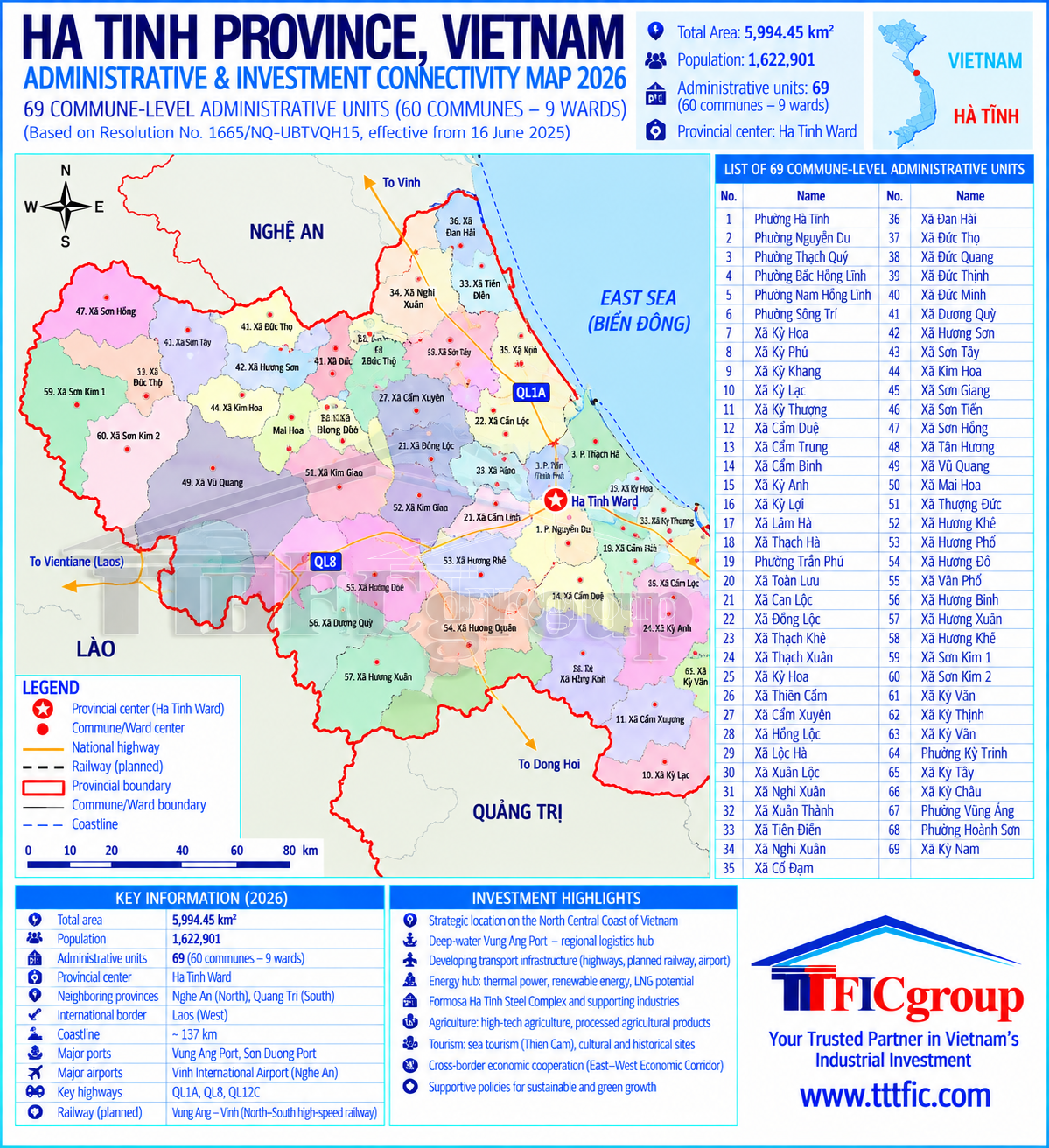
Ha Tinh occupies a narrow but highly strategic strip of North Central Vietnam.
It borders:
Nghe An Province
to the north;
Quang Tri Province
to the south;
Laos
to the west;
and:
the East Sea
to the east.
This creates a complete west–east investment geography.
From the Lao border:
connects eastward through Ha Tinh toward:
From north to south, the province is integrated into:
National Highway 1
North–South Expressway
North–South Railway
and the broader national economic corridor.
This creates two major investment axes:
and:
Few provinces in North Central Vietnam combine both so clearly.
Ha Tinh recorded strong economic performance in 2025.
Official year-end reporting estimated:
ranking:
and:
Current-price GRDP reached approximately:
The 2025 economic structure was approximately:
Agriculture, forestry & fisheries: 13.38%
Industry & construction: 40.41%
of which industry alone accounted for:
30.74%
Services: 37.37%
and:
Product taxes less subsidies: 8.84%.
This structure confirms Ha Tinh’s industrial identity.
But it also demonstrates that services and logistics are becoming increasingly important alongside industrial production.
Total realized social investment in 2025 reached approximately:
up around:
The most significant change was the surge in private-sector investment.
Domestic non-state investment reached approximately:
and increased sharply because of major industrial projects including VinFast.
FDI-sector realized investment reached approximately:
representing approximately:
The apparent decline in FDI investment implementation from the prior year was largely related to major projects such as Vung Ang II moving from intensive construction toward completion.
This distinction is important.
does not necessarily mean:
It can indicate that major FDI assets are transitioning from construction into operation.
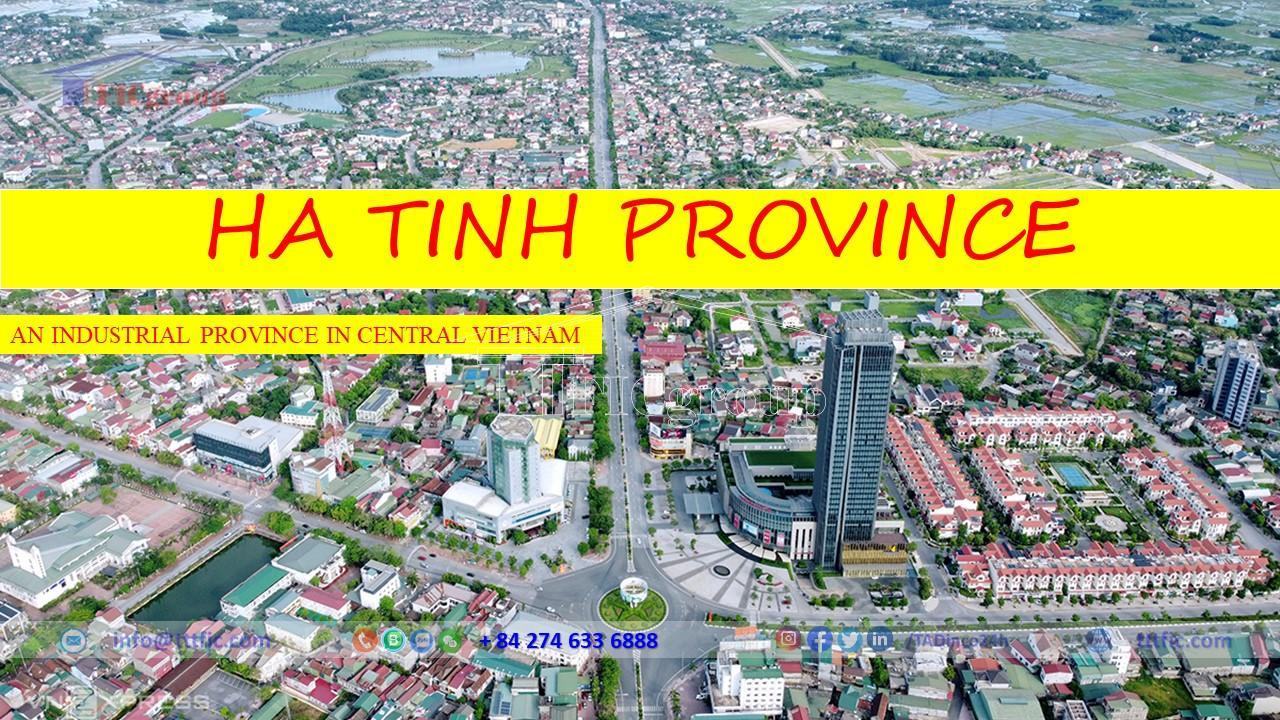
Vung Ang Economic Zone is the central industrial and logistics engine of Ha Tinh.
Its strategic advantages include:
deep-water port access
large industrial land areas
steel production
power generation
electric-vehicle manufacturing
battery manufacturing
energy infrastructure
and:
direct access to major national transport corridors.
The zone increasingly functions as an integrated industrial ecosystem rather than a collection of unrelated factories.
Its emerging structure can be viewed as:
→ STEEL
→ ENERGY
→ EV
→ BATTERIES
→ SUPPLIERS
→ LOGISTICS.
This is one of the strongest heavy-industry value-chain configurations in Central Vietnam.
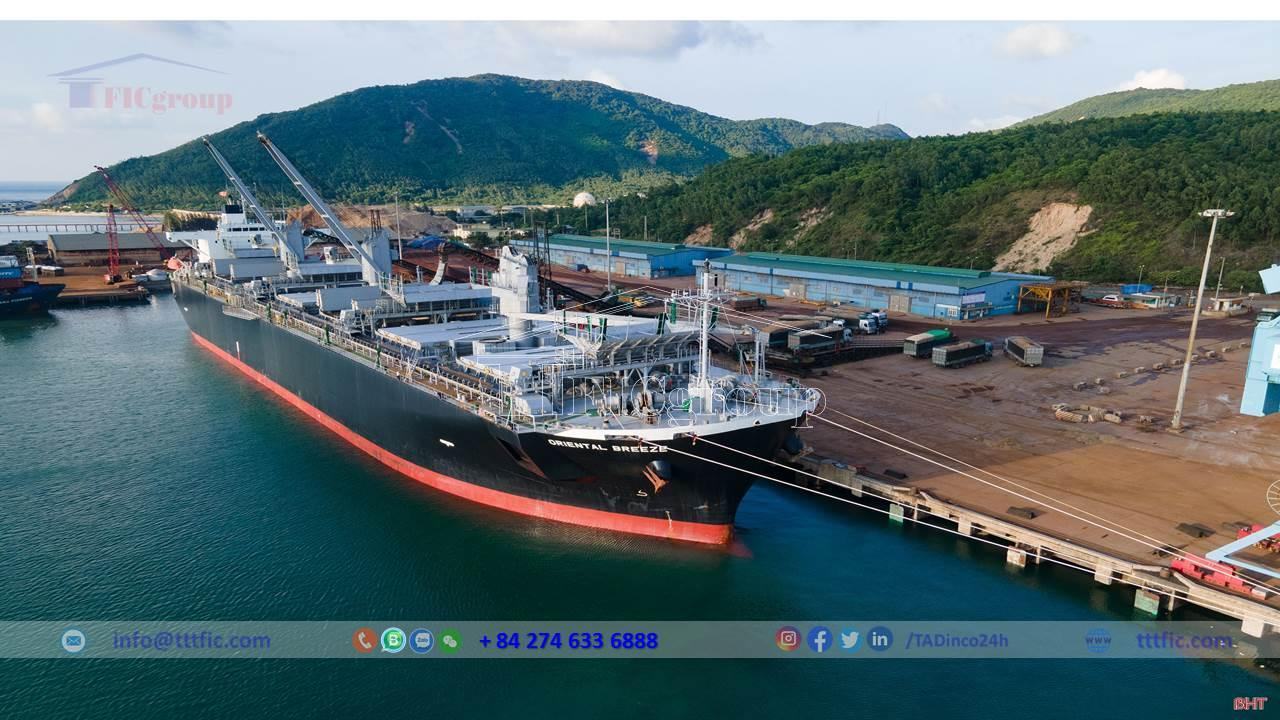
The Formosa Ha Tinh Steel complex remains the largest industrial anchor in the province.
The integrated steel and Son Duong port project was licensed in 2008 and began production in 2015.
By May 2025, cumulative production since operations began had reached approximately:
42.403 million tons of steel billet
31.711 million tons of steel products
21.092 million tons of coke
and approximately:
29.66 million MWh of electricity.
The project directly and indirectly supported more than:
at Formosa and related contractors.
Cumulative revenue had reached approximately:
while total cumulative import-export turnover reached approximately:
This demonstrates the scale of Vung Ang’s industrial economy.
Formosa is not merely a steel factory.
It anchors demand for:
raw materials
industrial maintenance
marine logistics
engineering
energy
industrial gases
mechanical services
and:
supporting industries.
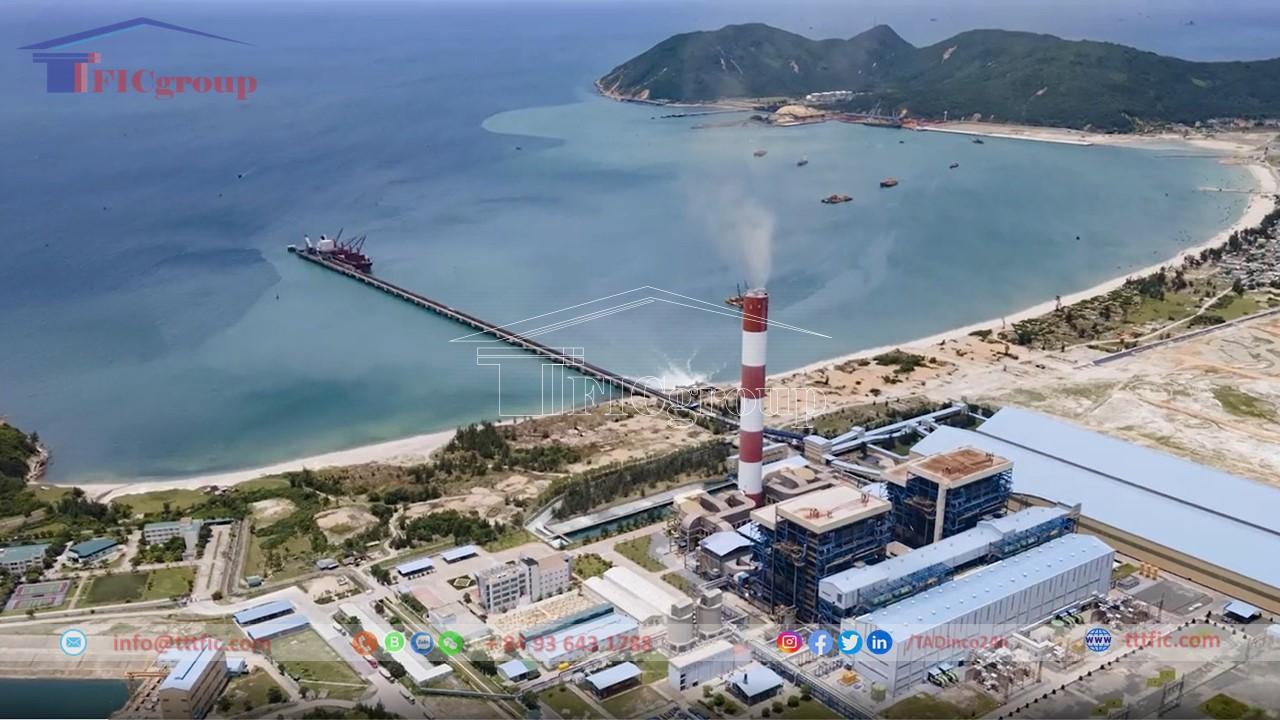
Son Duong is a critical component of the Formosa industrial ecosystem.
In the first 11 months of 2025 alone, the port handled:
and approximately:
This is actual operating cargo throughput—not planned capacity.
It demonstrates that Ha Tinh already possesses genuine large-scale maritime logistics activity.
The cargo system currently serves primarily:
steelmaking inputs
industrial materials
exports
and:
Formosa-related trade.
The longer-term opportunity is to broaden port use beyond captive industrial cargo.
The broader Ha Tinh port system currently includes:
Five are located in the Vung Ang–Son Duong area, including:
Vung Ang Port
Vung Ang LPG berth
Vung Ang I power-plant port
Vung Ang II power-plant port
and:
Son Duong Port.
Two additional operating facilities are located in the Nghi Xuan area.
Vung Ang increasingly handles cargo not only from Ha Tinh but also from:
Cargo such as:
potash
iron ore
wood products
and other commodities from Laos are already moving through the port system.
This supports the development of:
VUNG ANG AS A MARITIME GATEWAY FOR LANDLOCKED LAOS.
In late 2025, Ha Tinh approved investment policy for a new:
SON DUONG INTERNATIONAL PORT PROJECT
with estimated investment of approximately:
The project covers approximately:
including port land, marine area and connecting infrastructure.
Provincial port planning targets:
This represents significant logistics-growth potential.
However, TTTFIC maintains strict status control:
while:
These should never be presented as the same operational capacity.
One of the most important developments in Ha Tinh’s industrial profile is the arrival of:
VINFAST ELECTRIC-VEHICLE MANUFACTURING.
The VinFast Ha Tinh factory was completed after approximately seven months of construction and officially entered operation in 2025.
The project covers more than:
with investment around:
under the factory-development configuration publicly announced at completion.
Phase I has designed capacity of approximately:
with the possibility of future expansion to:
The factory focuses initially on vehicles including:
VF 3
and:
VF 5.
The first commercial VF 3 vehicles were produced in August 2025.
This is strategically significant.
Ha Tinh is no longer only:
It is becoming:
VinFast’s presence becomes more important because battery production also exists inside the Vung Ang ecosystem.
The province’s 2025 economic reporting confirms that battery-cell and battery-pack production was operating and contributing to industrial growth.
This creates a potential future supply-chain cluster involving:
battery systems
electrical components
plastic parts
metal stamping
electronics
charging-related equipment
vehicle interiors
packaging
industrial automation
and:
logistics.
For supporting-industry investors, this may become one of Ha Tinh’s strongest medium-term opportunities.
Ha Tinh’s EV ecosystem expanded further in 2026.
On February 28, 2026, authorities issued an Investment Registration Certificate for a new:
VINFAST ELECTRIC MOTORCYCLE FACTORY.
The project is located within the Vinhomes industrial area of Vung Ang Economic Zone and covers approximately:
This confirms that VinFast’s Ha Tinh strategy is developing beyond a single car plant.
It points toward a broader electric-mobility manufacturing ecosystem.
The old TTTFIC profile described Vung Ang II as a major BOT project under construction.
That status is now obsolete.
The plant has total capacity of approximately:
across:
Unit 1 entered commercial operation on:
Unit 2 entered commercial operation on:
With Unit 2 online, the entire Vung Ang II plant is now in commercial operation.
This is precisely the type of status change TTMS™ requires us to update.
UNDER CONSTRUCTION.
OPERATING POWER PLANT.
When fully operating, the plant is expected to contribute approximately:
to Vietnam’s national grid.
Ha Tinh’s energy base includes:
Vung Ang I
Vung Ang II
Formosa captive energy infrastructure
national 500-kV transmission infrastructure
and other regional energy systems.
This creates significant industrial capacity.
However:
does not automatically equal:
Investors must verify:
substation capacity
connection location
voltage level
redundancy
actual industrial-park allocation
and:
future load demand.
This is especially important for:
data centers
battery plants
metal processing
chemicals
and other energy-intensive users.
Cau Treo International Border Gate connects Ha Tinh directly with:
Bolikhamxay Province, Laos
and through the Lao road network toward:
Northeast Thailand.
The border area forms a second major investment pillar outside Vung Ang.
In 2025, Cau Treo recorded:
and:
Import-export turnover reached approximately:
representing growth of:
Customs declarations increased by approximately:
These are significant improvements.
However, official authorities also acknowledge that Cau Treo trade volume remains below other major central border gates such as Cha Lo and Lao Bao.
This is an important example of balanced investment intelligence.
The strategic logistics model is:
LAOS
→ CAU TREO
→ HA TINH
→ VUNG ANG
→ EAST SEA.
Potentially, the same corridor can extend toward:
Ha Tinh is therefore pursuing a broader logistics role rather than treating Vung Ang purely as a provincial port.
The province’s 2026–2035 logistics strategy includes objectives to:
increase container shipping through Vung Ang and Son Duong
attract cargo from Laos and Thailand
and:
develop the port system as a regional logistics hub.
This is strategically important.
But TTTFIC distinguishes:
from:
The opportunity is credible, but not yet fully mature.
The North–South Expressway has materially improved Ha Tinh’s national road connectivity.
The province now benefits from high-capacity access toward:
Nghe An
Hanoi
Quang Tri
Hue
and onward through Vietnam’s expanding expressway network.
This significantly improves the investment proposition of Vung Ang and inland industrial locations.
The benefit is especially relevant for:
time-sensitive cargo
supporting industries
automotive suppliers
industrial services
and:
labor mobility.
The combination:
is substantially stronger than any one asset independently.
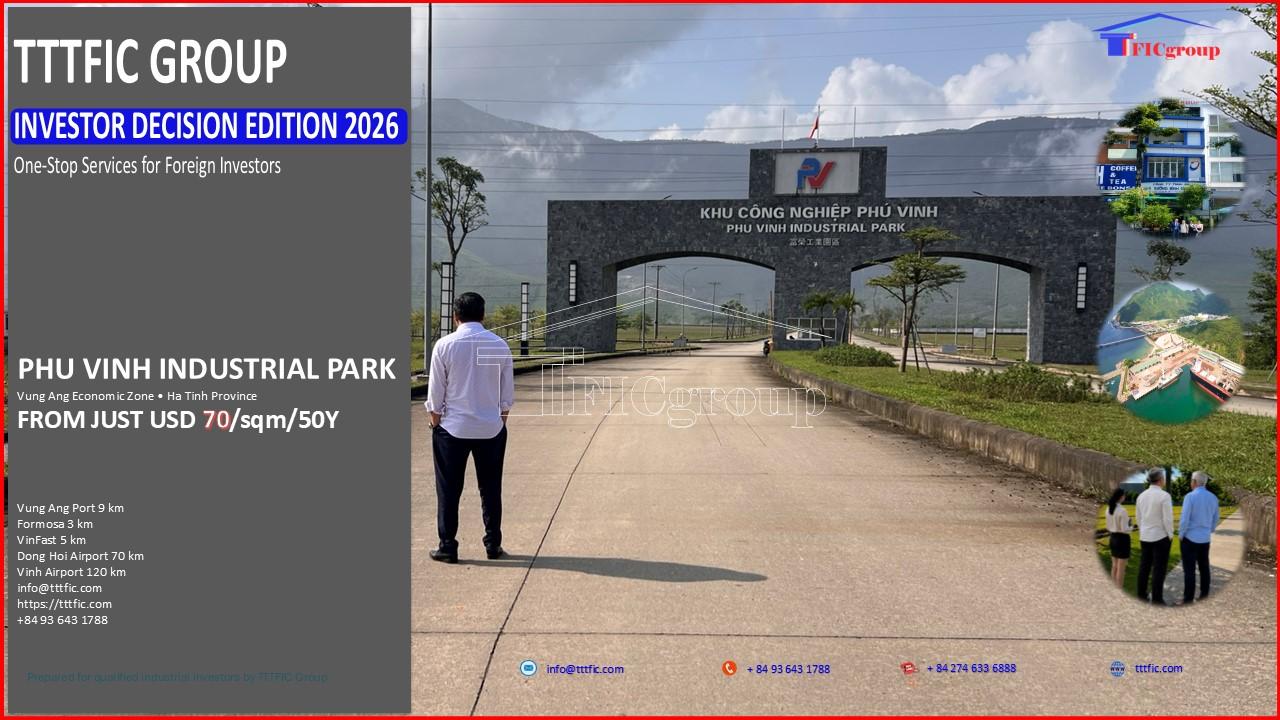
Ha Tinh’s industrial geography extends beyond Vung Ang.
Important industrial and economic-zone assets include:
plus multiple industrial parks and industrial clusters across the province.
The old TTTFIC article correctly identified the importance of these zones, but its project counts and occupancy figures are now historical and should not be reused as current statistics without verification.
For international investors, the more important question is:
Site selection should assess:
port distance
expressway access
industry acceptance
environmental requirements
power
water
workforce
land availability
and:
supplier proximity.
Ha Tinh remains strongly export-oriented.
Total export value in 2025 was approximately:
This represented a decline from 2024, largely because of weaker global steel demand.
Steel and steel billet remained dominant.
For December 2025 alone, steel-related products accounted for approximately:
This reveals both strength and risk.
Ha Tinh possesses industrial-export scale.
Exports remain highly concentrated in steel.
Diversification into:
automotive
EV components
batteries
textiles
agro-forestry products
and other manufacturing can reduce this concentration over time.
Ha Tinh is primarily an industrial investment destination, but tourism remains economically relevant.
In 2025, the province received approximately:
Total overnight visitors reached approximately:
including:
Major tourism assets include:
Thien Cam
Ke Go
Vu Quang
Nghi Xuan
Nguyen Du heritage
Dong Loc
coastal tourism
and spiritual and ecological destinations.
Tourism should therefore remain a secondary but meaningful diversification pillar.
It should not displace the primary Ha Tinh thesis:
Ha Tinh also possesses agricultural, forest and marine resources.
Potential investment areas include:
timber processing
wood products
tea
fruit
livestock
seafood
aquaculture
food processing
and:
marine services.
The province’s long-term 2030 policy seeks to maintain forest cover above:
For TTTFIC, agro-forestry investment should follow the same value-creation principle used across the national Profile system:
→ PROCESSING
→ CERTIFICATION
→ BRANDING
→ EXPORT.
TTTFIC identifies the following opportunity clusters as particularly relevant to Ha Tinh.
Components, electronics, stamping, plastics, interiors, charging equipment and supporting manufacturing.
Battery components, packaging, electrical systems, industrial equipment and recycling-related opportunities where legally appropriate.
Steel fabrication, components, mechanical engineering and value-added metal products.
Warehousing, container handling, freight forwarding and maritime services.
Cross-border trade, trucking, warehouses and regional distribution.
Maintenance, engineering, automation, industrial gases and technical services.
Power-plant services, electrical engineering and industrial utilities.
Land, factories, warehouses and built-to-suit facilities within suitable zones.
Wood, tea, agricultural products and export-oriented processing.
Selective coastal, cultural and ecological investment.
Ha Tinh is an excellent case for TTMS™-style investment-status control because it combines mature assets with major projects still in development.
Formosa Steel
Son Duong Formosa Port
Vung Ang Port
VinFast automobile production
battery production
Vung Ang I
Vung Ang II
Cau Treo International Border Gate
North–South Expressway.
VinFast Ha Tinh
Vung Ang II full two-unit operation.
These require monitoring of production ramp-up and ecosystem effects.
new Son Duong International Port project
new EV-related industrial expansions
future logistics facilities.
Vung Ang regional logistics hub
higher Laos–Thailand cargo flows
potential free-trade-zone development.
Only when:
land
legal status
utilities
environmental acceptance
transport
commercial demand
and:
execution conditions
are confirmed.
This prevents promotional ambition from being confused with bankable reality.
Steel remains a dominant contributor to industrial production and exports.
Global steel cycles can materially affect provincial performance.
Heavy industry, steel, power and ports require strong environmental compliance and monitoring.
The supplier ecosystem is improving but remains less dense than Hai Phong, Bac Ninh or Dong Nai.
Rapid expansion of EV and industrial manufacturing may increase competition for skilled workers.
Large cargo throughput at Son Duong remains strongly connected to Formosa’s captive supply chain.
Cau Treo is growing quickly, but freight volume remains below some competing border corridors.
Approved port expansions or logistics plans should not be treated as operating capacity until delivered.
Ha Tinh is exposed to:
typhoons
flooding
heavy rainfall
heat
and coastal weather risks.
Traditional thermal-power assets may face longer-term policy, financing and carbon-related pressures.
These risks should be incorporated into location and project design from the beginning.
Existing large-scale maritime activity is already proven by nearly 23 million tons handled through Son Duong in the first 11 months of 2025.
Formosa provides one of Vietnam’s largest integrated steel-industrial anchors.
VinFast Ha Tinh is operational and producing commercial electric vehicles.
Battery production strengthens the province’s emerging EV supply chain.
Vung Ang II’s full 1,200-MW capacity entered commercial operation by April 2026.
Cau Treo provides international land connectivity.
2025 cross-border turnover reached approximately USD 480.15 million, up 43.65%.
Ha Tinh is increasingly integrated into Vietnam’s national high-capacity road network.
GRDP grew approximately 8.78% in 2025.
The economy is moving from a steel-centered structure toward:
steel + EV + batteries + power + logistics + supporting industries.
For many years, the Ha Tinh investment story could be summarized as:
That is no longer sufficient.
The new industrial chain is becoming:
STEEL
→ AUTOMOTIVE
→ BATTERIES
→ POWER
→ SUPPLIERS
→ PORT
→ GLOBAL MARKET.
At the same time, the regional logistics chain can become:
LAOS
→ CAU TREO
→ HA TINH
→ VUNG ANG
→ EAST SEA.
These two systems intersect in one province.
That is the strategic advantage.
A steel processor benefits from proximity to steel production.
An EV supplier benefits from proximity to vehicle manufacturing.
A battery supplier follows the battery ecosystem.
A logistics company benefits from deep-water infrastructure.
A Laos-facing distributor benefits from Cau Treo.
The strongest Ha Tinh investment therefore follows:
rather than speculative industrial land alone.
This is why TTTFIC views Ha Tinh as one of Central Vietnam’s most credible locations for the next generation of:
TTTFIC Group supports investors evaluating Ha Tinh through a structured, risk-controlled process.
Province, economic zone, industrial park and site comparison.
Industrial land, factories, warehouses and built-to-suit solutions.
Evaluation of port proximity, utilities, supplier access and industrial suitability.
Support for suppliers evaluating proximity to VinFast and battery manufacturing.
Vung Ang, Son Duong and regional freight connectivity.
Assessment of Cau Treo and cross-border logistics requirements.
IRC, ERC and related procedures.
Planning, infrastructure, land status and project conditions.
Industrial, energy, port and manufacturing compliance support.
Power, water, wastewater and industrial utility analysis.
Land, ready-built factories, warehouses and development solutions.
Commercial negotiation, documentation and transaction-management support.
Purpose-built industrial facility support.
Assistance through establishment, implementation and operations.
Ha Tinh’s investment proposition has evolved significantly.
It is no longer simply:
A STEEL PROVINCE.
It is becoming:
A DEEP-WATER INDUSTRIAL PLATFORM.
Formosa provides:
Vung Ang and Son Duong provide:
Vung Ang I and II provide:
VinFast provides:
Battery production provides:
Cau Treo provides:
The North–South Expressway provides:
Together, they create a powerful industrial equation:
STEEL
The strategic opportunity is not simply to attract more unrelated factories.
It is to deepen the industrial ecosystem around the assets already operating.
The next phase of Ha Tinh should therefore focus on:
If this transition is executed successfully, Ha Tinh can move from being known primarily as the location of one of Vietnam’s largest steel complexes to becoming:
ONE OF CENTRAL VIETNAM’S MOST INTEGRATED INDUSTRIAL, ENERGY & DEEP-WATER LOGISTICS PLATFORMS.
HA TINH, VIETNAM 2026
TTTFIC GROUP
TTTFIC Group supports international manufacturers, industrial developers, automotive suppliers, energy companies, logistics operators and institutional investors evaluating opportunities in Ha Tinh Province and across Vietnam.
Our approach combines:
Explore Vietnam. Compare Locations. Invest with Intelligence.
34 Provinces & Cities. One Updated Investment Intelligence Platform.
———————-
Team Marketing
Email: info@tttfic.com
Phone: +84 93 643 1788
Table of contents