No. N/A
Phuoc Binh Industrial Land For Sale – Dong Nai
- Price: US$170/sqm – One-time payment for the remaining sublease term
- Area: Subject to current plot availability and developer confirmation


| Information | |
|---|---|
Operating time: 2026 - | Total Area: 347 |
Infrastructure investors: Phuoc Binh Investment Co., Ltd. | Price: USD 170/m² – One-time payment for the entire remaining land sublease term |
Building density: 70% | Occupancy: Updating |
Address: Phuoc Thai Commune, Dong Nai City, Vietnam | |
Industrial Land Investment | Long Thanh Airport Corridor | Southern Vietnam
Investment Profile Updated: October 2026
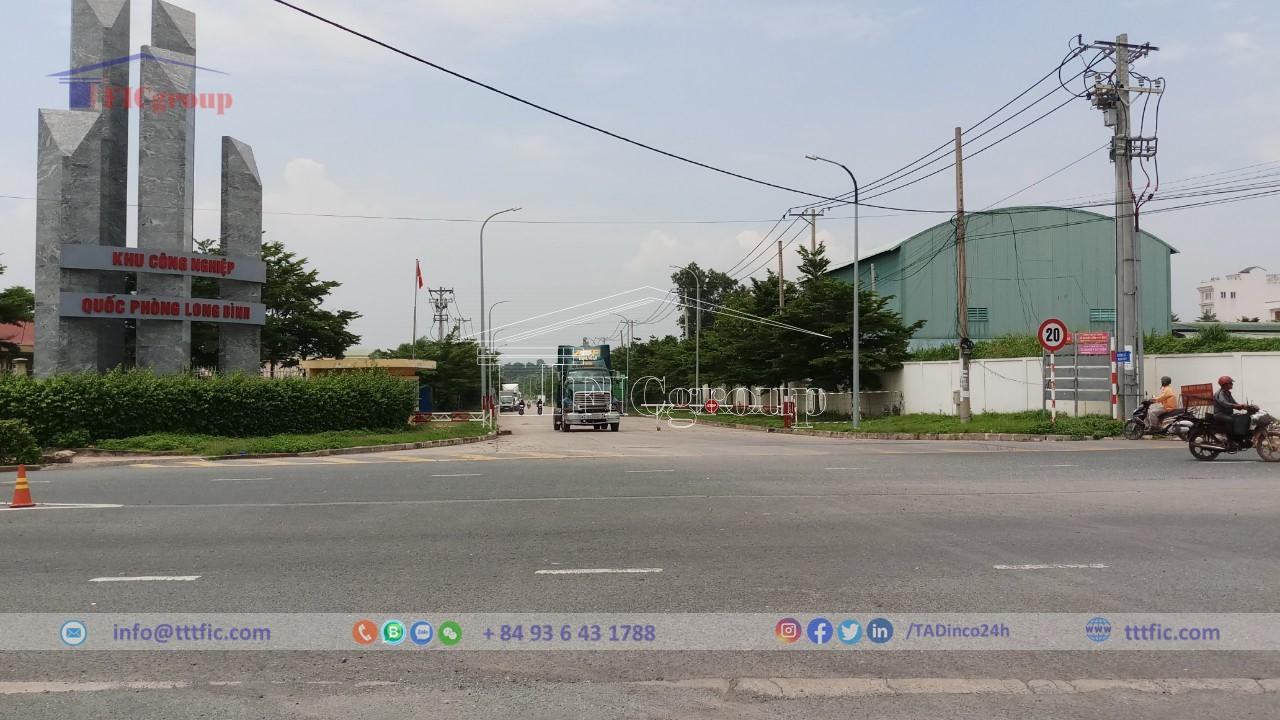
Phuoc Binh Industrial Park is a proposed industrial development in Phuoc Thai Commune, Dong Nai City, Vietnam, positioned within Southern Vietnam’s expanding manufacturing, logistics, and international investment corridor.
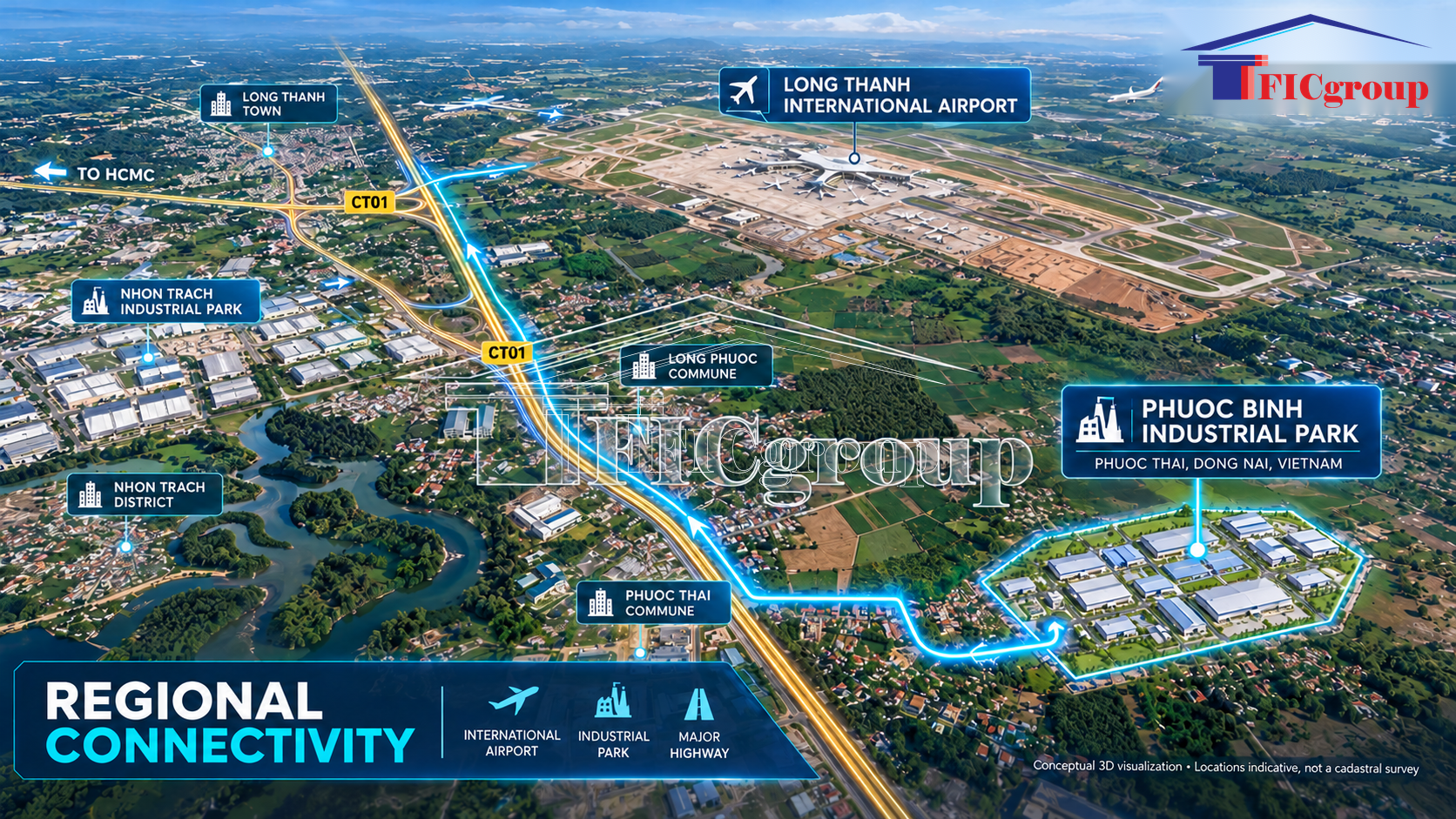
The industrial park is located near Long Thanh International Airport, National Highway 51, Phuoc An Port, and the Cai Mep–Thi Vai deep-water port complex.
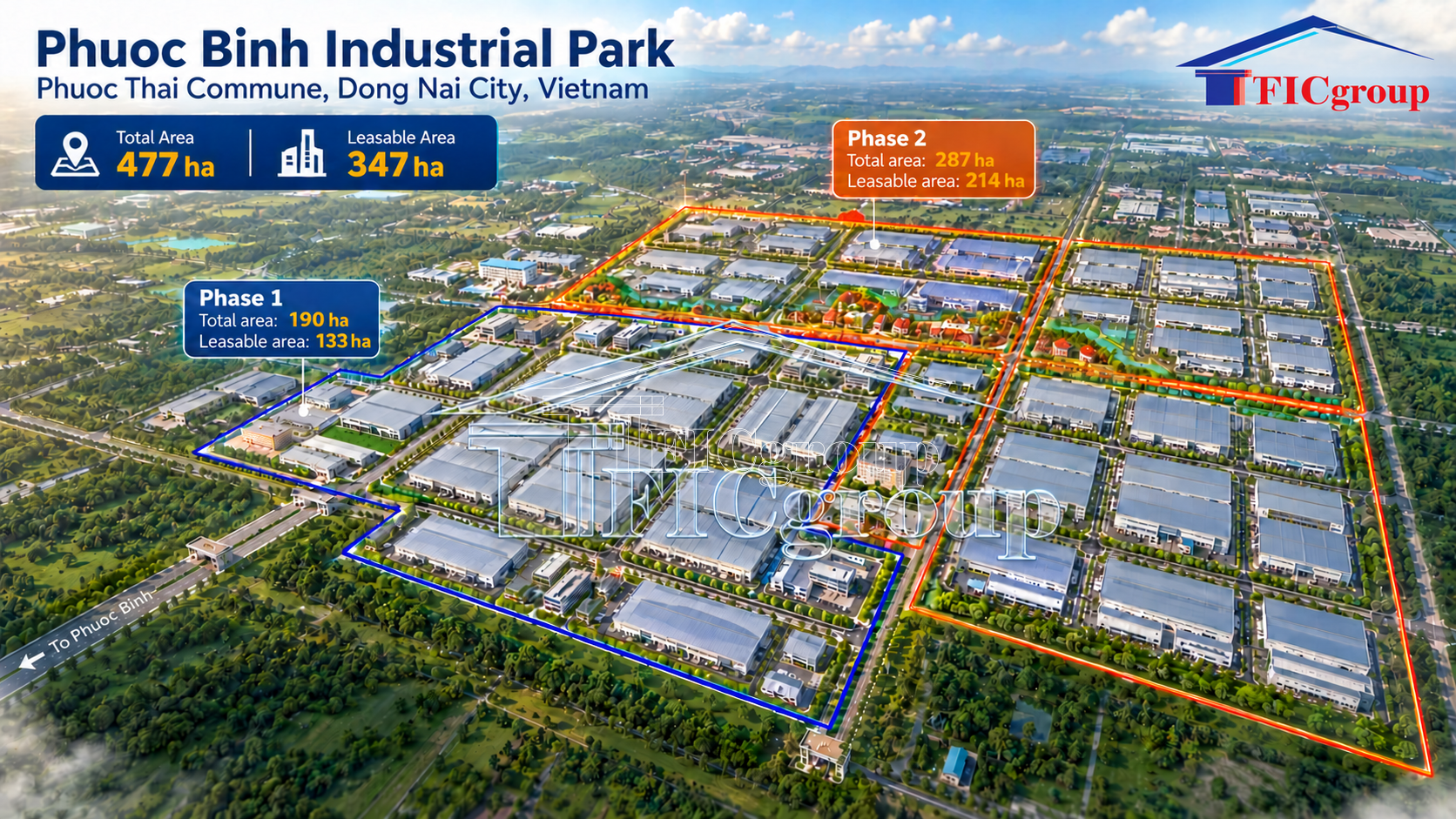
According to the developer’s project brochure, the broader Phuoc Binh development concept comprises two phases totaling approximately 477 hectares, including approximately 347 hectares designated as leasable industrial land.
Separately, an official investment proposal published in June 2026 identifies a 189.99-hectare industrial infrastructure project at Phuoc Binh. The relationship between the broader two-phase development plan and the formally proposed project must be confirmed through the relevant investment and planning documentation.
Developer-Quoted Industrial Land Sublease Price: USD 170/m²
The quoted price is structured as a one-time payment covering the remaining land sublease term. The remaining term, applicable taxes, land availability, infrastructure charges, and payment conditions require project-specific confirmation.
TTTFIC Group provides industrial site-selection advisory, commercial coordination, investment assessment, and transaction support for international manufacturers evaluating Phuoc Binh Industrial Park and other industrial locations throughout Vietnam.
1.1. General Project Information
| Investment Parameter | Project Information |
|---|---|
| Industrial Park | Phuoc Binh Industrial Park |
| Vietnamese Name | Khu Công Nghiệp Phước Bình |
| Current Location | Phuoc Thai Commune, Dong Nai City, Vietnam |
| Regional Location | Southern Key Economic Region |
| Development Concept | Industrial manufacturing, supporting industries, and logistics |
| Developer-Brochure Planning Area | Approximately 477 ha |
| Phase 1 Planning Area | 190 ha |
| Phase 2 Planning Area | 287 ha |
| Total Indicative Leasable Area | 347 ha |
| Officially Published Investment Proposal | 189.99 ha |
| Industrial Land Price Reference | USD 170/m² |
| Payment Method | One-time payment for the remaining sublease term |
| Commercial Reference Date | October 2026 |
1.2. Project Development and Planning
The developer’s brochure presents Phuoc Binh Industrial Park as a two-phase industrial development.
Phase 1
Phase 2
Combined Developer Planning Reference
These figures represent the developer’s broader planning presentation and should not be interpreted as confirmation that the entire area has received investment approval, completed infrastructure development, or become available for immediate sublease.
1.3. Official Investment Proposal – June 2026
According to the information publicly disclosed by the Dong Nai industrial park authority on June 1, 2026, the proposed Phuoc Binh industrial infrastructure investment includes:
| Officially Disclosed Item | Information |
|---|---|
| Project Area | 189.99 ha |
| Proposed Investment Capital | VND 1,501.081 billion |
| Equity Capital | VND 290 billion |
| Mobilized Capital | Approximately VND 1,211.08 billion |
| Proposed Operating Duration | 50 years from the relevant investment approval |
| Planned Construction Commencement | Q4 2026 |
| Infrastructure Completion Schedule | 36 months from the applicable land-allocation, lease, or land-use conversion decision |
The public notice described an investment proposal under review. It does not independently establish that final investment approval, land allocation, infrastructure completion, or commercial land delivery has occurred.
The 50-year period stated in the proposal must not be treated as the confirmed remaining sublease term available to an individual investor.
1.4. Administrative and Legal References
Current Administrative Address:
Phuoc Thai Commune, Dong Nai City, Vietnam.
Historical Administrative Reference:
Phuoc Thai Commune, Long Thanh District, former Dong Nai Province, Vietnam.
Historical legal documents should retain the administrative names applicable when those documents were issued.
1.5. Investment Positioning
Phuoc Binh’s principal investment proposition is its potential integration with the Long Thanh airport corridor, Southern Vietnam’s port network, and the established manufacturing ecosystem of the former Dong Nai and Ba Ria–Vung Tau industrial regions.
The project may be particularly relevant to manufacturers seeking industrial land for medium- and long-term development, subject to legal readiness, infrastructure availability, and industry acceptance.
2.1. Southern Vietnam Industrial Corridor
Phuoc Binh Industrial Park is positioned within the broader Long Thanh industrial development area.
Its regional advantages include access to:
2.2. Developer-Provided Distance References
| Infrastructure / Destination | Indicative Distance |
|---|---|
| Long Thanh International Airport | 20 km |
| Phuoc An Port | 15 km |
| National Highway 51 | 8 km |
| Ben Luc–Long Thanh Expressway | 8 km |
| Ho Chi Minh City–Long Thanh–Dau Giay Expressway | 22 km |
| Cai Mep Port Area | 26 km |
| Cat Lai Port | 44 km |
| Tan Son Nhat International Airport | 58 km |
Source: Phuoc Binh Industrial Park developer brochure.
Distances are preliminary planning references and have not been independently validated as current truck-route distances.
Actual transportation costs and transit times depend on road access, permitted truck routes, congestion, tolls, and the operating status of the relevant infrastructure.
2.3. Long Thanh International Airport
The Long Thanh airport development is a major long-term infrastructure consideration for industrial investment in this corridor.
Potential advantages include:
However, airport proximity does not automatically guarantee access to dedicated air-cargo facilities or reduced logistics costs.
Investors should evaluate the actual availability of cargo services, customs arrangements, transportation routes, and logistics providers.
2.4. Deep-Water Port Connectivity
The Cai Mep–Thi Vai port system is strategically relevant to export-oriented manufacturers.
Potential users include:
For container-intensive projects, TTTFIC recommends obtaining actual trucking quotations rather than relying solely on geographic distance.
2.5. Site-Selection Implications
Phuoc Binh may be suitable for investors prioritizing a combination of airport-region development, access to Southern Vietnam’s seaports, and proximity to established manufacturing supply chains.
A project-specific logistics study should examine inbound raw materials, outbound products, container frequency, transportation restrictions, and expected delivery schedules.
3.1. Infrastructure Development Status
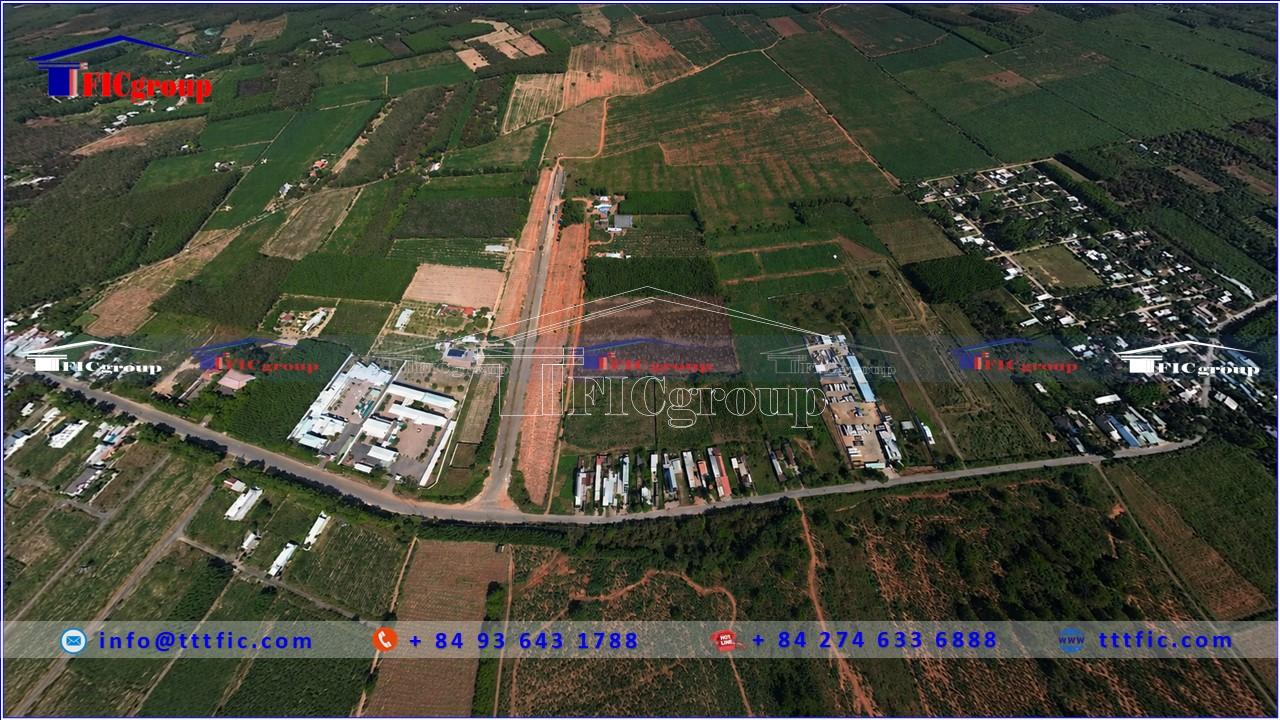
The developer’s brochure identifies Phuoc Binh as a planned industrial development.
Detailed operating specifications for electricity, water supply, wastewater treatment, internal roads, telecommunications, and fire protection have not been established from the available brochure.
Consequently, infrastructure specifications should be treated as matters requiring technical confirmation.
3.2. Internal Transportation Infrastructure
Industrial investors should verify:
For logistics-intensive operations, access for 40-foot containers and heavy vehicles should be evaluated before finalizing a land plot.
3.3. Electricity Infrastructure
The following information should be confirmed with the developer and electricity provider:
| Technical Parameter | Verification Requirement |
|---|---|
| Electricity Supply Source | Pending confirmation |
| Supply Voltage | Pending confirmation |
| Substation Capacity | Pending confirmation |
| Available Power Capacity | Pending confirmation |
| Backup / Redundancy | Pending confirmation |
| Connection Schedule | Pending confirmation |
| Expansion Capacity | Pending confirmation |
Electricity-intensive projects should submit detailed connected-load and operating-demand calculations before selecting a plot.
3.4. Industrial Water Supply
Water availability is especially important for food processing, chemicals, textiles, electronics, and other water-intensive industries.
The developer should confirm:
3.5. Centralized Wastewater Treatment
The availability and design capacity of the centralized wastewater treatment system require confirmation.
Investors should evaluate:
A manufacturing project’s wastewater characteristics must be compatible with the industrial park’s permitted environmental infrastructure.
3.6. Drainage and Flood Management
The drainage system should distinguish stormwater collection from industrial wastewater collection.
Site-specific flood elevation, drainage capacity, and finished-floor elevation requirements should be reviewed during technical due diligence.
3.7. Telecommunications
Fiber-optic connectivity, internet providers, network redundancy, and communications infrastructure should be confirmed before operational planning.
3.8. Fire Prevention and Fighting
Each investor must assess applicable fire protection obligations based on the intended building, manufacturing process, storage materials, and Vietnamese regulations.
The existence of industrial park infrastructure does not eliminate an individual factory’s fire protection responsibilities.
3.9. Supporting Infrastructure
Investors should evaluate access to:
4.1. Industrial Development Orientation
The developer’s brochure identifies supporting industries and logistics among the project’s development orientations.
Potential investment categories for further assessment include:
This is an investment-screening reference, not a confirmed list of officially approved industries.
4.2. Manufacturing Project Acceptance
The acceptance of any industrial project depends on its specific production process.
Relevant information includes:
4.3. Environmentally Sensitive Industries
Projects involving chemical processing, surface treatment, electroplating, dyeing, substantial wastewater generation, hazardous materials, or significant emissions require additional assessment.
Such activities should not be represented as automatically permitted at Phuoc Binh Industrial Park.
4.4. Investor Screening
TTTFIC Group can coordinate preliminary industry acceptance inquiries based on the investor’s manufacturing profile.
Final acceptance remains subject to the developer’s approved industry scope, environmental capacity, and applicable regulatory requirements.
5.1. Vietnam Investment Incentive Framework
Foreign investors evaluating Phuoc Binh Industrial Park should assess applicable investment incentives under Vietnam’s investment, corporate income tax, customs, and related regulations.
Investment incentives are determined by the investor’s specific project rather than automatically granted to every enterprise located inside an industrial park.
5.2. Corporate Income Tax
Vietnam’s corporate income tax framework provides preferential treatment for qualifying investments based on factors such as:
The applicable preferential tax rate, exemption period, and reduction period must be determined using the regulations in force and the investor’s actual project classification.
5.3. Supporting Industry Incentives
Manufacturers producing eligible supporting-industry products may qualify for investment incentives when they satisfy the relevant legal requirements.
Potentially relevant sectors include:
Eligibility depends on the specific product, production process, applicable classification, and supporting documentation.
5.4. High-Technology Investment
Qualifying high-technology enterprises and projects may be eligible for preferential treatment.
However, operating in a modern industrial park does not independently establish high-technology investment status.
5.5. Import Duty Incentives
Eligible investment projects may qualify for import-duty exemptions on certain machinery, equipment, or other qualifying imports, subject to the applicable customs legislation.
Investors should assess these benefits before importing production equipment.
5.6. Land-Related Incentives
Land-related incentives depend on the applicable legal framework and project circumstances.
An investor should not assume that a land-related incentive automatically reduces the commercial sublease price quoted by the industrial park infrastructure developer.
5.7. Foreign Investment Procedures
Depending on the proposed investment structure, investors may need to complete:
5.8. TTTFIC Investment Incentive Assessment
TTTFIC recommends evaluating investment incentives together with:
Investment incentives should be treated as a project-specific financial consideration, not an unconditional industrial park benefit.
6.1. Industrial Land Sublease Price
Developer-Quoted Price – October 2026
USD 170/m²
Payment Structure: One-time payment for the entire remaining industrial land sublease term.
This is a land sublease price, not a freehold land purchase price.
The precise remaining sublease duration must be confirmed against the project’s approved legal term and applicable land documentation.
The quoted price should not be assumed to include VAT, management fees, utilities, construction costs, or other charges unless expressly confirmed.
6.2. Indicative Land Investment by Plot Size
| Industrial Land Area | Indicative Land Sublease Value |
|---|---|
| 5,000 m² | USD 850,000 |
| 10,000 m² | USD 1,700,000 |
| 20,000 m² | USD 3,400,000 |
| 30,000 m² | USD 5,100,000 |
| 50,000 m² | USD 8,500,000 |
| 100,000 m² | USD 17,000,000 |
Calculations use the developer-quoted USD 170/m² rate.
These figures exclude additional costs and do not confirm the availability of any particular plot size.
6.3. Industrial Electricity Costs
Industrial electricity costs in Vietnam depend on the applicable tariff schedule, voltage level, customer classification, and time of consumption.
Under the electricity time-of-use framework effective in 2026, the applicable periods include:
| Electricity Consumption Period | Time |
|---|---|
| Off-Peak | 00:00–06:00 daily |
| Peak – Monday to Saturday | 17:30–22:30 |
| Normal – Monday to Saturday | 06:00–17:30 and 22:30–24:00 |
| Normal – Sunday | 06:00–24:00 |
There is no designated peak period on Sunday under this schedule.
The applicable VND/kWh tariff must be verified for the investor’s electricity supply arrangement and the tariff decision effective when electricity is supplied.
Manufacturers operating multiple shifts should evaluate the financial implications of their actual electricity consumption profile.
6.4. Industrial Water Costs
The current industrial water tariff applicable to Phuoc Binh has not been independently confirmed.
Investors should request:
6.5. Wastewater Treatment Costs
The applicable centralized wastewater treatment fee has not been confirmed.
Wastewater costs should be assessed based on:
For water-intensive manufacturers, wastewater treatment may represent a significant recurring operating expense.
6.6. Industrial Park Management Fees
The developer’s current management fee requires confirmation.
Investors should determine:
6.7. Industrial Operating Cost Reference
| Cost Component | October 2026 Reference |
|---|---|
| Industrial Land Sublease | USD 170/m² |
| Payment Method | One-time |
| Remaining Lease Term | Pending confirmation |
| Electricity | Applicable regulated tariff |
| Industrial Water | Developer / supplier quotation required |
| Wastewater Treatment | Developer quotation required |
| Management Fee | Developer quotation required |
| Infrastructure Connection | Pending confirmation |
| VAT | Subject to applicable tax treatment |
| Construction Cost | Project-specific estimate |
| Fire Protection Systems | Project-specific estimate |
| Environmental Compliance | Project-specific estimate |
6.8. Total Factory Investment Considerations
Industrial land cost is only one component of total project capital expenditure.
A complete factory investment budget may include:
6.9. Ready-Built Factory and Warehouse Options
The availability of ready-built factories or warehouses within Phuoc Binh has not been confirmed.
Investors seeking immediate manufacturing space should evaluate alternative operational industrial parks where necessary.
6.10. Build-to-Suit Opportunities
Build-to-Suit solutions may be considered depending on land availability, development rights, project scale, technical requirements, and commercial feasibility.
TTTFIC Group can assist investors in evaluating custom factory development and long-term occupancy structures.
7.1. Dong Nai City – Post-Reorganization Population
Following the administrative reorganization, Dong Nai City represents a substantially expanded population and industrial labor market.
According to official statistical reporting, the preliminary average population for 2025 was approximately:
4,493,699 PEOPLE
| Population Indicator | Official Statistical Reference |
|---|---|
| Total Population | 4,493,699 |
| Male Population | 2,260,804 |
| Female Population | 2,232,895 |
| Urban Population | 1,827,524 |
| Rural Population | 2,666,175 |
| Population Density | Approximately 354 people/km² |
These figures describe the citywide population and should not be interpreted as the population living within commuting distance of Phuoc Binh Industrial Park.
7.2. Labor Force – First Nine Months of 2026
According to Dong Nai’s official statistical reporting for the first nine months of 2026:
LABOR FORCE AGED 15 AND ABOVE: 2,587,435 PEOPLE
| Labor Market Indicator | Reference |
|---|---|
| Labor Force Aged 15+ | 2,587,435 |
| Urban Labor Force | 1,207,556 |
| Rural Labor Force | 1,379,879 |
| Reported Unemployment Rate | 2.15% |
The labor-force figure represents economically active people aged 15 and above, not the statutory working-age population or the number of workers immediately available for recruitment.
7.3. Working-Age Population and Age Structure
The age composition of the labor market is particularly important for manufacturers planning long-term operations.
Relevant age groups include:
| Age Group | Investment Relevance |
|---|---|
| 15–24 | Young labor market entrants and vocational graduates |
| 25–34 | Early-career production workers, technicians, and professionals |
| 35–44 | Experienced manufacturing workers and supervisors |
| 45–54 | Experienced technical personnel and management |
| 55+ | Senior specialists and other workers, subject to applicable employment conditions |
A verified citywide population distribution for these exact age groups has not been established from the available official data.
Therefore, numerical estimates for individual age groups are intentionally excluded.
7.4. Long Thanh and Nhon Trach Labor Market
Phuoc Binh’s practical recruitment environment should be assessed within the broader Long Thanh–Nhon Trach industrial corridor.
Potential recruitment sources include:
Recruitment feasibility depends on commuting time, wage competitiveness, skills, accommodation, and transportation.
7.5. Labor Availability and Competition
Dong Nai’s large labor force is an important regional advantage.
However, a large population does not guarantee immediate access to skilled workers.
Manufacturers should assess:
7.6. Labor Cost Planning
A realistic labor budget should include:
Current regional minimum wage classifications and market salary references should be confirmed for the actual operating location and job categories.
7.7. Workforce Development
Investors requiring specialized labor should consider cooperation with vocational institutions, technical schools, and universities in the wider region.
For technology-intensive projects, recruitment planning should begin before factory commissioning.
7.8. TTTFIC Labor Market Assessment
Phuoc Binh may benefit from access to Dong Nai’s established manufacturing labor ecosystem.
Nevertheless, the project’s actual recruitment potential must be evaluated through a location-specific workforce assessment rather than citywide population statistics alone.
8.1. Southern Vietnam Manufacturing Ecosystem
Dong Nai is part of one of Vietnam’s most established manufacturing regions.
Its industrial ecosystem includes domestic manufacturers, foreign-invested enterprises, supporting industries, logistics companies, and export-oriented production facilities.
8.2. Long Thanh Airport Economic Corridor
The development of Long Thanh International Airport may strengthen the surrounding area’s long-term economic position.
Potential effects include increased demand for:
The scale and timing of these opportunities depend on actual infrastructure delivery and market demand.
8.3. Port-Oriented Manufacturing
Phuoc Binh’s regional position may be relevant to manufacturers importing raw materials and exporting finished products through Southern Vietnam’s seaport system.
8.4. Supply-Chain Integration
Investors should evaluate the proximity of suppliers, subcontractors, customers, logistics operators, and maintenance providers.
Supply-chain integration can materially affect working capital, inventory requirements, and delivery reliability.
8.5. Long-Term Industrial Development
The broader Phuoc Binh planning concept may offer future development opportunities.
However, future expansion potential must be distinguished from land that has already received the necessary approvals and is available for commercial sublease.
9.1. Principal Investment Advantages
Phuoc Binh Industrial Park offers a potentially attractive combination of:
9.2. Key Investment Considerations
Before making an investment commitment, investors should verify:
9.3. TTTFIC Site-Selection Assessment
Phuoc Binh merits consideration by manufacturers planning medium- to long-term industrial operations in Southern Vietnam.
Its suitability is particularly dependent on the investor’s desired project commencement date.
For investors requiring immediate factory construction or operational occupancy, legal readiness and infrastructure delivery schedules are critical decision factors.
9.4. Investment Conclusion
Phuoc Binh should be evaluated as a developing industrial investment opportunity rather than automatically classified as a fully operational industrial park.
The developer’s commercial quotation provides a useful starting point for investment budgeting, but transaction readiness must be independently established.
10.1. Environmental Compliance
Environmental compliance is a central requirement for industrial development in Vietnam.
Investors should review the industrial park’s applicable environmental approvals and the specific obligations of their proposed manufacturing project.
10.2. Environmental Impact Assessment
The status and scope of the project’s environmental impact assessment and related approvals require confirmation.
10.3. Wastewater Management
The developer should confirm the centralized wastewater treatment system’s approved capacity, treatment technology, discharge standards, and commissioning schedule.
10.4. Industrial Emissions
Each manufacturing project must assess applicable air-emission requirements based on its production processes and equipment.
10.5. Solid and Hazardous Waste
Industrial tenants must establish appropriate arrangements for waste segregation, storage, transportation, and treatment.
10.6. Renewable Energy
Rooftop solar and other renewable-energy solutions may be evaluated subject to technical feasibility, legal requirements, and project-specific conditions.
No existing renewable-energy installation or certification is assumed.
10.7. Green Factory Development
Investors may incorporate:
10.8. ESG Assessment
No independent green industrial park certification has been established from the available project documentation.
ESG claims should be supported by verifiable project-specific evidence.
11.1. Legal Due Diligence
Verify:
11.2. Planning Due Diligence
Confirm:
11.3. Infrastructure Due Diligence
Confirm:
11.4. Environmental Due Diligence
Evaluate:
11.5. Commercial Due Diligence
Review:
11.6. Construction Due Diligence
Assess:
11.7. Labor Due Diligence
Evaluate:
11.8. Transaction Risk Assessment
Before signing an LOI, MOU, deposit agreement, or land sublease agreement, investors should verify the legal and commercial conditions applicable to the specific transaction.
A developer’s marketing brochure or indicative quotation does not replace legal due diligence.
12.1. Industrial Site Selection
TTTFIC Group assists international investors in evaluating industrial locations based on:
12.2. Industrial Land Advisory
Services may include:
12.3. Industrial Real Estate Solutions
TTTFIC Group supports investors evaluating:
12.4. FDI Investment Coordination
Depending on project requirements, TTTFIC can coordinate with qualified professional service providers regarding:
12.5. Factory Development and Implementation
Support may extend to:
12.6. Investor Protection
TTTFIC emphasizes transparent commercial communication, project-specific verification, and structured transaction coordination.
Investors should independently verify all material legal, technical, environmental, and financial conditions before committing funds.
12.7. Contact TTTFIC Group
Industrial Land | Ready-Built Factories | Warehouses | Build-to-Suit | FDI Site Selection
Vietnam Nationwide + Thailand
Tel / WhatsApp: +84 936 431 788
Email: marketing@tttfic.com
Industrial Site Selection → Investment Assessment → Site Survey → Due Diligence → Commercial Negotiation → Factory Implementation
Information Reference: October 2026
Project planning figures originate from the developer’s brochure. Public investment proposal information, population statistics, labor market data, and regulatory references are based on information available as of the stated update date. Commercial conditions and project status remain subject to confirmation.
TTTFIC Group provides industrial investment intelligence, industrial real estate advisory, site selection, factory and warehouse solutions, and business advisory services for foreign investors seeking to establish, expand, relocate, acquire, lease, or invest in manufacturing operations in Vietnam.
Industrial land, ready-built factories, warehouses, industrial parks, economic zones, high-tech parks, export processing zones, and other investment opportunities displayed on TTTFIC.com are provided for preliminary investor reference. Availability, pricing, infrastructure readiness, legal status, investment incentives, industry acceptance, and transaction conditions may change over time and should be independently verified before any investment decision is made.
TTMS™ Investment Status Control
Under the TTTFIC Transaction Management Standard – TTMS™, investment opportunities are evaluated according to their actual development and transaction status. TTTFIC Group distinguishes between Planned, Approved, Under Development, Infrastructure-Ready, Operating, and Currently Available opportunities. The appearance of an industrial park, industrial property, project, or investment location on this website does not automatically mean that land, factories, warehouses, licenses, utilities, or investment capacity are currently available.
Before recommending an opportunity for an investor’s shortlist, site visit, negotiation, or transaction, TTTFIC Group may conduct updated verification covering industrial land and factory availability, developer or asset-owner confirmation, pricing and commercial terms, land-use and project legal status, industry and zoning compatibility, IRC/ERC requirements, environmental compliance, fire prevention and fighting requirements, infrastructure and utility readiness, logistics connectivity, investment incentives, transaction conditions, and counterparty due diligence.
Industrial Investment Services for Foreign Investors in Vietnam
TTTFIC Group supports qualified foreign investors throughout the investment lifecycle, including Vietnam market entry, industrial site selection, industrial park comparison, industrial land acquisition and leasing, ready-built factory and warehouse leasing, built-to-suit factory solutions, factory acquisition and M&A, investment due diligence, transaction negotiation, IRC and ERC procedures, environmental and fire-safety compliance, legal coordination, construction support, and post-investment implementation.
Our controlled investment advisory process follows a structured decision pathway:
INVESTOR REQUEST → REQUIREMENT ANALYSIS → MARKET SCREENING → VERIFICATION → SHORTLIST → DUE DILIGENCE → SITE VISIT → NEGOTIATION → TRANSACTION → IMPLEMENTATION
This process is designed to help investors move beyond basic property listings and evaluate industrial investment opportunities based on verified commercial, legal, technical, infrastructure, location, and transaction considerations.
Verify Before You Invest
Industrial real estate conditions in Vietnam can change rapidly. Industrial land may become reserved or unavailable, factory inventory may be leased or sold, infrastructure schedules may change, and certain industries may require additional environmental, technical, zoning, or regulatory approvals. Investors should therefore request an updated verification from TTTFIC Group before relying on historical availability, pricing, project status, or other information published on the website.
TTTFIC Group | Your Trusted Partner in Vietnam’s Industrial Investment
Investor Advisory: +84 274 633 6888
Factory for Sale: +84 93 643 1788
Factory for Lease: +84 916 97 4488
Industrial Land: +84 973 108 629
Email: info@tttfic.com | marketing@tttfic.com
Head Office: No. 290 Dong Khoi Street, Binh Duong Ward, Ho Chi Minh City, Vietnam.
Table of contents
0 customer reviews
1
0%0 review
2
0%0 review
3
0%0 review
4
0%0 review
5
0%0 review
There are no reviews yet
No. N/A

No. LAND-14936

No. N/A

No. LAND-17518