O Mon Industrial Zone - Can Tho
- Investor: Hiep Hoa Phat Corporation
- Price: 0 USD/m2
- Area: 0 Ha
CAN THO CITY, VIETNAM 2026
The Mekong Delta’s Integrated Industrial, Agro-Processing, Logistics & Maritime Growth Hub
TTTFIC GLOBAL INVESTMENT PROFILE 2026
Can Tho City, Vietnam 2026 is evolving into an integrated Mekong Delta investment hub combining industrial parks, agro-processing, aquaculture, human capital, Can Tho International Airport, inland waterways, logistics, energy and direct access to the East Sea. This profile reviews the city’s post-merger industrial geography, transport network, processing economy and long-term maritime investment potential.
URBAN CENTER + INDUSTRY + AGRICULTURE + AQUACULTURE + FOOD PROCESSING + HUMAN CAPITAL + INTERNATIONAL AIRPORT + MEKONG WATERWAYS + COAST + LOGISTICS + ENERGY + FUTURE MARITIME GATEWAY
“Can Tho — white rice and clear waters,
a place those who visit find difficult to leave.”
For generations, the Vietnamese folk verse “Can Tho gao trang nuoc trong – Ai di den do long khong muon ve” has captured the fertility, waterways, abundance and human appeal of Can Tho.
In 2026, that traditional image has acquired an entirely new economic meaning.
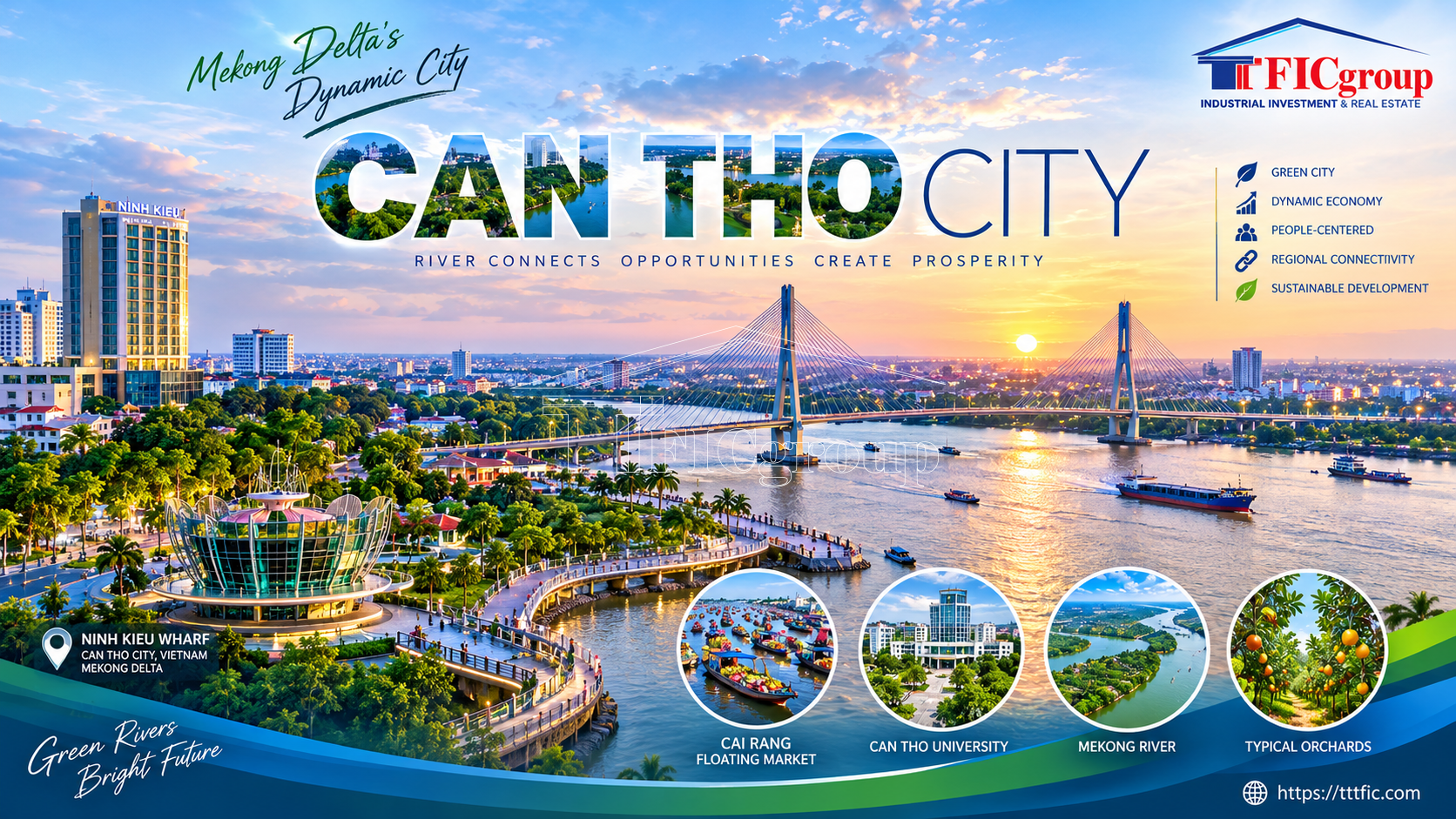
Following the historic merger of former Can Tho City, former Hau Giang Province and former Soc Trang Province, the new Can Tho is no longer simply the urban and commercial center of the Mekong Delta.
It is now a much larger integrated economic platform combining a centrally governed city, a population of more than 4.19 million, major agricultural and aquaculture production areas, industrial land, Can Tho International Airport, the Hau River and extensive inland waterways, direct access to the East Sea, and the future development of Tran De as a major maritime gateway.
Former Can Tho contributed the Mekong Delta’s principal urban, education, healthcare, financial, aviation, research and service center.
Former Hau Giang contributed industrial land, agriculture, agro-processing, energy infrastructure and additional development space.
Former Soc Trang contributed the coastline, fisheries, aquaculture, renewable-energy potential and Tran De’s strategic maritime position.
Together, they create something substantially more important than the sum of three former administrative territories:
ONE CITY – ONE RIVER-TO-SEA ECONOMY – ONE INTEGRATED MEKONG DELTA INVESTMENT PLATFORM.
For international investors, the new Can Tho increasingly connects the complete value chain:
RAW MATERIALS → PROCESSING → MANUFACTURING → LOGISTICS → EXPORT.
FARM → FACTORY → PORT.
AQUACULTURE → PROCESSING → COLD CHAIN → GLOBAL MARKET.
UNIVERSITY → HUMAN CAPITAL → TECHNOLOGY → INDUSTRY.
MEKONG WATERWAYS → HAU RIVER → EAST SEA.
This is the new investment identity of Can Tho.

The new Can Tho City was formed in 2025 through the merger of former Can Tho City, former Hau Giang Province and former Soc Trang Province.
The post-merger city has:
Can Tho now borders An Giang, Dong Thap, Vinh Long, Ca Mau and the East Sea.
That final geographic change is strategically important.
CAN THO IS NOW A COASTAL CITY.
Before the merger, Can Tho’s logistics geography was centered primarily on roads, the Hau River, inland ports and Can Tho International Airport.
The merger extends that geography directly to the coast.
Can Tho can therefore develop around four complementary transportation modes:
AIR + ROAD + INLAND WATERWAY + SEA.
This gives the new city the potential to evolve from a regional service center into a much more integrated production, processing, logistics and export platform for the Mekong Delta.
The merger created three complementary economic territories within one centrally governed city.
Urban Center + Services + Education + Healthcare + Airport + Industry + Research + Technology
Industrial Land + Agriculture + Agro-Processing + Energy + Logistics
Coast + Fisheries + Aquaculture + Renewable Energy + Maritime Economy + Tran De
The resulting economic structure can be summarized as:
ONE CITY – THREE COMPLEMENTARY ECONOMIC GEOGRAPHIES – ONE INTEGRATED MEKONG GROWTH PLATFORM.
The strategic significance is not simply administrative scale.
The merger creates the possibility of integrating agricultural production, industrial processing, urban services, universities, logistics infrastructure, energy, ports and export gateways under one city-level development strategy.
The post-merger economy is substantially larger and more diversified than the former Can Tho economy.
In 2025, Can Tho’s Gross Regional Domestic Product (GRDP) reached approximately:
VND 306.17 TRILLION.
Average GRDP growth during 2021–2025 was approximately:
6.86% PER YEAR.
Industrial and construction activity recorded the strongest average growth during the period at approximately:
9.17% PER YEAR,
while services expanded by approximately:
7.89% PER YEAR.
GRDP per capita reached approximately:
VND 94.94 MILLION
in 2025.
The economic structure therefore reflects a city increasingly driven by both industrialization and higher-value services.
For investors, this matters because Can Tho is no longer only a consumer and service market.
It is increasingly becoming a regional production platform.
GRDP SCALE ≠ INDUSTRIAL SCALE
ECONOMIC GROWTH ≠ FDI GROWTH
REGISTERED INVESTMENT ≠ DISBURSED INVESTMENT
Each indicator must be evaluated independently.
The expanded city creates a much larger platform for foreign direct investment.
International investment opportunities now extend across:
Can Tho’s principal FDI advantage is increasingly the combination of industrial locations with access to one of Southeast Asia’s major agricultural and aquaculture production regions.
The city therefore offers international manufacturers the possibility of locating closer to raw materials while retaining access to urban services, universities, logistics infrastructure and an international airport.
The post-merger investment proposition is:
PRODUCTION + PROCESSING + LOGISTICS + EXPORT.
FDI PROJECT COUNT ≠ FDI CAPITAL
REGISTERED FDI ≠ DISBURSED FDI
INVESTOR INTEREST ≠ MOU
MOU ≠ APPROVED PROJECT
TTTFIC evaluates investment activity according to project status, implementation and actual operating capacity rather than announcement value alone.
Following the merger, Can Tho inherited the industrial systems of all three former jurisdictions.
This creates a substantially broader network of Industrial Parks (IPs) than the former Can Tho City possessed.
The industrial geography now extends from the traditional Can Tho manufacturing areas through former Hau Giang and toward the former Soc Trang coastal corridor.
Important existing and developing industrial locations include:
The city’s development strategy prioritizes modern, green and sustainable industrial development, with particular attention to:
The strategic change is important.
Can Tho’s industrial geography is no longer concentrated primarily around its traditional urban-industrial core.
It now stretches:
FROM INLAND INDUSTRY → TO AGRICULTURAL PROCESSING → TO COASTAL INDUSTRY.
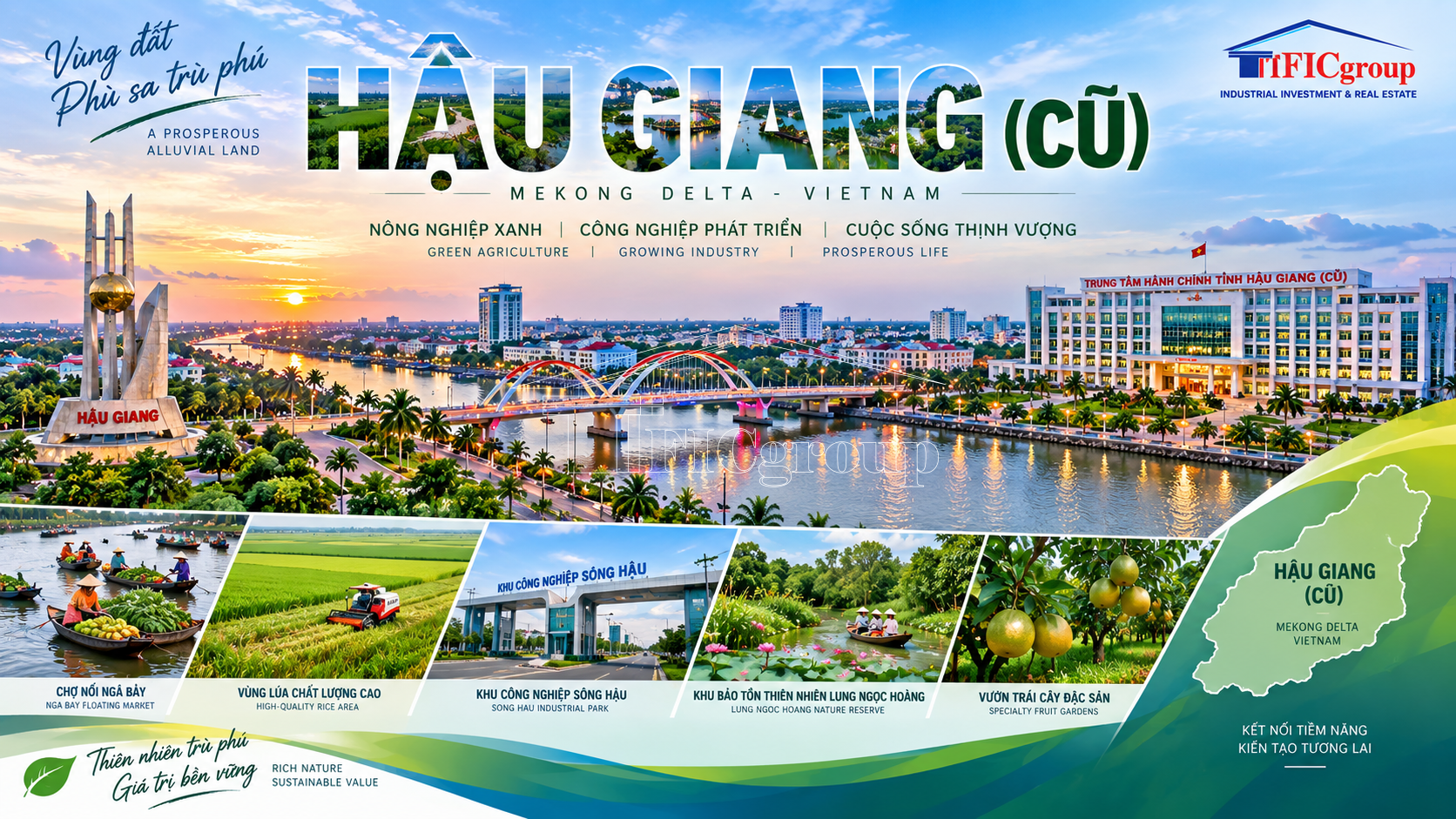
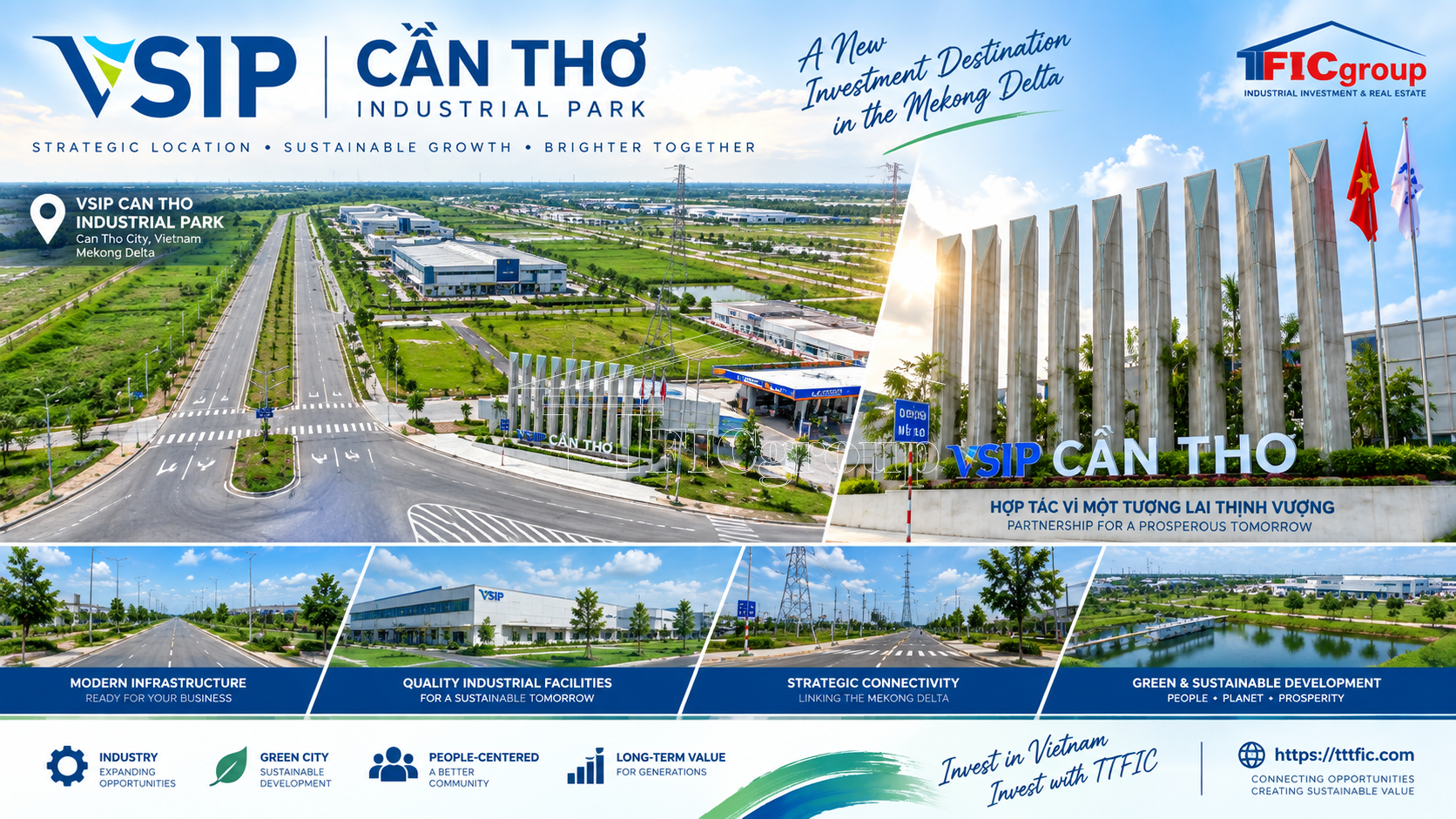
One of the most important new-generation industrial developments in the city is the Vinh Thanh industrial platform associated with VSIP Can Tho.
It represents an important institutional-scale industrial development in the Mekong Delta and signals increasing investor confidence in the region’s manufacturing potential.
Its strategic advantages include:
Potential industries include:
For international investors, the significance extends beyond industrial land.
It provides a recognizable modern industrial-development model in a region where industrial supply has historically been more fragmented than in Vietnam’s major manufacturing centers around Ho Chi Minh City or Hanoi.
MASTER-PLANNED AREA ≠ CURRENTLY AVAILABLE LAND
PROJECT LAUNCH ≠ COMPLETED INFRASTRUCTURE
INDUSTRIAL PARK DEVELOPMENT ≠ SITE-SPECIFIC READINESS
Land availability, infrastructure, utilities, wastewater capacity and commercial terms must be verified at the time of investment.
Industrial Clusters (ICs) form another important layer of Can Tho’s industrial land market.
They can complement larger Industrial Parks by providing suitable locations for:
This model is particularly relevant to the Mekong Delta.
Agricultural and aquaculture production is geographically distributed.
Processing facilities do not always require several hundred hectares of contiguous industrial land.
A distributed network of appropriately planned Industrial Clusters can therefore bring industrial processing closer to raw-material areas and reduce unnecessary logistics movements.
PLANNED IC ≠ ESTABLISHED IC
ESTABLISHED IC ≠ OPERATING IC
LAND AVAILABLE ≠ FDI PROJECT AUTOMATICALLY ACCEPTED
Foreign-invested projects require project-specific verification of investment eligibility, permitted industries, land status, environmental infrastructure, utilities and regulatory approvals.
Agriculture remains one of Can Tho’s most important strategic assets.
The merger integrates major production territories for:
But the international investment opportunity is not simply agricultural production.
The larger opportunity is:
INDUSTRIALIZING AGRICULTURE.
The value chain is:
FARM
↓
STANDARDIZED PRODUCTION
↓
TRACEABILITY
↓
PROCESSING
↓
PACKAGING
↓
COLD STORAGE
↓
LOGISTICS
↓
EXPORT.
This creates opportunities in:
Can Tho can increasingly become the industrial-processing center for agricultural resources produced across the broader Mekong Delta.
The traditional image of Can Tho as a land of “white rice and clear waters” remains economically relevant.
But the investment opportunity has changed.
The future is not simply more rice.
It is:
HIGHER-VALUE RICE.
The transition includes:
This transforms the value chain from:
RICE FIELD → COMMODITY
into:
RICE FIELD → TECHNOLOGY → PROCESSING → BRAND → PORT → GLOBAL MARKET.
This is where the cultural identity introduced at the beginning of the profile becomes part of the investment thesis.
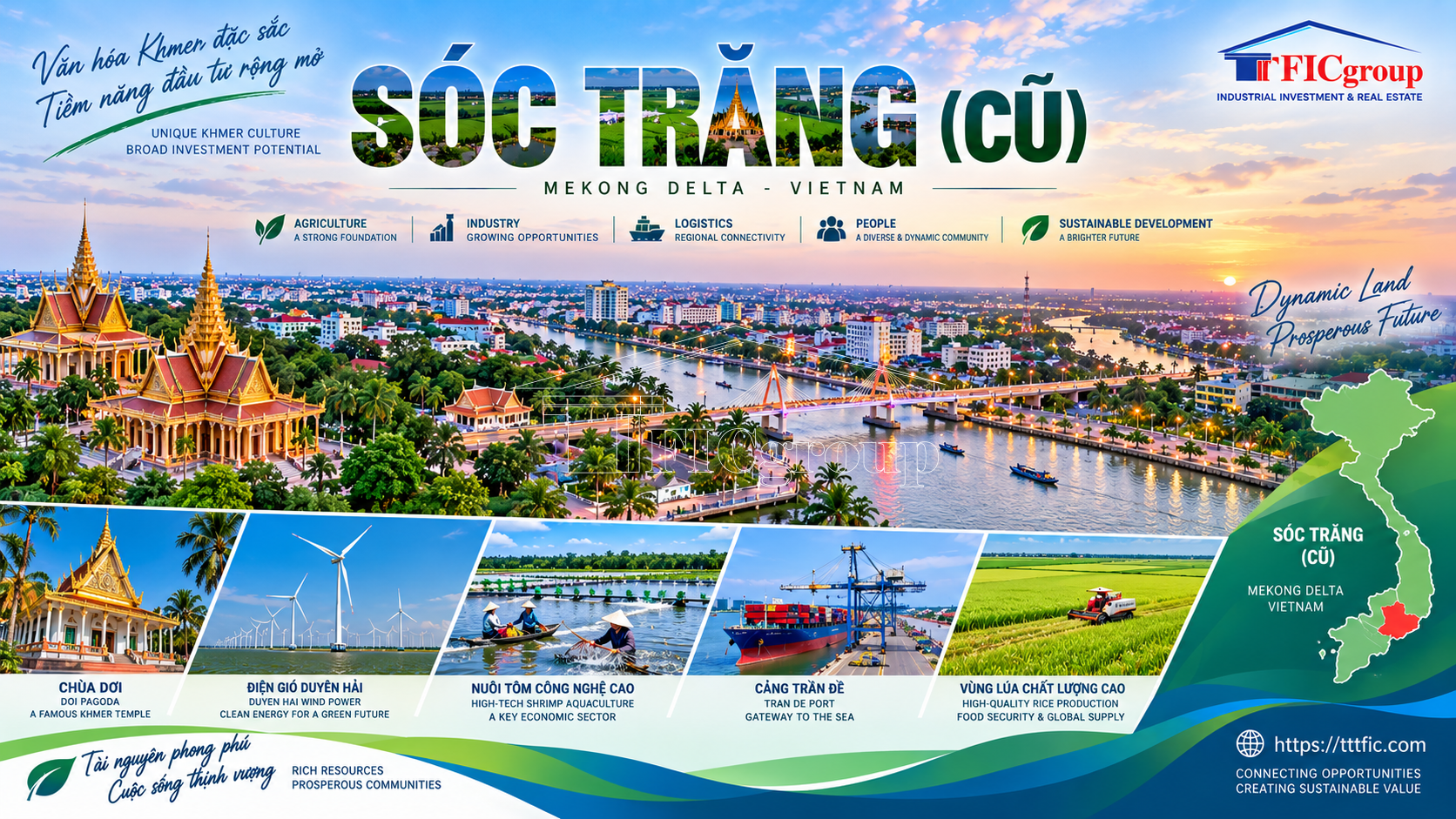
Former Soc Trang contributes one of Vietnam’s important aquaculture and seafood production territories.
Its integration into Can Tho significantly expands the city’s seafood economy.
Investment opportunities include:
The merger allows this coastal production base to connect more directly with:
The integrated value chain becomes:
AQUACULTURE → PROCESSING → COLD CHAIN → LOGISTICS → GLOBAL MARKET.
The Hau River is one of Can Tho’s most important infrastructure assets.
Together with the city’s extensive canal and river network, it supports:
This waterway system gives Can Tho a logistics characteristic fundamentally different from many inland industrial provinces.
Heavy and bulk cargo can potentially use combinations of road and water transport rather than relying exclusively on trucks.
Key river-port infrastructure and cargo facilities form part of a broader logistics system linking industrial production with the Hau River.
Following the merger, this system can increasingly evolve from:
INLAND WATERWAY LOGISTICS
toward:
RIVER-TO-SEA LOGISTICS.
The merger with former Soc Trang gives Can Tho direct access to the East Sea and brings Tran De into the city’s strategic development geography.
Tran De has the potential to become one of the most important components of Can Tho’s long-term investment proposition.
The city’s development direction includes:
The strategic objective is to strengthen the Mekong Delta’s direct connection to international shipping.
If major maritime infrastructure is successfully developed, the supply-chain model could increasingly become:
MEKONG DELTA PRODUCTION
↓
CAN THO PROCESSING
↓
TRAN DE
↓
INTERNATIONAL SHIPPING.
This could materially reduce dependence on longer cargo movements toward ports outside the Mekong Delta.
However:
FUTURE DEEP-WATER MARITIME GATEWAY ≠ CURRENT OPERATING DEEP-SEA PORT
PROPOSED ECONOMIC ZONE ≠ FULLY OPERATING ECONOMIC ZONE
PLANNED CAPACITY ≠ CURRENT CAPACITY
TTTFIC therefore treats Tran De as a major strategic future asset whose legal, investment, construction and operating status must be continuously verified.
Can Tho International Airport provides the city with an infrastructure advantage that many Mekong Delta locations do not possess.
Its strategic functions include:
The city’s development strategy includes further expansion of airport infrastructure and associated services.
For FDI investors, the airport strengthens Can Tho’s ability to serve:
However:
INTERNATIONAL AIRPORT ≠ AUTOMATIC INTERNATIONAL CARGO HUB
Actual cargo competitiveness depends on routes, frequency, handling facilities, customs, airline capacity and cost.
Can Tho is becoming increasingly integrated into the Mekong Delta expressway network.
Strategically important corridors include connections toward:
Of particular strategic importance is the Chau Doc–Can Tho–Soc Trang corridor.
Within the post-merger geography, this creates the potential for an east–west logistics axis:
CAMBODIA-FACING WESTERN MEKONG DELTA
↓
CAN THO
↓
COASTAL CAN THO
↓
TRAN DE
↓
EAST SEA.
This corridor could become increasingly important for manufacturing, agricultural processing, logistics and cross-regional trade.
UNDER CONSTRUCTION ≠ OPERATING
EXPRESSWAY COMPLETION ≠ IMMEDIATE LOGISTICS COMPETITIVENESS
The actual investor benefit depends on completion, interchanges, connecting roads and last-mile infrastructure.
Few locations in the Mekong Delta can combine all four major transport modes within one administrative territory:
ROAD
INLAND WATERWAY
INTERNATIONAL AIRPORT
DIRECT SEA ACCESS.
This is potentially one of the strongest long-term advantages created by the merger.
The logistics model can become:
FACTORY → ROAD / WATERWAY → LOGISTICS CENTER → AIRPORT / PORT → MARKET.
For agriculture:
FARM → COLLECTION → PROCESSING → COLD CHAIN → PORT.
For seafood:
AQUACULTURE → PROCESSING → COLD STORAGE → MARITIME EXPORT.
For manufacturing:
INDUSTRIAL PARK → LOGISTICS → DOMESTIC / INTERNATIONAL MARKET.
Can Tho therefore has the potential to develop into the principal multimodal logistics platform of the Mekong Delta.
The former Hau Giang and former Soc Trang territories contribute important energy infrastructure and renewable-energy potential.
The broader investment landscape includes:
This creates opportunities in:
However:
ENERGY POTENTIAL ≠ APPROVED PROJECT
APPROVED PROJECT ≠ OPERATING CAPACITY
REGIONAL GENERATION ≠ SITE-SPECIFIC INDUSTRIAL POWER AVAILABILITY
Every industrial site must be checked independently for grid capacity, substation access, redundancy and future expansion requirements.
Can Tho possesses one of the Mekong Delta’s strongest education and research ecosystems.
The city is advancing development in:
The development of Can Tho’s proposed High-Tech Park and the expansion of the former Hau Giang digital-technology platform represent important longer-term directions.
Potential applications include:
PROPOSED HIGH-TECH PARK ≠ OPERATING HIGH-TECH PARK
MOU ≠ APPROVED INVESTMENT
TECHNOLOGY STRATEGY ≠ ESTABLISHED TECHNOLOGY CLUSTER
The post-merger city has a population exceeding 4.19 million.
More importantly, Can Tho has long functioned as one of the Mekong Delta’s leading centers for:
This creates an important advantage for international investors.
Manufacturing increasingly requires more than low-cost labor.
Investors need:
Can Tho’s combination of a large regional labor catchment and established education institutions strengthens its potential to support higher-value investment.
LARGE POPULATION ≠ AVAILABLE INDUSTRIAL LABOR
Actual recruitment conditions must be evaluated by location, skill level, wage, shift requirements and commuting radius.
Can Tho is differentiated from many industrial provinces by the strength of its regional service ecosystem.
The city provides:
This matters directly to FDI.
A successful industrial investment requires more than land and a factory.
It also requires an environment supporting:
Can Tho provides one of the Mekong Delta’s most complete urban support ecosystems for these functions.
The real investment value of the merger can be summarized through three economic engines.
CITY + AIRPORT + SERVICES + UNIVERSITIES + INDUSTRY + TECHNOLOGY
AGRICULTURE + INDUSTRIAL LAND + PROCESSING + ENERGY
AQUACULTURE + COAST + MARITIME ECONOMY + TRAN DE
Together:
THREE ECONOMIC TERRITORIES → ONE INTEGRATED VALUE CHAIN.
The combined model is:
AGRICULTURE / AQUACULTURE
↓
PROCESSING
↓
INDUSTRIAL PARKS
↓
LOGISTICS
↓
AIRPORT / WATERWAY / MARITIME GATEWAY
↓
GLOBAL MARKET.
This is the core economic logic of the new Can Tho.
International investors should not evaluate Can Tho as one homogeneous industrial market.
The new city offers several distinct location models.
Suitable for conventional manufacturing and existing industrial ecosystems.
Suitable for larger and more modern manufacturing projects.
Potentially suitable for smaller manufacturing, supporting industries and processing projects.
Closer to agricultural production.
Suitable where waterway logistics materially benefits the project.
Potentially relevant to fisheries, seafood processing, energy and maritime-oriented industries.
The correct site therefore depends on the investor’s operating model.
TTTFIC identifies several major opportunity groups within the new Can Tho.
Rice, fruit, food ingredients, beverages and higher-value agricultural products.
Shrimp, seafood processing, feed, hatcheries, technology and cold chain.
Projects within established and developing Industrial Parks.
Processing, ingredients, packaging, quality control and traceability.
Road, inland waterway, airport and future maritime logistics.
Agricultural, food and seafood supply chains.
Serving the broader Mekong Delta market.
Packaging, mechanical engineering, components and industrial services.
Subject to project-specific planning, licensing and grid conditions.
Agriculture, logistics, healthcare, education and smart-city applications.
Before recommending a location, TTTFIC evaluates:
LAND
LEGAL STATUS
PLANNING
SITE CLEARANCE
FDI ELIGIBILITY
INDUSTRY ELIGIBILITY
POWER
WATER
WASTEWATER
ENVIRONMENT
FIRE SAFETY
LABOR
RAW MATERIALS
ROAD ACCESS
WATERWAY ACCESS
PORT ACCESS
AIRPORT ACCESS
COMMERCIAL TERMS
IMPLEMENTATION TIMELINE.
Can Tho offers substantial investment potential, but the Mekong Delta also presents distinctive execution risks.
Investors must assess:
PLANNED LAND ≠ READY-TO-LEASE LAND.
Major transport projects are improving regional connectivity, but some strategic infrastructure remains under development.
Its long-term strategic potential is significant, but future infrastructure must not be represented as current operating capacity.
Power, water and wastewater capacity must be checked at the specific site.
Food, seafood, manufacturing and energy projects can require substantial environmental infrastructure.
Legacy planning, land and regulatory documents may still refer to former Can Tho, Hau Giang or Soc Trang.
Investors must determine which documents remain effective and which have been replaced, integrated or adjusted under the new city administration.
The new Can Tho combines something unusual within the Mekong Delta:
A CENTRALLY GOVERNED CITY
4.19+ MILLION PEOPLE
INDUSTRIAL PARKS
INDUSTRIAL CLUSTERS
INTERNATIONAL AIRPORT
HAU RIVER
EXTENSIVE INLAND WATERWAYS
AGRICULTURE
AQUACULTURE
FOOD & SEAFOOD PROCESSING
ENERGY
DIRECT EAST SEA ACCESS
FUTURE MARITIME GATEWAY
UNIVERSITIES & RESEARCH
LOGISTICS.
The combination matters more than any single asset.
Can Tho’s investment opportunity lies in connecting them.
TTTFIC sees the new Can Tho as a multi-node investment system.
Urban Services + Finance + Education + Healthcare + Airport + Technology
Manufacturing + Processing + River Logistics
FDI + Modern Industry + Regional Connectivity
Agriculture + Industrial Land + Processing + Energy
Aquaculture + Seafood + Industry + Coastal Economy
Future Maritime Logistics + Coastal Economic Development
The resulting investment corridor is:
FARM / AQUACULTURE
↓
PROCESSING
↓
INDUSTRIAL PARK
↓
LOGISTICS
↓
ROAD / WATERWAY
↓
AIRPORT / FUTURE MARITIME GATEWAY
↓
GLOBAL MARKET.
For an international investor, the most important question is therefore not simply:
“Is there industrial land available in Can Tho?”
The correct question is:
“WHICH PART OF THE NEW CAN THO BEST FITS MY SUPPLY CHAIN, INDUSTRY, UTILITIES, LABOR AND LOGISTICS REQUIREMENTS?”
That distinction is fundamental to professional site selection.
TTTFIC Group | Vietnam Industrial Investment & Business Advisory
TTTFIC supports international investors throughout the investment cycle.
Our services include:
Our process is:
INVESTOR REQUIREMENTS
↓
REGIONAL LOCATION STRATEGY
↓
INDUSTRIAL PARK / INDUSTRIAL CLUSTER / FACTORY SCREENING
↓
LAND & LEGAL DUE DILIGENCE
↓
UTILITIES & ENVIRONMENTAL ANALYSIS
↓
LABOR & SUPPLY-CHAIN ANALYSIS
↓
LOGISTICS ANALYSIS
↓
COMMERCIAL NEGOTIATION
↓
INVESTMENT PROCEDURES
↓
DESIGN & BUILD
↓
OPERATION.
TTTFIC does not evaluate a site simply because land is available.
We evaluate whether the location is commercially, legally and operationally suitable for the investor.
The 2025 merger fundamentally changed Can Tho.
Former Can Tho provided:
CITY + AIRPORT + SERVICES + EDUCATION + INDUSTRY.
Former Hau Giang provided:
AGRICULTURE + INDUSTRIAL LAND + PROCESSING + ENERGY.
Former Soc Trang provided:
COAST + AQUACULTURE + SEAFOOD + TRAN DE + MARITIME POTENTIAL.
Together, they create:
THE MEKONG DELTA’S INTEGRATED INDUSTRIAL, AGRO-PROCESSING, LOGISTICS & MARITIME GROWTH PLATFORM.
The investment opportunity is not simply to make Can Tho larger.
It is to connect its economic systems.
FARM → PROCESSING → EXPORT.
AQUACULTURE → COLD CHAIN → GLOBAL MARKET.
INDUSTRIAL LAND → MANUFACTURING → LOGISTICS.
HAU RIVER → COAST → SEA.
UNIVERSITY → TECHNOLOGY → INDUSTRY.
AIRPORT + EXPRESSWAY + WATERWAY + FUTURE PORT → MULTIMODAL LOGISTICS.
The traditional Can Tho was remembered for:
“white rice and clear waters.”
The new Can Tho can build upon that identity through:
HIGH-VALUE AGRICULTURE + MODERN INDUSTRY + HUMAN CAPITAL + TECHNOLOGY + LOGISTICS + GLOBAL CONNECTIVITY.
If this integration is successfully executed, Can Tho has the potential to strengthen its role as one of the principal economic engines and investment gateways of the Mekong Delta.
For international investors, the question is therefore no longer simply:
“Why Can Tho?”
It is:
“WHERE WITHIN THE NEW CAN THO SHOULD WE INVEST?”
That is the question TTTFIC Group is designed to help investors answer.
TTTFIC VIETNAM INVESTMENT INTELLIGENCE PLATFORM 2026
TTTFIC Group | Vietnam Industrial Investment & Business Advisory
FDI INVESTORS — CONTACT TTTFIC GROUP
Vietnam Nationwide + Thailand
Tel / WhatsApp: +84 936 431 788
Email: marketing@tttfic.com
Table of contents