Dong Binh Industrial Park
- Investor: TNI VINH LONG INVESTMENT JOINT STOCK COMPANY
- Price: 90 USD/m2
- Area: 350 Ha
VINH LONG PROVINCE, VIETNAM 2026
TTTFIC GLOBAL INVESTMENT PROFILE 2026 — PROFILE #31
Vinh Long Province, Vietnam 2026 is emerging as a major Mekong Delta investment destination combining industrial parks, Dinh An Economic Zone, seaports, inland waterways, renewable energy, coconut and agricultural processing, aquaculture, logistics, and strategic connectivity with Can Tho, Ho Chi Minh City and the East Sea.
Vinh Long has changed fundamentally.
The former inland province has been transformed through the consolidation of the former Vinh Long, Ben Tre and Tra Vinh provinces into a substantially larger economic territory stretching:
FROM THE TIEN RIVER
through
THE CO CHIEN & HAU RIVER SYSTEMS
to
THE EAST SEA.
For international investors, this is not simply an administrative change.
It creates an entirely different investment geography.
The new Vinh Long combines three previously separate economic platforms:
Former Vinh Long
→ Can Tho proximity, Mekong logistics, industrial manufacturing, fruit production and inland processing.
Former Ben Tre
→ Vietnam’s largest coconut-production ecosystem, coastal aquaculture, established manufacturing, Giao Long–An Hiep industrial corridor and access toward Ho Chi Minh City.
Former Tra Vinh
→ Dinh An Economic Zone, Duyen Hai energy complex, seaports, offshore wind potential, fisheries, industrial development and maritime logistics.
Together, these assets create a new investment proposition:
RIVER + SEA + INDUSTRY + AGRICULTURE + ENERGY + PORT + LOGISTICS.
That combination makes post-merger Vinh Long fundamentally different from the province described in pre-2025 investment materials.
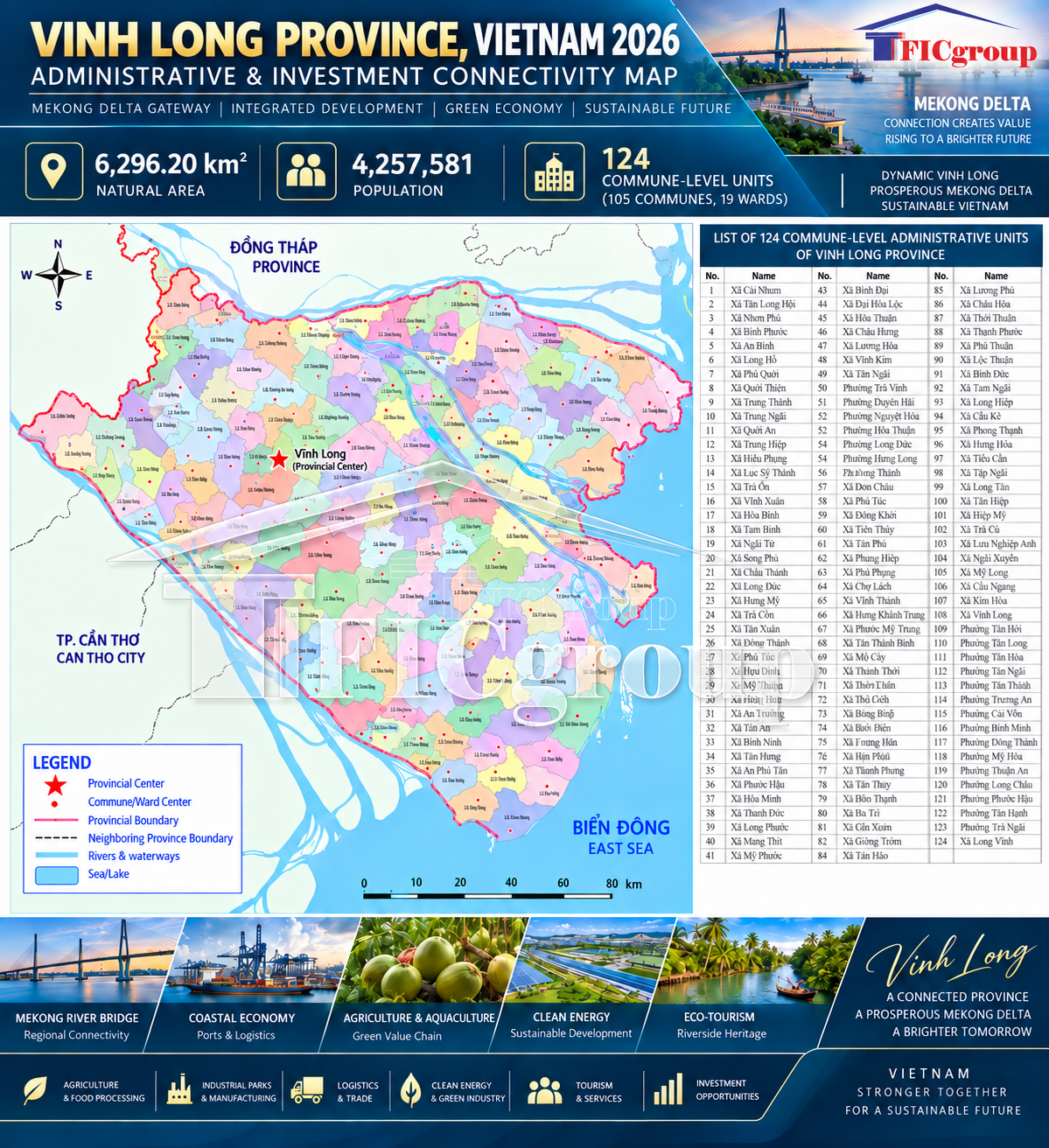
Vinh Long is located in the heart of Vietnam’s Mekong Delta and now extends from the region’s major river systems to the East Sea.
Following Vietnam’s 2025 provincial restructuring, the former provinces of:
VINH LONG + BEN TRE + TRA VINH
were consolidated into the new:
VINH LONG PROVINCE.
The new province covers approximately:
6,296.20 KM²
and contains:
124 COMMUNE-LEVEL ADMINISTRATIVE UNITS
comprising:
105 COMMUNES + 19 WARDS.
The provincial political and administrative center remains in the former Vinh Long urban area.
The transformation has dramatically expanded the province’s economic geography.
Pre-merger Vinh Long was primarily an inland agricultural and processing economy.
Post-merger Vinh Long now possesses:
The province should therefore no longer be interpreted simply as an agricultural province between Can Tho and Ho Chi Minh City.
It is becoming a:
MEKONG DELTA INDUSTRIAL–MARITIME ECONOMY.
The 2025 consolidation created a province with a far more diversified economic structure than any of its three predecessor provinces possessed independently.
The strategic change can be summarized as:
Vinh Long
Inland agriculture + processing + Can Tho connectivity.
Ben Tre
Coconut + agriculture + coastal economy + manufacturing.
Tra Vinh
Energy + coast + Dinh An EZ + fisheries + ports.
ONE INTEGRATED PROVINCE.
The resulting investment geography extends from the central Mekong Delta toward both:
HO CHI MINH CITY
and
THE EAST SEA.
This creates opportunities to develop industrial and logistics corridors connecting production areas, processing centers, ports and export markets.
The consolidation has also created a much larger provincial economy.
Official provincial information in late 2025 placed the economic scale of the new Vinh Long at approximately:
USD 11 BILLION.
The province reported approximately:
176 OPERATING FDI PROJECTS
with total registered foreign investment exceeding:
USD 5.6 BILLION.
Major international investment relationships include investors from:
The existing FDI base covers sectors including:
This gives Vinh Long a stronger industrial foundation than its traditional agricultural image might suggest.
CUMULATIVE FDI ≠ NEW ANNUAL FDI
REGISTERED CAPITAL ≠ REALIZED CAPITAL
FDI PROJECT ≠ OPERATING FACTORY
Project-level verification remains necessary.
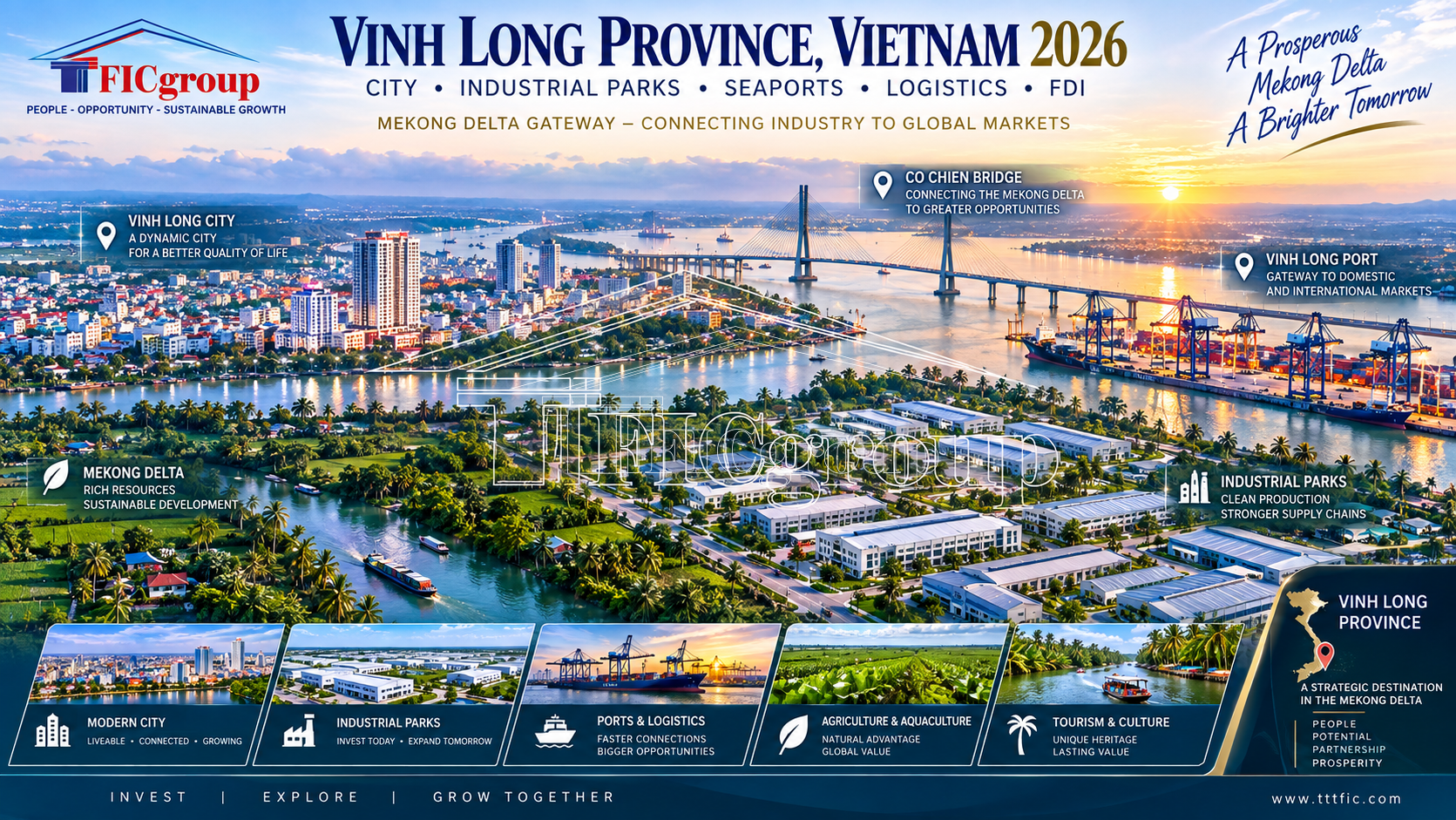
TTTFIC identifies four principal investment geographies within the new province.
This is the western industrial and logistics corridor.
Key assets include:
This corridor is particularly relevant to:
MANUFACTURING + LOGISTICS + FOOD PROCESSING + AUTOMOTIVE COMPONENTS + CONSUMER INDUSTRY.
This corridor links the former Ben Tre industrial economy with the broader Ho Chi Minh City market.
Important assets include:
This is Vinh Long’s emerging maritime and energy corridor.
Key assets include:
DINH AN ECONOMIC ZONE
DUYEN HAI ENERGY COMPLEX
WIND ENERGY
SEAPORTS
MARINE ECONOMY
INDUSTRIAL DEVELOPMENT
LOGISTICS.
The province’s extensive agricultural territory creates a large raw-material platform for:
The investment opportunity is increasingly:
AGRICULTURE → PROCESSING → COLD CHAIN → BRANDING → EXPORT.
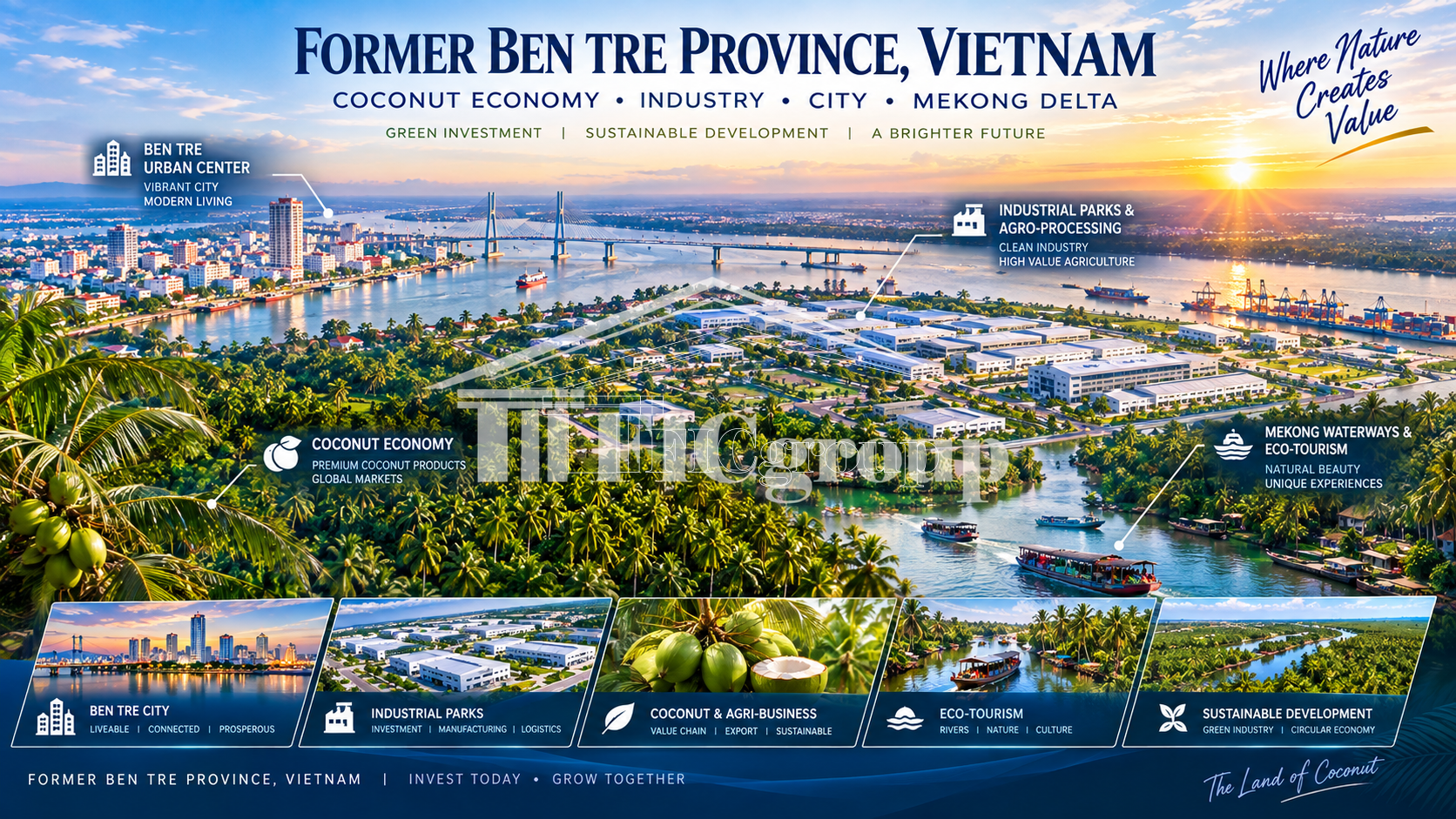
Vinh Long’s post-merger industrial geography is considerably larger and more complex than that of the former inland province.
The provincial planning framework identifies approximately:
3,442 HA OF INDUSTRIAL PARK DEVELOPMENT
across the Industrial Park (IP) system targeted toward 2030.
The critical issue for investors, however, is not simply the number of IPs shown on a planning map.
Their development status varies substantially.
TTTFIC therefore classifies Vinh Long’s industrial platform according to:
OPERATING
↓
NEWLY COMPLETED / INVESTMENT ATTRACTION
↓
ESTABLISHED & UNDER DEVELOPMENT
↓
PLANNED / INVESTMENT-CALLING
↓
LONG-TERM ECONOMIC-ZONE INDUSTRIAL RESERVES.
This distinction is essential because:
PLANNED INDUSTRIAL LAND ≠ AVAILABLE INDUSTRIAL LAND.
Five established IPs form the current operating industrial base of the enlarged province.
They are:
HOA PHU
BINH MINH
GIAO LONG
AN HIEP
LONG DUC.
These parks provide the clearest evidence that Vinh Long already possesses an operating manufacturing ecosystem rather than merely future industrial plans.
Location: Phu Quoi Commune.
Existing scale: approximately 250.97 ha.
Hoa Phu is one of the most established manufacturing locations in the former Vinh Long industrial system.
Its industrial structure includes:
The existing phases have achieved very high occupancy, significantly limiting opportunities for large new greenfield projects within the developed area.
For investors, Hoa Phu is therefore important not only as a location but also as evidence of established industrial demand.
Location: Cai Von Ward.
Scale: approximately 134.82 ha.
Binh Minh occupies one of the most strategically important industrial locations in western Vinh Long.
Its principal advantage is proximity to:
CAN THO.
The park benefits from connections to:
Its industrial base includes:
Existing automotive wiring-harness production demonstrates that Vinh Long’s manufacturing capability extends beyond traditional agricultural processing.
For selected manufacturers requiring access to Can Tho, the Hau River and the regional expressway network, Binh Minh is one of the province’s most strategically positioned industrial locations.
Location: Giao Long Commune.
The established Giao Long industrial platform consists of approximately:
101 HA — PHASE I
and approximately:
67 HA — PHASE II.
Giao Long has developed into an important manufacturing base inherited from former Ben Tre.
Existing industries include:
The existing phases have reached very high occupancy.
Its strategic value is strengthened by its position within the former Ben Tre manufacturing corridor and its connection toward Ho Chi Minh City and the coastal economy.
Location: Phu Tuc Commune.
Scale: approximately 68.5 ha.
An Hiep is another mature industrial location inherited from former Ben Tre.
Existing industries include:
The park has reached high occupancy and should therefore be viewed primarily as an established industrial ecosystem rather than a major source of new large-scale industrial land.
Location: Long Duc Ward.
Scale: approximately 98 ha.
Long Duc is an established industrial location inherited from former Tra Vinh.
It has attracted both domestic and foreign-invested manufacturing activities and has reached a high level of occupancy.
Its strategic role is important because it demonstrates the industrial foundation of the eastern part of the enlarged province before the larger Dinh An coastal industrial platform reaches maturity.
The five operating IPs collectively demonstrate:
EXISTING INDUSTRIAL DEMAND.
However, their high occupancy also creates a structural challenge:
EXISTING INDUSTRIAL SUCCESS → LIMITED REMAINING LAND → NEED FOR NEW INDUSTRIAL SUPPLY.
For new investors requiring substantial contiguous industrial land, the next generation of IPs is therefore increasingly important.
Location: Phu Thuan Commune.
Scale: approximately 231.78 ha.
Phu Thuan is one of the most important recent additions to Vinh Long’s industrial-land platform.
The IP was inaugurated in December 2025 after major infrastructure development.
Approximately:
156 HA OF CLEAN INDUSTRIAL LAND
was reported available for investment attraction at the time of inauguration.
This gives Phu Thuan a fundamentally different investor profile from older, highly occupied parks.
Potential industrial directions include:
For investors seeking industrial land in the former Ben Tre portion of the new province, Phu Thuan deserves particular attention.
Phu Thuan should be treated as a:
NEWLY COMPLETED / INVESTMENT-ATTRACTION PLATFORM
rather than grouped either with mature fully occupied IPs or with projects that remain only in planning.
Scale: approximately 350 ha.
The project includes approximately:
258.83 HA
of planned leasable industrial land.
Dong Binh is strategically located close to:
This gives Dong Binh one of the strongest logistics propositions among Vinh Long’s future industrial locations.
However, compensation and land-clearance procedures remain under implementation.
ESTABLISHED / LAND-CLEARANCE & DEVELOPMENT STAGE.
Investors should not equate the park’s 350-ha planned scale with immediately available serviced land.
Former name: Binh Tan Industrial Park.
Location: Tan Quoi Commune.
Total planned scale:
400 HA.
Phase I:
255 HA.
The remaining development component is approximately:
145 HA.
Gilimex Vinh Long is located approximately:
Its target sectors include:
Infrastructure development remains linked to compensation and land-clearance progress.
ESTABLISHED / PHASED DEVELOPMENT.
The distinction between the 400-ha total planning scale and the 255-ha first phase should be maintained in all investor presentations.
Location: Nhi Long Commune.
Scale: approximately 199.98 ha.
Co Chien is positioned along an important corridor connecting the former Ben Tre–Tra Vinh geography.
Potential industries include:
The project has an infrastructure investor but remains dependent on continued land clearance and infrastructure implementation.
ESTABLISHED / LAND-CLEARANCE & DEVELOPMENT STAGE.
Location: Ngu Lac Commune.
Ngu Lac must be interpreted differently from a conventional standalone IP.
It sits within the much larger:
DINH AN ECONOMIC ZONE.
Its development is connected to the future industrial–urban–service structure of the coastal economic zone.
The broader planning framework reserves a substantially larger industrial development area around Ngu Lac, while actual project implementation is phased.
This distinction is important:
LONG-TERM PLANNING AREA ≠ CURRENT INVESTMENT-READY PHASE.
Ngu Lac has strategic potential because it can eventually connect:
INDUSTRY + DINH AN EZ + ENERGY + PORT + LOGISTICS + EAST SEA.
ESTABLISHED / PHASED DEVELOPMENT WITHIN DINH AN EZ.
The next layer of Vinh Long’s industrial pipeline consists of locations included in provincial planning or investment-attraction programs but which should not be presented as operating IPs.
Location: Tan Hoa and Phong Thanh areas.
Scale: approximately:
120 HA.
Target sectors include:
The planning framework includes supporting water, wastewater and worker-housing infrastructure.
Nevertheless, project-specific land and infrastructure readiness must be independently verified before site selection.
Location: Cai Nhum Commune.
Planned scale:
200 HA.
An Dinh is included in the province’s investment-attraction program for industrial infrastructure development.
Its role can support industrial expansion in the central part of the enlarged province.
PLANNED / INVESTMENT-CALLING.
Location: Phu Quoi Commune.
Planned expansion:
157 HA.
The expansion is strategically significant because the existing Hoa Phu phases are already highly occupied.
If implemented, Phase 3 would extend one of Vinh Long’s most established industrial ecosystems rather than create an entirely new industrial location.
PLANNED EXPANSION.
Location: Giao Long Commune.
Planned scale:
249 HA.
Giao Hoa can potentially extend the industrial platform around the established Giao Long manufacturing corridor.
PLANNED / INVESTMENT-CALLING.
Location: Phuoc Long Commune.
Planned scale:
182 HA.
The project forms part of the province’s future industrial infrastructure pipeline.
PLANNED / INVESTMENT-CALLING.
Location: Bao Thanh Commune.
Planned scale:
153 HA.
Bao Thanh is included in the province’s industrial infrastructure investment-attraction portfolio.
PLANNED / INVESTMENT-CALLING.
Location: An Qui Commune.
Planned scale:
269.2 HA.
Part of the proposed development area includes public land, while the remainder includes land currently in other use.
This may create a different land-development profile from projects dependent entirely on fragmented private land acquisition.
PLANNED / INVESTMENT-CALLING.
Dinh An EZ contains a much larger long-term industrial geography than the conventional provincial IP pipeline alone suggests.
The current economic-zone framework identifies or reserves industrial development associated with:
These areas form part of the long-term industrial–urban–service structure of the Economic Zone.
They should not be added mechanically to the number of currently operating or immediately investable IPs.
Instead, they represent:
LONG-TERM INDUSTRIAL CAPACITY.
For international investors, the most important question is not:
“HOW MANY INDUSTRIAL PARKS DOES VINH LONG HAVE?”
The more useful question is:
“WHICH INDUSTRIAL PARK CAN ACTUALLY RECEIVE MY PROJECT NOW?”
The answer depends on:
TTTFIC therefore separates:
PLANNING SUPPLY
from:
LEGALLY ESTABLISHED SUPPLY
from:
INFRASTRUCTURE-COMPLETED SUPPLY
from:
ACTUALLY AVAILABLE INDUSTRIAL LAND.
OPERATING IP
≠
NEWLY COMPLETED IP
≠
ESTABLISHED / DEVELOPING IP
≠
PLANNED IP
≠
LONG-TERM INDUSTRIAL RESERVE
≠
READY INDUSTRIAL LAND.
This distinction is particularly important in Vinh Long because several mature IPs have high occupancy while a substantial portion of future industrial supply remains under development or within longer-term planning.

Vinh Long’s Industrial Cluster (IC) network deserves almost as much attention as its larger IP system.
Under the integrated planning framework inherited from the three predecessor provinces, Vinh Long has:
31 PLANNED INDUSTRIAL CLUSTERS
with a combined planning area of approximately:
1,655.86 HA.
However, implementation is smaller than the headline planning figure.
Provincial reporting identifies approximately:
1,546.2 HA
within the actual implementation framework.
This distinction is important.
31 PLANNED ICs ≠ 31 OPERATING ICs.
At the reported implementation stage, nine ICs had been established, comprising:
4 OPERATING ICs
3 ICs UNDER INFRASTRUCTURE INVESTMENT
2 ESTABLISHED ICs WITHOUT INFRASTRUCTURE INVESTORS
while the remaining locations were still within future development or establishment pipelines.
Scale: approximately 47.98 ha.
Trung Nghia has an energy-oriented industrial function.
Scale: approximately 72 ha.
The cluster supports industrial and handicraft activity within the former Ben Tre production geography.
Scale: approximately 36 ha.
Current implementation scale: approximately 33 ha.
Its broader planning area is larger, with potential expansion associated with future demand and infrastructure completion.
The distinction between existing implementation area and ultimate planning area should be maintained.
Scale: approximately 10.1 ha.
Scale: approximately 40 ha.
Scale: approximately 40.72 ha.
These clusters represent the next implementation layer after the currently operating ICs.
Actual land availability, infrastructure and environmental capacity must nevertheless be checked project by project.
Two additional ICs have been reported as established but without completed infrastructure-investor implementation.
Together they account for approximately:
67.4 HA.
This is an important TTMS™ distinction.
ESTABLISHED ≠ INFRASTRUCTURE COMPLETED.
An investor should therefore not interpret legal establishment alone as confirmation of serviced industrial land.
The broader IC development and investment-attraction pipeline includes locations such as:
Approximately 74.56 ha.
Approximately 50 ha.
Approximately 64 ha.
Approximately 75 ha.
Approximately 60 ha.
Approximately 50 ha.
Approximately 75 ha.
Approximately 75 ha.
Approximately 50 ha.
Approximately 70 ha.
Approximately 75 ha.
Approximately 75 ha.
The planning framework provides for future expansion beyond the initially implemented area as demand develops.
Approximately 75 ha.
Approximately 70 ha.
Approximately 32.58 ha.
Approximately 31.52 ha.
Approximately 33 ha.
Approximately 10.5 ha.
Approximately 25 ha.
Approximately 20 ha.
The wider provincial IC planning system also contains additional locations carried forward from predecessor provincial plans.
Because legal establishment, boundaries and implementation areas can change during detailed planning, investors should verify the current legal status of every individual IC before treating it as an available site.
Vinh Long’s land and production geography differs significantly from major concentrated industrial provinces.
Agricultural production is distributed across:
This makes decentralized industrial processing particularly relevant.
Large IPs are generally better suited to:
ICs can perform a complementary role by locating processing closer to:
RAW MATERIALS
FARMERS
AQUACULTURE
RURAL LABOR
LOCAL SUPPLY CHAINS.
The economic model becomes:
RICE / FRUIT / COCONUT / AQUACULTURE
↓
LOCAL IC
↓
PRIMARY & SECONDARY PROCESSING
↓
COLD CHAIN / REGIONAL LOGISTICS
↓
IP / PORT / DOMESTIC MARKET
↓
EXPORT.
This is particularly relevant to:
For Vinh Long, ICs can potentially serve another important function:
BRING INDUSTRY CLOSER TO THE RAW-MATERIAL ECONOMY.
Instead of transporting large volumes of low-value raw agricultural materials long distances before processing, selected processing stages can occur closer to production areas.
This can potentially:
However, these benefits depend on adequate:
PLANNED IC
≠
ESTABLISHED IC
≠
INFRASTRUCTURE UNDER CONSTRUCTION
≠
OPERATING IC
≠
AVAILABLE LAND
≠
SUITABLE LAND FOR A SPECIFIC INDUSTRY.
TTTFIC therefore recommends project-level verification rather than relying solely on the provincial IC list.
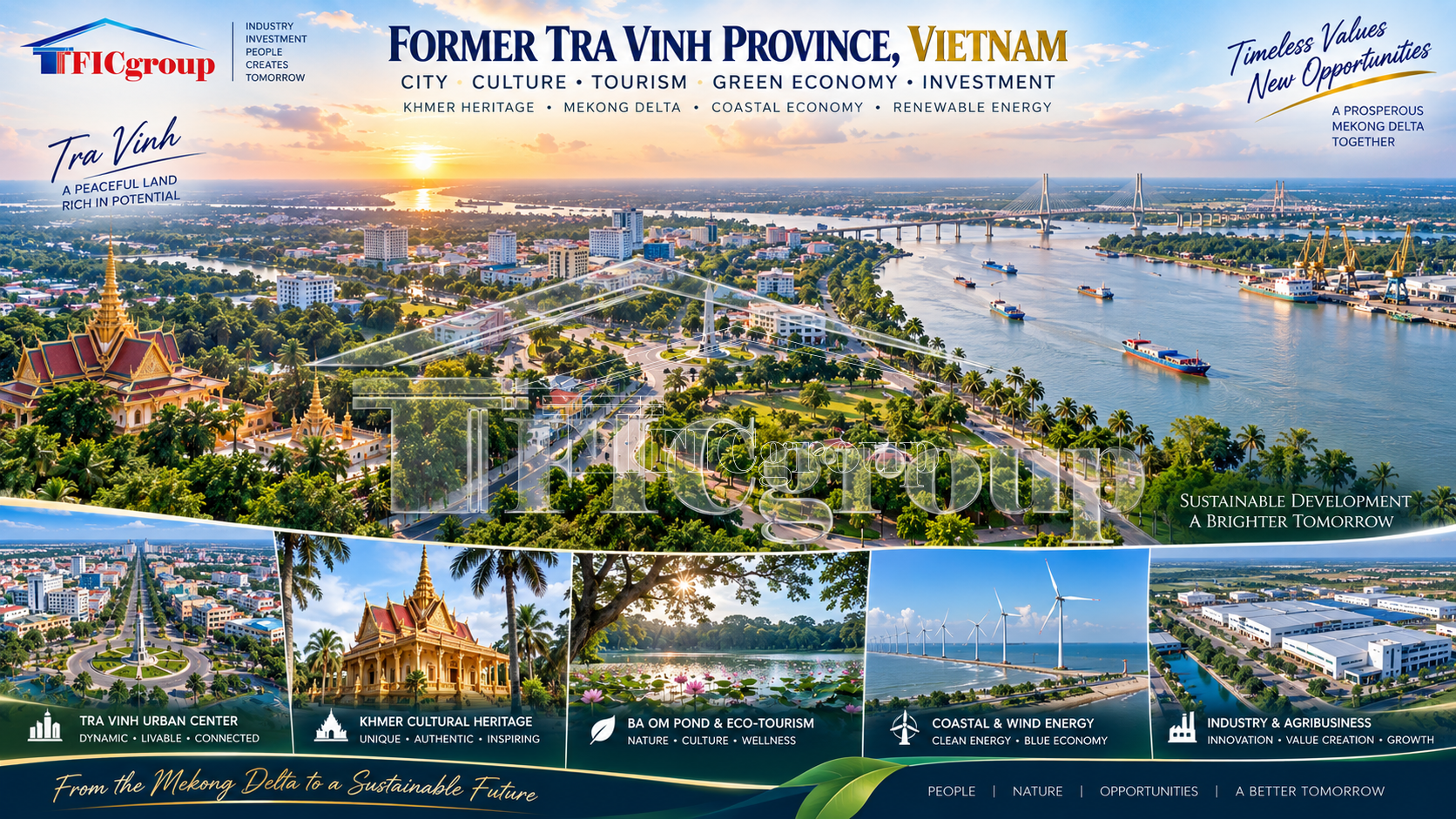
One of the most important structural changes to Vinh Long’s investment identity is the integration of:
DINH AN ECONOMIC ZONE.
Located in the southeastern coastal part of the province, Dinh An EZ covers approximately:
39,020 HA.
Following the new administrative geography, the Economic Zone extends across areas including:
Dinh An should not be interpreted simply as another industrial location.
Its long-term development model integrates:
INDUSTRY
PORT
LOGISTICS
ENERGY
URBAN DEVELOPMENT
SERVICES
TOURISM
MARINE ECONOMY.
This gives Dinh An the potential to become the principal maritime growth platform of the new Vinh Long.
The planning framework identifies approximately:
5,041 HA
for Industrial Parks and warehousing areas, including four IP areas and two industrial reserve areas.
The Economic Zone also includes planned space for:
501 HA — NON-TARIFF AREA
and approximately:
100.8 HA — BONDED-WAREHOUSE AREA.
These functions indicate a long-term ambition extending well beyond conventional industrial land.
They create the possibility of integrating:
MANUFACTURING
↓
WAREHOUSING
↓
LOGISTICS
↓
PORT
↓
INTERNATIONAL TRADE.
Industrial development within the wider Dinh An framework includes or reserves space associated with:
NGU LAC INDUSTRIAL PARK
DON XUAN–DON CHAU INDUSTRIAL PARK
DINH AN INDUSTRIAL PARK
LONG KHANH INDUSTRIAL RESERVE
LONG VINH INDUSTRIAL RESERVE.
These areas are at different planning and implementation stages.
They must not be represented collectively as operating industrial land.
Their strategic significance lies in the amount of long-term industrial capacity that the coastal economic zone can potentially provide.
The planning framework identifies approximately:
125 HA
for the Dinh An General Port area.
Together with the large-vessel navigation channel into the Hau River, this gives Dinh An strategic importance not only to Vinh Long but potentially to the wider Mekong Delta logistics system.
The long-term economic model is:
MEKONG PRODUCTION
↓
PROCESSING
↓
LOGISTICS
↓
DINH AN
↓
EAST SEA.
Approximately:
1,900 HA
is identified for a Renewable Energy Export Center.
This connects Dinh An directly with Vinh Long’s broader renewable-energy strategy.
The surrounding coastal geography supports potential development related to:
Vinh Long has also identified green-hydrogen development within the broader Dinh An energy economy.
This is strategically significant because a successful new-energy ecosystem would require integration among:
RENEWABLE POWER
INDUSTRIAL LAND
WATER
PORT INFRASTRUCTURE
STORAGE
OFFTAKE
EXPORT MARKETS.
However, green hydrogen remains highly dependent on project economics, electricity pricing, technology, water availability, infrastructure, approvals and long-term offtake.
It should therefore be treated as:
A STRATEGIC DEVELOPMENT OPPORTUNITY
rather than:
AN ESTABLISHED INDUSTRIAL ECOSYSTEM.
The province is positioning logistics as an increasingly important economic sector.
Dinh An is particularly relevant because it can potentially connect:
MEKONG AGRICULTURE
INDUSTRIAL PROCESSING
INLAND WATERWAYS
SEAPORTS
EAST SEA SHIPPING.
This could support:
Dinh An’s planning is not purely industrial.
The Economic Zone also incorporates:
This mixed-use structure is important because a large coastal economic zone requires more than factories.
It requires:
INDUSTRY + WORKFORCE + SERVICES + URBAN INFRASTRUCTURE + ENVIRONMENT.
TTTFIC summarizes the long-term Dinh An opportunity as:
INDUSTRIAL LAND
RENEWABLE ENERGY
PORT
LOGISTICS
NON-TARIFF FUNCTIONS
BONDED WAREHOUSING
MARINE ECONOMY
EAST SEA ACCESS.
If these components are progressively implemented, Dinh An could materially change Vinh Long’s role within the Mekong Delta.
Instead of remaining primarily an inland production economy whose goods must move through external gateways, Vinh Long could increasingly develop its own:
PRODUCTION → PROCESSING → LOGISTICS → MARITIME GATEWAY.
This long-term potential must be separated carefully from current implementation.
ECONOMIC-ZONE PLANNING
≠
COMPLETED INFRASTRUCTURE.
INDUSTRIAL RESERVE
≠
INVESTMENT-READY LAND.
NON-TARIFF AREA PLANNING
≠
OPERATING FREE-TRADE PLATFORM.
PORT PLANNING
≠
OPERATING TERMINAL CAPACITY.
RENEWABLE-ENERGY POTENTIAL
≠
BANKABLE ENERGY PROJECT.
Every investment inside Dinh An must therefore be assessed at project level.
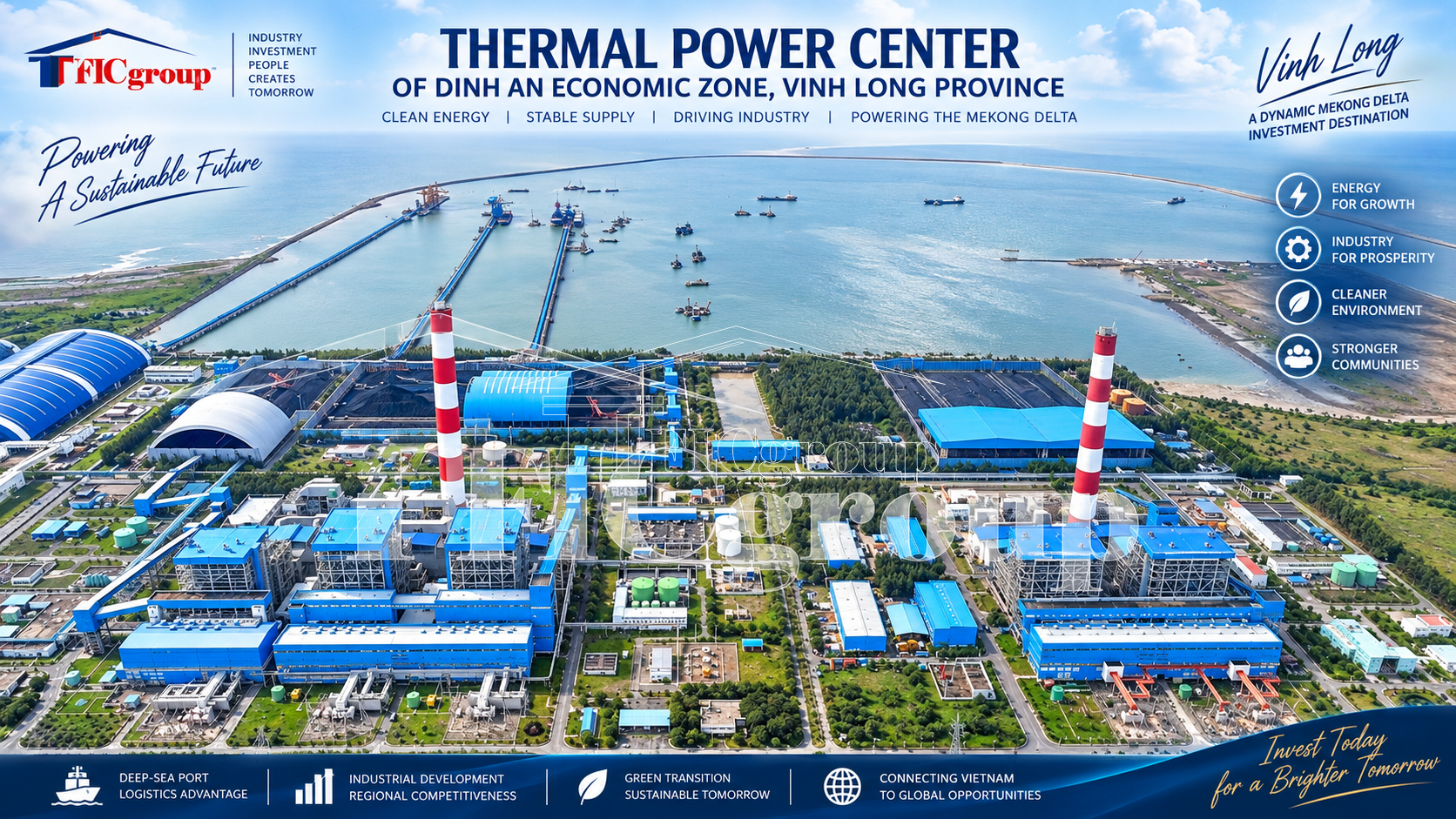
Post-merger Vinh Long possesses a logistics geography fundamentally different from that of the former inland province.
The enlarged province combines:
TIEN RIVER
HAU RIVER
CO CHIEN RIVER
MANG THIT RIVER
APPROXIMATELY 130 KM OF COASTLINE
SIX MAJOR ESTUARIES
The six major river mouths connecting the province with the East Sea include:
The province has approximately:
2,117 KM OF INLAND WATERWAYS.
This river–sea interface is one of the strongest structural advantages created by the merger.
Under Vietnam’s national seaport planning framework, the enlarged province contains:
BEN TRE SEAPORT
VINH LONG SEAPORT
TRA VINH SEAPORT.
These should be understood as port systems containing multiple port areas, terminals, anchorages and future development components rather than as three individual terminals.
The Ben Tre seaport system includes principal port areas at:
together with:
Depending on the individual port area and navigation conditions, the planning framework provides for vessels approximately:
5,000–50,000 DWT.
Strategically, the Ben Tre port system supports:
The Vinh Long seaport system includes:
and:
The planning framework provides for vessel sizes approximately:
5,000–20,000 DWT
depending on the individual port area and navigation conditions.
Binh Minh is particularly important because of its proximity to:
This creates a potentially powerful industrial logistics relationship:
FACTORY
↓
ROAD / SHORT-HAUL TRANSPORT
↓
BINH MINH PORT
↓
HAU RIVER / REGIONAL PORT NETWORK.
For selected cargo types, waterway transport can provide an alternative or complement to long-distance trucking.
The former Tra Vinh maritime platform adds the largest deep maritime dimension to the new province.
Principal areas include:
and:
together with:
The planning framework provides for vessels approximately:
20,000–50,000 DWT
depending on port area and navigation conditions.
This system is strategically connected with:
DINH AN EZ
DUYEN HAI ENERGY COMPLEX
INDUSTRIAL DEVELOPMENT
RENEWABLE ENERGY
MEKONG EXPORT LOGISTICS.
The Duyen Hai–Dinh An geography is particularly important because it combines:
The large-vessel navigation channel into the Hau River strengthens the strategic relevance of this corridor to the broader Mekong Delta.
It creates the long-term possibility of connecting inland production more directly with maritime shipping.
Vinh Long’s logistics platform is not limited to seaports.
The province reports nine inland cargo ports located along the Tien, Ham Luong and Co Chien river systems:
These inland ports are reported as capable of receiving vessels generally in the approximately:
1,000–3,000 TONNE RANGE.
For bulk agricultural commodities, construction materials and selected industrial cargoes, inland waterway transport can be commercially important.
FISHING PORT SYSTEM
The province also possesses five fishing ports:
Collectively, this infrastructure supports more than:
5,000 FISHING VESSELS
and approximately:
60,000 TONNES OF SEAFOOD HANDLING & DISTRIBUTION PER YEAR.
The fishing-port network is relevant not only to fisheries.
It supports a wider value chain:
FISHING / AQUACULTURE
↓
LANDING
↓
COLD STORAGE
↓
PROCESSING
↓
PACKAGING
↓
DOMESTIC DISTRIBUTION / EXPORT.
WATERWAY LOGISTICS AS AN INDUSTRIAL ADVANTAGE
Vinh Long’s river system can provide a particularly important advantage for industries moving:
Road transport remains essential.
But for suitable cargoes, the combination of:
ROAD + RIVER + SEAPORT
can create a more diversified logistics model than road-only industrial locations.
THE LONG-TERM MULTIMODAL LOGISTICS MODEL
The enlarged province now has the physical geography to develop:
FARM / AQUACULTURE AREA
↓
LOCAL IC / PROCESSING FACILITY
↓
IP / COLD STORAGE
↓
ROAD OR INLAND WATERWAY
↓
LOGISTICS CENTER
↓
SEAPORT
↓
EAST SEA
↓
INTERNATIONAL MARKET.
This is one of the most important structural changes created by the merger.
Historic Vinh Long was primarily:
AN INLAND MEKONG ECONOMY.
Post-merger Vinh Long has the potential to become:
A RIVER–SEA LOGISTICS ECONOMY.
Potential investment fields include:
Investors must distinguish carefully among:
NATIONAL PORT PLANNING
PORT AREA
TERMINAL
OPERATING BERTH
NAVIGATION CHANNEL
ACTUAL VESSEL ACCESS
ACTUAL CARGO-HANDLING CAPACITY.
Therefore:
PORT PLANNING ≠ OPERATING TERMINAL.
DESIGN VESSEL SIZE ≠ GUARANTEED VESSEL ACCESS AT ALL TIMES.
PROXIMITY TO WATER ≠ COMMERCIAL PORT ACCESS.
PORT CAPACITY ≠ AVAILABLE CAPACITY FOR A SPECIFIC CARGO.
Site-selection analysis should verify:
For international investors, this operational verification is more important than simply measuring distance from a factory site to the nearest river or port.
The new Vinh Long sits at the intersection of multiple regional corridors.
Key road and bridge assets include:
The province also benefits from proximity to:
CAN THO INTERNATIONAL AIRPORT.
Future transport projects should strengthen connections among:
HO CHI MINH CITY
↓
BEN TRE / GIAO LONG
↓
VINH LONG
↓
CAN THO
and:
CENTRAL MEKONG DELTA
↓
DINH AN / DUYEN HAI
↓
EAST SEA.
PLANNED ROAD ≠ OPERATING ROAD
APPROVED BRIDGE ≠ COMPLETED BRIDGE
PORT PLANNING ≠ OPERATING TERMINAL.
This is one of the largest changes to Vinh Long’s investment identity.
The former inland province had no coastline.
The new province has approximately:
130 KM OF COASTLINE.
This brings into Vinh Long’s investment portfolio:
Provincial investment materials identify renewable-energy technical potential exceeding:
22,100 MW,
with wind energy representing the largest component.
By late 2025, 13 wind projects with combined commercial capacity of approximately:
572.75 MW
had entered operation, while additional projects remained under implementation.
The Duyen Hai energy complex also makes the province an important power-production location.
The province is additionally examining:
GREEN HYDROGEN
and related energy-industrial opportunities.
TECHNICAL POTENTIAL ≠ APPROVED CAPACITY
APPROVED PROJECT ≠ CONSTRUCTION
CONSTRUCTION ≠ COMMERCIAL OPERATION
OFFSHORE WIND POTENTIAL ≠ BANKABLE OFFSHORE WIND PROJECT.
One of the strongest assets created by the merger is the integration of the former Ben Tre coconut economy into Vinh Long.
The new province contains approximately:
119,270 HA OF COCONUT.
This represents close to:
HALF OF VIETNAM’S COCONUT AREA.
More than 30,000 ha have been reported under VietGAP, organic or other standardized production linked to growing-area identification.
Approximately:
180 COCONUT PROCESSING ENTERPRISES
operate within the province.
The industry already produces products including:
This is not merely agriculture.
It is an existing:
AGRICULTURAL INDUSTRIAL ECOSYSTEM.
The next stage should move further toward:
COCONUT
↓
DEEP PROCESSING
↓
FOOD INGREDIENTS
↓
BIOMATERIALS
↓
CONSUMER PRODUCTS
↓
EXPORT.
For international investors seeking renewable natural materials and agricultural processing platforms, this is one of Vinh Long’s strongest differentiated opportunities.
The consolidated province contains one of the Mekong Delta’s most diversified agricultural raw-material systems.
Major sectors include:
COCONUT
FRUIT
RICE
AQUACULTURE
SEAFOOD
LIVESTOCK.
The traditional Vinh Long fruit economy remains important, including:
Former Ben Tre and Tra Vinh add:
The investment opportunity lies increasingly in:
PROCESSING
COLD STORAGE
IQF
PACKAGING
TRACEABILITY
FOOD SAFETY
IRRADIATION
EXPORT LOGISTICS.
Rather than exporting raw agricultural commodities, Vinh Long can increase value through:
FARM → PROCESSING → COLD CHAIN → PORT → INTERNATIONAL MARKET.
Vinh Long’s post-merger agricultural scale should be understood not simply as agricultural production, but as the foundation for a much larger food-processing, bioeconomy and export-manufacturing platform.
The consolidated province records annual rice cultivation of more than:
329,000 HA
with production of approximately:
1.9 MILLION TONNES OF RICE PER YEAR.
Beyond rice, Vinh Long possesses approximately:
221,000 HA OF PERENNIAL CROPS
including coconut and fruit, with annual production exceeding:
3.5 MILLION TONNES.
Aquaculture adds another major production platform.
The province has approximately:
111,500 HA OF AQUACULTURE
while total fisheries production approaches:
984,000 TONNES.
Combined with livestock, vegetables, coconut and other agricultural products, this gives Vinh Long the raw-material scale to develop an integrated:
MEKONG FOOD INDUSTRIAL ECOSYSTEM.
The opportunity extends across the complete value chain:
RICE + COCONUT + FRUIT + AQUACULTURE + LIVESTOCK
↓
COLLECTION & TRACEABILITY
↓
DEEP PROCESSING
↓
FOOD INGREDIENTS
↓
COLD STORAGE
↓
PACKAGING
↓
QUALITY CONTROL
↓
LOGISTICS
↓
EXPORT.
Potential investment fields include:
Vinh Long also participates in Vietnam’s transition toward high-quality, lower-emission rice production in the Mekong Delta.
This creates a new investment chain:
HIGH-QUALITY RICE
↓
LOWER-EMISSION PRODUCTION
↓
TRACEABILITY
↓
CERTIFICATION
↓
GREEN PROCESSING
↓
PREMIUM FOOD PRODUCTS
↓
INTERNATIONAL MARKETS.
Future demand can extend into:
The opportunity is therefore no longer simply:
PRODUCE MORE RICE.
It is:
CREATE MORE VALUE FROM EVERY TONNE OF RICE.
Large-scale rice, coconut, fruit, livestock and aquaculture production also creates substantial volumes of agricultural by-products.
These can potentially become industrial inputs for:
The value chain changes from:
AGRICULTURAL WASTE
to:
INDUSTRIAL INPUT
to:
VALUE-ADDED PRODUCT.
For international investors, this is the difference between viewing Vinh Long merely as an agricultural province and understanding it as an:
AGRICULTURAL INDUSTRIAL PLATFORM.
One of the least appreciated advantages of post-merger Vinh Long is the ecological diversity contained within a single provincial economy.
The enlarged province now extends across:
FRESHWATER
↓
BRACKISH-WATER ENVIRONMENTS
↓
COASTAL & MARINE ECONOMY.
This creates a diversified production platform rarely explained by conventional provincial investment profiles.
The inland Mekong system supports:
Moving toward the coast, changing water conditions support:
At the East Sea, the investment environment changes again.
The province gains:
The resulting economic geography can be visualized as:
RICE FIELD
↓
FRUIT ORCHARD
↓
COCONUT
↓
AQUACULTURE
↓
MANGROVE
↓
SEAPORT
↓
EAST SEA.
This ecological diversity provides Vinh Long with an economic structure substantially broader than that of the former inland province.
This geography also creates significant climate challenges.
Investors must consider:
But adaptation itself creates investment demand.
Potential fields include:
Climate change should therefore be evaluated simultaneously as:
AN INVESTMENT RISK
and:
A TECHNOLOGY & INFRASTRUCTURE OPPORTUNITY.
Tourism has become a materially larger component of Vinh Long’s post-merger economy than the former provincial geography would suggest.
In 2025, the consolidated province received approximately:
9.35 MILLION VISITOR ARRIVALS
including approximately:
1.27 MILLION INTERNATIONAL VISITOR ARRIVALS.
Tourism revenue reached approximately:
VND 7.96 TRILLION.
The strategic opportunity is particularly interesting because the merger combines three different tourism identities within one province.
The former Vinh Long area offers:
This supports:
RIVER TOURISM + AGRICULTURAL TOURISM + CULTURAL TOURISM.
Former Ben Tre contributes one of the Mekong Delta’s most recognizable identities:
THE COCONUT LAND.
Its tourism economy combines:
But the investment value extends beyond tourism.
Coconut tourism can become a consumer-facing platform for the province’s coconut industry.
COCONUT FARM
↓
TOURISM EXPERIENCE
↓
LOCAL PRODUCT
↓
PROCESSING
↓
RETAIL
↓
BRAND RECOGNITION
↓
E-COMMERCE
↓
EXPORT.
Former Tra Vinh contributes another distinctive identity through:
This supports:
CULTURAL TOURISM + ECO-TOURISM + COASTAL TOURISM.
The merger makes it possible to develop integrated itineraries instead of marketing three isolated destinations.
An international visitor can potentially experience:
MEKONG RIVER LIFE
↓
FRUIT ORCHARDS
↓
COCONUT CULTURE
↓
KHMER CULTURE
↓
MANGROVE & COAST
↓
EAST SEA.
This represents a much broader tourism product than any of the three predecessor provinces could provide independently.
The most interesting relationship for investors is not tourism alone.
It is:
TOURISM + AGRICULTURE + MANUFACTURING + BRANDING.
Visitors discover and consume:
Tourism therefore functions as a physical showroom for the local economy.
A visitor who discovers a product in Vinh Long can later become:
AN E-COMMERCE CUSTOMER
or potentially:
AN IMPORTER / DISTRIBUTOR.
The development chain becomes:
LOCAL PRODUCT
↓
VISITOR EXPERIENCE
↓
BRAND RECOGNITION
↓
RETAIL
↓
E-COMMERCE
↓
WIDER DOMESTIC & INTERNATIONAL MARKET.
Potential investment fields include:
VISITOR GROWTH ≠ HOTEL FEASIBILITY
TOURISM POTENTIAL ≠ APPROVED TOURISM PROJECT
COASTLINE ≠ DEVELOPABLE RESORT LAND
TOURISM PLANNING ≠ INVESTMENT-READY SITE.
Every project requires independent assessment of land, planning, environment, accessibility, seasonality, market positioning and commercial feasibility.
TTTFIC identifies the following major investment themes.
Vinh Long’s enormous agricultural and aquaculture output creates opportunities extending far beyond primary commodity production.
Potential fields include:
The coconut economy can support:
The long-term objective should be:
COCONUT → DEEP PROCESSING → HIGHER VALUE → GLOBAL MARKET.
Opportunities include:
Freshwater, brackish-water and marine production creates opportunities in:
Cold-chain investment is particularly relevant near:
Established and emerging IPs can support manufacturing serving both the domestic market and international supply chains.
Existing automotive-component manufacturing around Binh Minh demonstrates that Vinh Long’s industrial proposition is not limited to food and agriculture.
Supporting-industry opportunities may include:
Potential areas include:
All projects remain subject to national power planning, investment approval, grid capacity and commercial feasibility.
The combination of Dinh An EZ, the coastal economy and seaport development creates opportunities in:
This represents a longer-term opportunity linked to renewable energy and the province’s maritime economy.
Bankability will depend on:
Future IPs and ICs create opportunities for qualified infrastructure developers.
As mature IPs become increasingly occupied and new industrial locations develop, demand can expand for:
The province’s environmental conditions create investment demand for:
The integrated Vinh Long–Ben Tre–Tra Vinh tourism geography creates opportunities in:
The economic logic of the merger becomes much clearer when the three predecessor territories are viewed as complementary parts of one value chain.
CAN THO ACCESS + HOA PHU + BINH MINH + MANUFACTURING + RICE + FRUIT + MEKONG LOGISTICS.
COCONUT + COAST + GIAO LONG + AN HIEP + PHU THUAN + TOURISM + PROCESSING.
DINH AN + DUYEN HAI + ENERGY + WIND + PORT + AQUACULTURE + KHMER CULTURE + COAST.
Together, they create:
RAW MATERIAL
↓
LOCAL PROCESSING
↓
INDUSTRIAL CLUSTER
↓
INDUSTRIAL PARK
↓
COLD CHAIN & LOGISTICS
↓
PORT
↓
EXPORT.
At the same time:
AGRICULTURE + CULTURE + LOCAL PRODUCTS
↓
TOURISM
↓
CONSUMER EXPERIENCE
↓
BRAND RECOGNITION
↓
DOMESTIC & INTERNATIONAL MARKET.
This is the deeper post-merger investment thesis.
Vinh Long is no longer dependent on a single economic identity.
It now combines:
AGRICULTURAL DEPTH
INDUSTRIAL CAPACITY
RIVER LOGISTICS
MARITIME ACCESS
ENERGY CAPACITY
TOURISM ECONOMY.
Industrial development in Vinh Long should not be evaluated solely by the number or size of its Industrial Parks.
The province’s Industrial Cluster network can play an important complementary role.
Vinh Long’s agricultural production is geographically dispersed across rice fields, coconut areas, orchards, aquaculture regions and rural communities.
Large centralized Industrial Parks remain important for:
Industrial Clusters can serve a different development function.
They can potentially place smaller and medium-scale processing closer to:
RAW MATERIALS
RURAL LABOR
AGRICULTURAL PRODUCTION
LOCAL SUPPLY CHAINS.
This is particularly relevant to:
The model becomes:
FARM / AQUACULTURE
↓
LOCAL INDUSTRIAL CLUSTER
↓
PROCESSING
↓
REGIONAL LOGISTICS
↓
DOMESTIC MARKET / PORT / EXPORT.
This decentralized industrialization model can reduce unnecessary movement of low-value raw materials before processing while helping capture more value closer to production areas.
However:
PLANNED IC ≠ ESTABLISHED IC
ESTABLISHED IC ≠ COMPLETED INFRASTRUCTURE
COMPLETED INFRASTRUCTURE ≠ AVAILABLE LAND
AVAILABLE LAND ≠ SUITABLE SITE.
Investors must verify each Industrial Cluster independently.
Include:
Include newly commissioned industrial and infrastructure assets requiring individual verification of actual operational readiness.
Phu Thuan Industrial Park represents an important recent addition to the provincial industrial-land platform.
Include relevant components of:
Include projects with established planning or investment approvals that have not yet achieved full commercial operation.
Potential components include:
TTTFIC only classifies an opportunity as genuinely investable after verification of:
LAND
PLANNING
LEGAL STATUS
LAND CLEARANCE
INFRASTRUCTURE
ELECTRICITY
WATER
WASTEWATER
ENVIRONMENTAL CAPACITY
FLOOD & CLIMATE RISK
ROAD ACCESS
PORT ACCESS
LABOR
SUPPLY CHAIN
INDUSTRY ELIGIBILITY
COMMERCIAL TERMS.
An investor should never assume that inclusion in provincial planning automatically means that land is immediately available for investment.
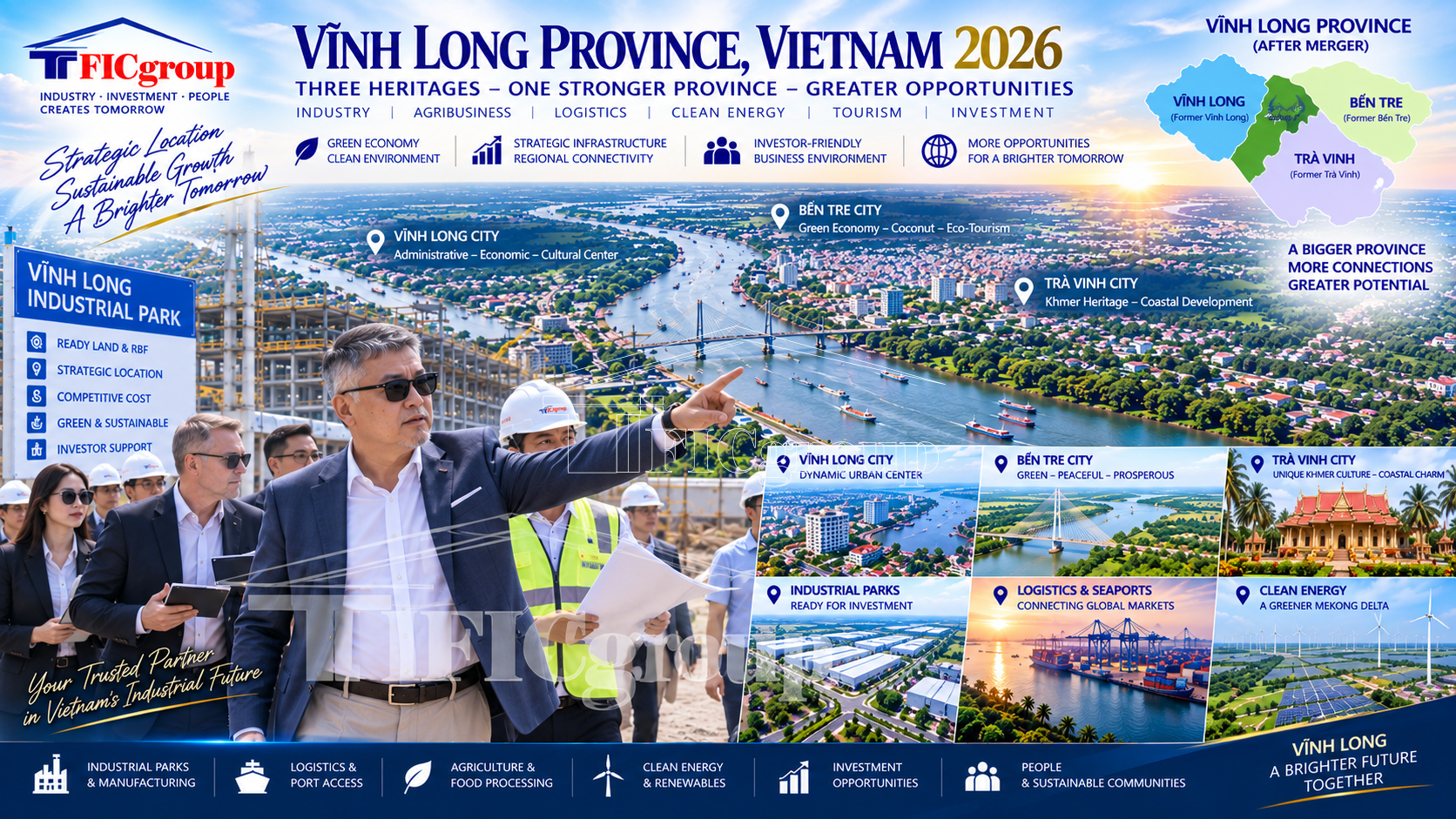
Vinh Long’s enlarged investment geography creates major opportunities but also significant execution considerations.
The Mekong Delta faces:
Site-specific hydrology and climate resilience should therefore form part of industrial due diligence.
Soft ground conditions can materially affect:
Industrial land price alone therefore does not determine the true cost of a project.
A site located near a river or planned port does not automatically have commercially efficient export logistics.
Actual conditions requiring verification include:
A large population creates a substantial theoretical labor catchment.
But:
POPULATION ≠ AVAILABLE INDUSTRIAL LABOR.
Investors must evaluate:
Several mature IPs have high occupancy or limited remaining industrial land.
Future industrial supply increasingly depends on newer and developing locations such as:
The status of each site must be verified at the time of investment.
The province’s large IC pipeline should not be confused with immediately available serviced industrial land.
Each location requires verification of:
Agro-processing, seafood, coconut processing, chemicals, energy and water-intensive industries require careful evaluation of:
The province’s agricultural strength also means industrial development must coexist with:
Large contiguous industrial sites may therefore require particularly careful planning, land assembly and infrastructure development.
Vinh Long should not compete with Ho Chi Minh City, Dong Nai or other mature manufacturing centers simply by presenting itself as a lower-cost industrial-land alternative.
Its investment economics are different.
The province can offer investors access to:
LARGE AGRICULTURAL RAW-MATERIAL BASE
RICE PRODUCTION
COCONUT INDUSTRIAL ECOSYSTEM
FRUIT PRODUCTION
FRESHWATER, BRACKISH & MARINE AQUACULTURE
INDUSTRIAL PARK PIPELINE
INDUSTRIAL CLUSTER NETWORK
CAN THO MARKET & AIRPORT ACCESS
MEKONG WATERWAYS
EAST SEA ACCESS
SEAPORT SYSTEM
DINH AN ECONOMIC ZONE
RENEWABLE ENERGY
TOURISM ECONOMY
LARGE LABOR CATCHMENT.
This combination is particularly relevant to investors in:
Vinh Long’s proposition is therefore not:
“ANOTHER INDUSTRIAL PROVINCE.”
It is:
AN INTEGRATED MEKONG PRODUCTION, PROCESSING & EXPORT ECONOMY.
The transformation of Vinh Long cannot be understood simply by adding together the economic statistics of three former provinces.
The merger has created a fundamentally different investment geography.
TTTFIC identifies seven interconnected economic platforms.
Rice + fruit + coconut + livestock + aquaculture + seafood.
Industrial Parks + Industrial Clusters + processing + manufacturing + supporting industries.
Tien River + Hau River + Co Chien River + Ham Luong River + Mekong inland waterways.
Approximately 130 kilometers of coastline + fisheries + seaports + marine economy.
Duyen Hai + wind + renewable energy + future new-energy opportunities.
Mekong river culture + Coconut Culture + Khmer Culture + agricultural tourism + coastal tourism.
Road + expressway + inland waterways + ports + cold chain + Can Tho connectivity.
These seven platforms should not develop independently.
The greater opportunity lies in connecting them.
RICE / FRUIT / COCONUT / AQUACULTURE
↓
LOCAL INDUSTRIAL CLUSTERS
↓
DEEP PROCESSING
↓
INDUSTRIAL PARKS
↓
COLD CHAIN & LOGISTICS
↓
RIVER / ROAD TRANSPORT
↓
DINH AN / SEAPORT SYSTEM
↓
INTERNATIONAL MARKET.
At the same time:
AGRICULTURE + CULTURE + LOCAL PRODUCTS
↓
TOURISM
↓
CONSUMER EXPERIENCE
↓
BRAND RECOGNITION
↓
DOMESTIC & INTERNATIONAL MARKET.
Large IPs remain important for:
ICs can perform a complementary function.
They can potentially bring processing closer to:
RAW MATERIALS
RURAL LABOR
AGRICULTURAL PRODUCTION
LOCAL SUPPLY CHAINS.
For Vinh Long’s dispersed agricultural geography, this is strategically relevant.
The central economic challenge is not simply increasing production.
Vinh Long already possesses substantial production scale.
The opportunity is to capture more value inside the province.
Instead of:
RICE → RAW COMMODITY
the objective becomes:
RICE → PROCESSING → BRANDED FOOD → PREMIUM EXPORT.
Instead of:
COCONUT → RAW COCONUT
the opportunity becomes:
COCONUT → FOOD INGREDIENTS → BEVERAGES → BIOMATERIALS → ACTIVATED CARBON → CONSUMER PRODUCTS.
Instead of:
FRUIT → FRESH MARKET
the opportunity becomes:
FRUIT → IQF / JUICE / FREEZE-DRIED / INGREDIENTS → COLD CHAIN → EXPORT.
Instead of:
AQUACULTURE → PRIMARY SEAFOOD
the opportunity becomes:
AQUACULTURE → PROCESSING → VALUE-ADDED FOOD → GLOBAL DISTRIBUTION.
This is perhaps the most important structural transformation.
Historic Vinh Long had no coastline.
Post-merger Vinh Long now possesses:
RIVER
COAST
SEAPORTS
DINH AN ECONOMIC ZONE
ENERGY
MARINE ECONOMY.
This fundamentally raises the province’s long-term investment ceiling.
TTTFIC summarizes Vinh Long 2026 as:
MEKONG FOOD POWERHOUSE
COCONUT INDUSTRIAL ECOSYSTEM
INDUSTRIAL PARK & INDUSTRIAL CLUSTER NETWORK
MEKONG RIVER LOGISTICS
DINH AN ECONOMIC ZONE
SEAPORT SYSTEM
RENEWABLE ENERGY
TOURISM ECONOMY
EAST SEA ACCESS.
The province’s greatest long-term advantage may not be any single IP, crop, port or energy project.
It is the possibility of integrating all of them.
FOOD + INDUSTRY + RIVER + SEA + ENERGY + TOURISM + LOGISTICS.
That is the emerging investment identity of the new Vinh Long.
International investors evaluating the province solely through its pre-2025 profile may therefore substantially underestimate what Vinh Long has become.
TTTFIC Group | Vietnam Industrial Investment & Business Advisory
TTTFIC Group supports international investors evaluating Vinh Long through:
For each project, TTTFIC can compare locations across the enlarged province according to the investor’s specific requirements rather than assuming that all Vinh Long industrial locations provide the same economics.
The correct location for a food-processing investor may be very different from the correct location for:
This is why site selection must begin with the investor’s value chain rather than simply with available land.
Vinh Long 2026 is not the Vinh Long described in historical investment profiles.
It has transformed from an inland Mekong Delta province into a large integrated economic territory extending:
FROM CAN THO
through:
THE MEKONG RIVER SYSTEM
and:
THE RICE, FRUIT & COCONUT HEARTLAND
through:
INDUSTRIAL PARKS & INDUSTRIAL CLUSTERS
to:
DINH AN
and finally:
THE EAST SEA.
The merger has combined:
FOOD
AGRICULTURE
INDUSTRY
COCONUT
AQUACULTURE
TOURISM
PORTS
RENEWABLE ENERGY
LOGISTICS.
The central investment opportunity is therefore not merely lower-cost industrial land.
It is the possibility of building integrated value chains within one provincial economy:
RAW MATERIAL
↓
LOCAL PROCESSING
↓
INDUSTRIAL PRODUCTION
↓
COLD CHAIN
↓
LOGISTICS
↓
PORT
↓
EXPORT.
And simultaneously:
AGRICULTURE
↓
CULTURE & TOURISM
↓
LOCAL PRODUCT
↓
BRAND
↓
CONSUMER MARKET.
Vinh Long’s long-term opportunity is to convert its enormous agricultural and natural-resource base into higher-value industrial, consumer and export products while using its new maritime geography to connect those products with international markets.
For investors in:
Vinh Long deserves to be reassessed from the beginning.
Its administrative map has changed.
Its economic geography has changed.
Its access to the sea has changed.
And consequently:
ITS INVESTMENT THESIS HAS CHANGED.
TTTFIC VIETNAM INVESTMENT INTELLIGENCE PLATFORM 2026
TTTFIC Group | Vietnam Industrial Investment & Business Advisory
Vietnam Nationwide + Thailand
Tel / WhatsApp: +84 936 431 788
Email: marketing@tttfic.com
Table of contents