Hoa Khanh Industrial Park Expansion - Da Nang
- Investor: Saigon - Da Nang Investment Joint Stock Company (SDN)
- Price: 115 USD/m2
- Area: 132,6 Ha
TTTFIC GLOBAL INVESTMENT PROFILE 2026 — PROFILE #33
TTTFIC INVESTMENT THESIS
CENTRAL VIETNAM
DA NANG METROPOLIS
CHU LAI INDUSTRIAL ENGINE
DA NANG HIGH-TECH PARK
DA NANG FREE TRADE ZONE
VSIP DA NANG
2 ECONOMIC ZONES
INDUSTRIAL PARK & INDUSTRIAL CLUSTER NETWORK
AUTOMOTIVE & MECHANICAL ENGINEERING
SEMICONDUCTORS & DIGITAL TECHNOLOGY
LIEN CHIEU & CHU LAI PORT SYSTEMS
DA NANG & CHU LAI AIRPORTS
EAST–WEST ECONOMIC CORRIDOR
LAOS BORDER GATE
INTERNATIONAL FINANCE
TOURISM & GLOBAL SERVICES.
I – EXECUTIVE INVESTMENT OVERVIEW
Da Nang 2026 is fundamentally different from the Da Nang represented in historical investment profiles.
Following Vietnam’s 2025 administrative restructuring, the former:
DA NANG CITY
and:
QUANG NAM PROVINCE
were consolidated into the new centrally governed:
DA NANG CITY.
The merger fundamentally expanded Da Nang’s economic geography.
Historically, Da Nang was widely recognized for:
The enlarged city now also incorporates:
At the same time, new strategic initiatives are adding another development layer:
DA NANG FREE TRADE ZONE
INTERNATIONAL FINANCIAL CENTER
SEMICONDUCTOR & AI ECOSYSTEM
LIEN CHIEU PORT
VSIP DA NANG
ADVANCED LOGISTICS.
Da Nang should therefore no longer be evaluated merely as:
A TOURISM & SERVICE CITY.
Its emerging investment identity is:
TECHNOLOGY + INDUSTRY + FREE TRADE + LOGISTICS + FINANCE + TOURISM + INTERNATIONAL GATEWAY.
For international investors, the critical change is not simply that Da Nang has become geographically larger.
The important change is that multiple economic systems that previously operated across separate jurisdictions can now increasingly be evaluated within:
ONE INTEGRATED INVESTMENT TERRITORY.
II – WHAT CHANGED AFTER THE ADMINISTRATIVE REORGANIZATION?
Before the merger, the two predecessor territories had substantially different economic structures.
FORMER DA NANG
The former city contributed:
FORMER QUANG NAM
The former province contributed:
THE NEW DA NANG
The merger creates the potential for a vertically integrated economic system:
RESEARCH / FINANCE / TECHNOLOGY
↓
HIGH-TECH MANUFACTURING
↓
LARGE-SCALE INDUSTRIAL MANUFACTURING
↓
SUPPORTING INDUSTRIES
↓
LOGISTICS
↓
FREE TRADE
↓
AIRPORT / SEAPORT / BORDER GATE
↓
INTERNATIONAL MARKET.
This is one of the most important changes in Da Nang’s modern investment history.
III – THE NEW INVESTMENT GEOGRAPHY
TTTFIC identifies seven major investment corridors.
CORRIDOR 1 — CENTRAL DA NANG
FINANCE + TECHNOLOGY + SERVICES + TOURISM
The metropolitan core supports:
This is primarily a:
KNOWLEDGE + CAPITAL + SERVICES ECONOMY.
CORRIDOR 2 — LIEN CHIEU–HIGH-TECH PARK–BA NA
This is the emerging northern:
TECHNOLOGY + INDUSTRY + FTZ + LOGISTICS CORRIDOR.
Its strategic assets include:
Priority sectors include:
CORRIDOR 3 — DIEN BAN–VSIP–HOI AN
The approval of:
VSIP DA NANG
adds a major new FDI-oriented industrial platform to this corridor.
The geography connects:
DA NANG METROPOLIS
↓
DIEN BAN
↓
VSIP DA NANG
↓
DIEN NAM–DIEN NGOC
↓
HOI AN
↓
SOUTHERN INDUSTRIAL CORRIDORS.
This corridor combines:
CORRIDOR 4 — TAM KY–THANG BINH
This represents an important industrial expansion geography.
Key functions include:
CORRIDOR 5 — NUI THANH–CHU LAI
This is Da Nang’s principal:
AUTOMOTIVE + MECHANICAL + LARGE-SCALE MANUFACTURING PLATFORM.
Its strategic assets include:
CORRIDOR 6 — WESTERN RESOURCE & BIOECONOMY BELT
The enlarged city now includes mountainous areas supporting:
CORRIDOR 7 — NAM GIANG–LAOS INTERNATIONAL GATEWAY
The western corridor connects Da Nang directly with:
LAOS
and potentially onward toward:
NORTHEAST THAILAND
and the:
GREATER MEKONG SUBREGION.
This gives Da Nang an international land-based economic hinterland in addition to its maritime gateway.
IV – MASTER INDUSTRIAL ARCHITECTURE
Current official city information describes the enlarged Da Nang industrial system as having:
2 ECONOMIC ZONES
20 INDUSTRIAL PARKS
93 INDUSTRIAL CLUSTERS
1 HIGH-TECH PARK
1 CENTRALIZED INFORMATION-TECHNOLOGY ZONE
7 SOFTWARE PARKS.
However, this headline inventory must not be confused with the substantially larger industrial development portfolio contained in the city’s planning framework toward 2030 and beyond.
TTTFIC therefore separates Da Nang’s industrial geography into:
CURRENT OPERATING / ESTABLISHED ASSETS
↓
NEWLY APPROVED / DEVELOPING ASSETS
↓
EXPANDING ASSETS
↓
APPROVED / INVESTMENT-CALLING ASSETS
↓
2030 PLANNING PORTFOLIO
↓
POST-2030 / LONG-TERM INDUSTRIAL RESERVE.
The underlying investment principle is:
PLANNED IP ≠ ESTABLISHED IP.
ESTABLISHED IP ≠ INFRASTRUCTURE COMPLETED.
INFRASTRUCTURE COMPLETED ≠ AVAILABLE LAND.
AVAILABLE LAND ≠ INVESTMENT-READY LAND.
V – INDUSTRIAL PARK SYSTEM OUTSIDE CHU LAI
The adjusted industrial planning framework identifies a much larger portfolio outside Chu Lai than the current operating-IP headline number alone suggests.
1. DA NANG INDUSTRIAL PARK
Approximate planning area:
50.10 HA.
An historical industrial area of the former Da Nang.
Its long-term function should be monitored in relation to metropolitan restructuring and higher-value urban and service development.
EXISTING INDUSTRIAL AREA / LONG-TERM FUNCTIONAL TRANSFORMATION TO BE MONITORED.
2. HOA KHANH INDUSTRIAL PARK
Approximate area:
394 HA.
One of northern Da Nang’s principal established manufacturing locations.
Its future direction increasingly emphasizes:
CLEANER INDUSTRY + ECO-INDUSTRIAL TRANSFORMATION + HIGHER-VALUE MANUFACTURING.
OPERATING / ESTABLISHED.
3. HOA KHANH EXPANDED INDUSTRIAL PARK
Approximate area:
132.60 HA.
An established extension of the Hoa Khanh manufacturing ecosystem.
OPERATING / ESTABLISHED.
4. LIEN CHIEU INDUSTRIAL PARK
Approximate area:
214.35 HA.
Its strategic importance extends beyond its land area because it sits within the emerging:
LIEN CHIEU PORT + FTZ + HIGH-TECH + INDUSTRIAL + LOGISTICS CORRIDOR.
OPERATING / STRATEGIC LOGISTICS-INDUSTRIAL LOCATION.
5. HOA CAM INDUSTRIAL PARK
Approximate area:
149.84 HA.
An established manufacturing location serving the metropolitan industrial economy.
OPERATING / ESTABLISHED.
6. HOA CAM INDUSTRIAL PARK — PHASE 2
Approximate planning area:
120.02 HA.
EXPANSION / DEVELOPING INDUSTRIAL SUPPLY.
7. HOA NINH INDUSTRIAL PARK
Approximate planning area:
404.82 HA.
Strategically positioned within the western technology–industry–logistics corridor.
Potential connectivity includes:
PLANNED / DEVELOPING STRATEGIC IP.
8. DIEN NAM–DIEN NGOC INDUSTRIAL PARK
Approximate planning area:
357.08 HA.
One of Central Vietnam’s established manufacturing locations.
Its strategic position lies between:
DA NANG METROPOLIS
and:
HOI AN / SOUTHERN INDUSTRIAL CORRIDOR.
OPERATING / ESTABLISHED.
9. DONG QUE SON INDUSTRIAL PARK
Approximate planning area:
211.26 HA.
ESTABLISHED INDUSTRIAL PLATFORM.
10. THUAN YEN INDUSTRIAL PARK
Approximate planning area:
108 HA.
Supports the Tam Ky industrial economy.
ESTABLISHED INDUSTRIAL PLATFORM.
11. PHU XUAN INDUSTRIAL PARK
Approximate planning area:
230 HA.
2030 INDUSTRIAL DEVELOPMENT PORTFOLIO.
12. BAC THANG BINH 1 INDUSTRIAL PARK
Approximate planning area:
245 HA.
2030 INDUSTRIAL DEVELOPMENT PORTFOLIO.
13. BAC THANG BINH 2 INDUSTRIAL PARK
Approximate planning area:
770 HA.
Potentially a major future large-scale manufacturing platform.
MAJOR 2030 INDUSTRIAL DEVELOPMENT PLATFORM.
14. DIEN TIEN INDUSTRIAL–URBAN–SERVICE PLATFORM
Approximate planning area:
400 HA.
Its development model integrates:
INDUSTRY + URBAN DEVELOPMENT + SERVICES.
PLANNED / DEVELOPING INTEGRATED INDUSTRIAL PLATFORM.
15. DAI LOC INDUSTRIAL PARK
Approximate planning area:
600 HA.
Potentially a major western industrial land platform.
PLANNED 2030 INDUSTRIAL PLATFORM.
16. DAI SON INDUSTRIAL PARK
Approximate planning area:
300 HA.
PLANNED 2030 INDUSTRIAL PLATFORM.
17. TAY QUE SON INDUSTRIAL PARK
Approximate planning area:
1,200 HA.
One of the largest individual future industrial areas identified outside Chu Lai.
Its scale could support:
MAJOR LONG-TERM INDUSTRIAL DEVELOPMENT PLATFORM.
18. HIGH-TECH INDUSTRIAL PARK 2
Approximate planning area:
300 HA.
FUTURE HIGH-TECH INDUSTRIAL PLATFORM.
19. WESTERN EXPRESSWAY INDUSTRIAL PARK — THANG BINH
Approximate planning area:
400 HA.
Potentially oriented toward expressway-linked manufacturing and logistics.
PLANNED LOGISTICS-ORIENTED INDUSTRIAL PLATFORM.
20. BINH LAM–BINH LANH INDUSTRIAL PARK
Approximate planning area:
490 HA.
PLANNED 2030 INDUSTRIAL PLATFORM.
21. THANG PHU–TAY HO INDUSTRIAL PARK
Approximate planning area:
1,000 HA.
Another major long-term industrial land reserve.
MAJOR 2030 INDUSTRIAL DEVELOPMENT PLATFORM.
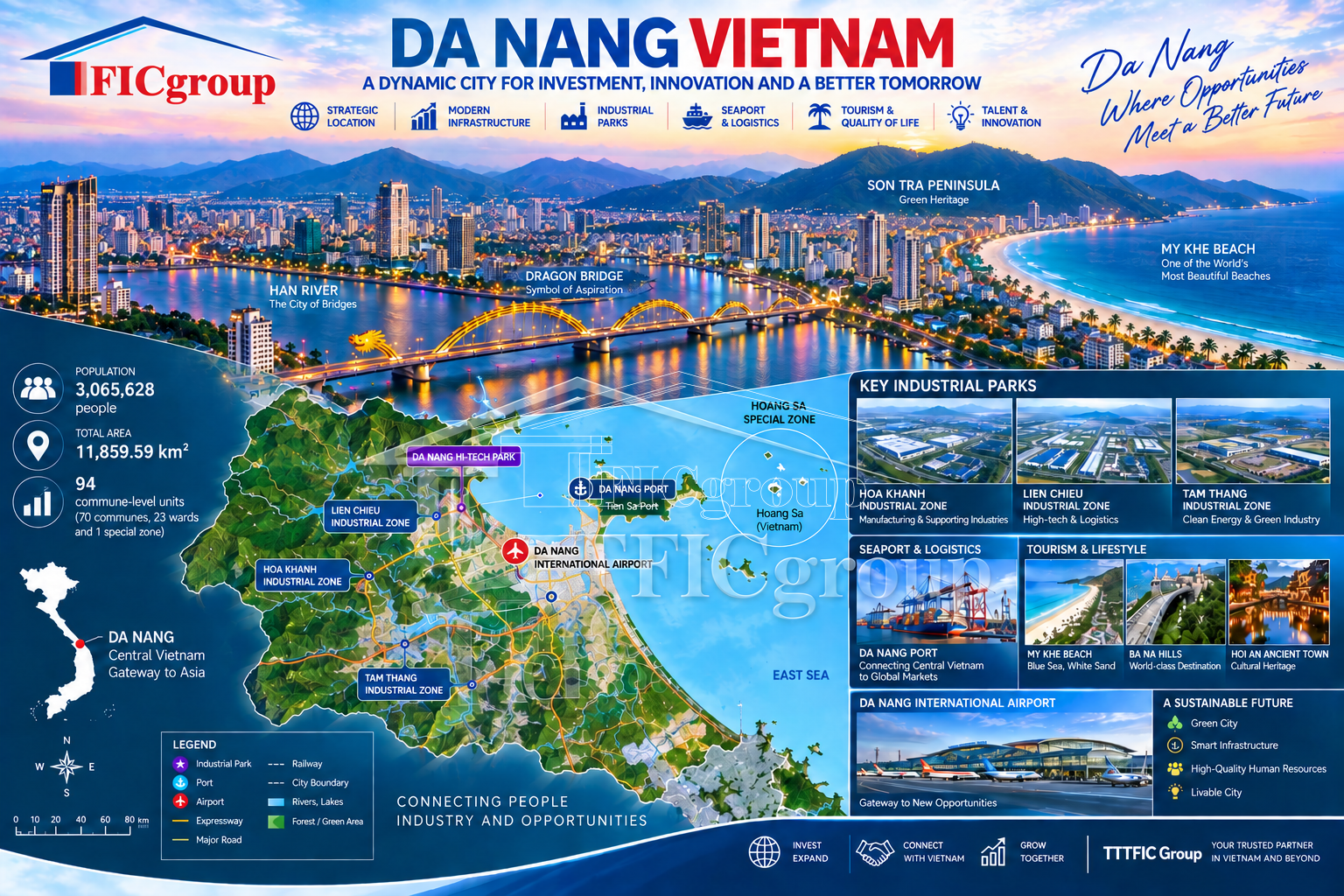
VI – VSIP DA NANG — NEW APPROVED FDI INDUSTRIAL PLATFORM
A particularly important development in 2026 is:
VSIP DA NANG INDUSTRIAL PARK.
Da Nang has officially approved the investment policy and approved:
VIETNAM–SINGAPORE INDUSTRIAL PARK JOINT VENTURE COMPANY
as the infrastructure investor.
LOCATION
DIEN BAN BAC WARD.
LAND AREA
Approximately:
249.8 HA.
REGISTERED INFRASTRUCTURE INVESTMENT
Approximately:
VND 3.73 TRILLION.
PROJECT TERM
50 YEARS
from the date of the State’s land lease / land-use conversion decision in accordance with the approved project framework.
IMPLEMENTATION ROADMAP
Q3/2026–Q3/2027
Investment preparation and required procedures.
Q4/2026–Q2/2028
Compensation, land clearance and site handover.
Q3/2027–Q4/2031
Infrastructure construction and phased operational development.
FROM Q3/2028
Marketing and investment attraction are expected to begin under the approved implementation schedule.
WHY VSIP DA NANG MATTERS
The significance of VSIP Da Nang extends beyond 249.8 hectares.
VSIP introduces an internationally recognized industrial-park development platform into the new Da Nang industrial geography.
Its location creates a potential investment corridor:
DA NANG METROPOLITAN ECONOMY
↓
DIEN BAN BAC
↓
VSIP DA NANG
↓
DIEN NAM–DIEN NGOC
↓
HOI AN / SOUTHERN ECONOMIC CORRIDOR
↓
TAM KY
↓
CHU LAI.
For international manufacturers, this creates another future location option between:
HIGH-TECH / METROPOLITAN DA NANG
and:
LARGE-SCALE INDUSTRIAL CHU LAI.
Potential positioning may include:
Actual industry acceptance must be verified against the project’s approved sector framework and environmental criteria.
APPROVED INVESTMENT POLICY
INFRASTRUCTURE INVESTOR APPROVED
does not mean:
OPERATING INDUSTRIAL PARK.
And it does not mean:
READY LAND.
TTTFIC classification:
APPROVED / DEVELOPING ASSET.
The transition sequence remains:
APPROVAL
↓
INVESTMENT PROCEDURES
↓
LAND CLEARANCE
↓
LAND HANDOVER
↓
INFRASTRUCTURE DEVELOPMENT
↓
MARKETING
↓
INVESTOR PROJECT APPROVAL
↓
COMMERCIAL OPERATION.
VSIP Da Nang should therefore be presented to investors as:
A MAJOR EMERGING INDUSTRIAL PLATFORM
rather than an existing ready-land option.
VII – CHU LAI OPEN ECONOMIC ZONE — INDUSTRIAL MASTER SYSTEM
Chu Lai should not be treated as one conventional Industrial Park.
It is a complete:
INDUSTRIAL + AUTOMOTIVE + AIRPORT + SEAPORT + LOGISTICS + URBAN + ENERGY ECONOMIC SYSTEM.
The planning framework contains approximately:
17 INDUSTRIAL PARK COMPONENTS
with a combined planning scale of approximately:
4,718 HA.
Major components include:
TAM THANG INDUSTRIAL PARK — APPROX. 197 HA
TAM THANG 2 INDUSTRIAL PARK — APPROX. 103 HA
TAM THANG EXPANDED INDUSTRIAL PARK — APPROX. 242 HA
TAM THANG EXPANSION 2 — APPROX. 111 HA
TAM HIEP PORT–LOGISTICS INDUSTRIAL PARK — APPROX. 417 HA
BAC CHU LAI INDUSTRIAL PARK — APPROX. 355 HA
CHU LAI–TRUONG HAI AUTOMOTIVE MECHANICAL INDUSTRIAL PARK — APPROX. 243 HA
CHU LAI–TRUONG HAI AUTOMOTIVE MECHANICAL IP EXPANSION — APPROX. 115 HA
TAM ANH 1 INDUSTRIAL PARK — APPROX. 167 HA
TAM ANH–KOREA INDUSTRIAL PARK — APPROX. 193 HA
TAM ANH–AN HOA INDUSTRIAL PARK — APPROX. 436 HA
THACO CHU LAI INDUSTRIAL PARK — APPROX. 451 HA
TAM ANH 3 INDUSTRIAL PARK — APPROX. 298 HA
GAS–ENERGY & DOWNSTREAM ENERGY INDUSTRIAL PARK — APPROX. 431 HA
NAM THANG BINH INDUSTRIAL PARK — SUBZONE A — APPROX. 303 HA
NAM THANG BINH INDUSTRIAL PARK — SUBZONE B — APPROX. 346 HA
THANG BINH HIGH-TECH INDUSTRIAL PARK — APPROX. 310 HA.
These assets are at different stages of development.
They must never be collectively presented as:
4,718 HA OF READY INDUSTRIAL LAND.
VIII – THACO & THE AUTOMOTIVE–MECHANICAL ECOSYSTEM
One of Da Nang’s strongest differentiated industrial assets lies in Chu Lai.
The ecosystem developed around THACO has created substantial industrial concentration in:
AUTOMOTIVE
MECHANICAL ENGINEERING
COMPONENTS
SUPPORTING INDUSTRIES
LOGISTICS.
Potential supplier opportunities include:
For international manufacturers, this is strategically important because it demonstrates that the enlarged Da Nang is not merely planning future manufacturing.
It already contains:
A LARGE-SCALE INDUSTRIAL PRODUCTION ECOSYSTEM.
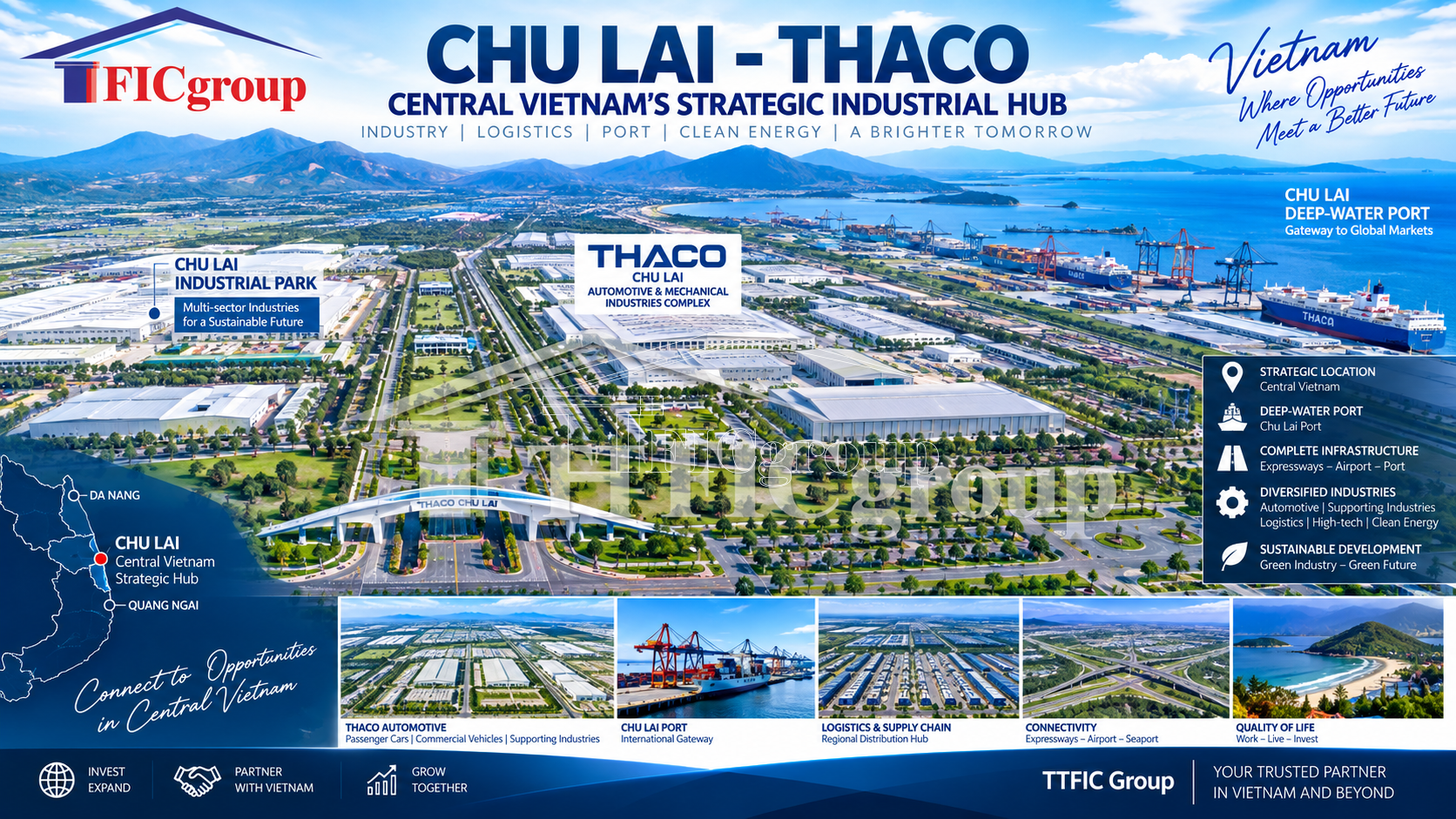
IX – THE TWO ECONOMIC ZONES
The enlarged Da Nang contains two Economic Zones with very different functions.
1. CHU LAI OPEN ECONOMIC ZONE
Planning scale toward 2030:
APPROXIMATELY 43,575 HA.
Chu Lai integrates:
INDUSTRY + PORT + AIRPORT + LOGISTICS + URBAN DEVELOPMENT + SERVICES + ENERGY + TOURISM.
Its principal strategic functions include:
Chu Lai has already developed a substantial operating investment base.
It is therefore:
AN EXISTING INDUSTRIAL ECONOMY
as well as:
A FUTURE DEVELOPMENT PLATFORM.
2. NAM GIANG BORDER GATE ECONOMIC ZONE
Planning scale:
APPROXIMATELY 28,430 HA.
Its strategic role is:
BORDER TRADE + LOGISTICS + LAOS CONNECTIVITY + GREATER MEKONG ACCESS.
Potential activities include:
The two EZs therefore perform complementary roles:
CHU LAI = SEA + INDUSTRY + AIRPORT + PORT.
NAM GIANG = LAND BORDER + LOGISTICS + INTERNATIONAL HINTERLAND.
X – DA NANG HIGH-TECH PARK
Da Nang High-Tech Park covers approximately:
1,128.4 HA.
The park is one of the city’s most important FDI assets.
Priority fields include:
Unlike many mature IPs where land availability is increasingly constrained, Da Nang High-Tech Park remains an active investment-attraction platform.
Its strategic value chain is:
UNIVERSITY / TALENT
↓
R&D
↓
HIGH-TECH PARK
↓
ADVANCED MANUFACTURING
↓
FTZ
↓
AIRPORT / PORT
↓
GLOBAL MARKET.
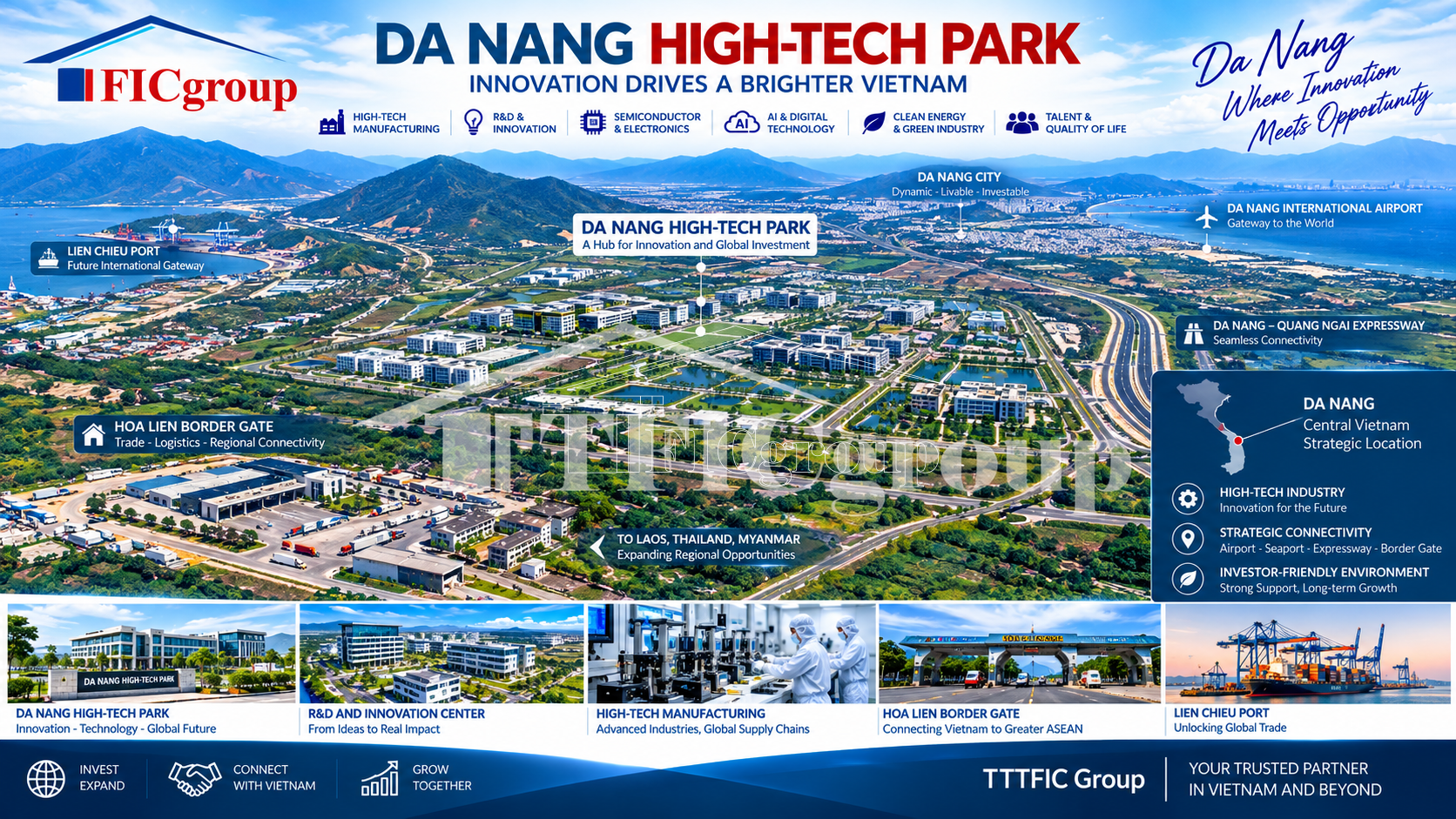
XI – SEMICONDUCTOR, AI & DIGITAL ECONOMY
Da Nang is positioning science, technology, innovation and digital transformation as major growth engines.
Priority fields include:
SEMICONDUCTORS
ARTIFICIAL INTELLIGENCE
DATA INFRASTRUCTURE
ELECTRONICS
SOFTWARE
DIGITAL SERVICES
R&D.
Potential semiconductor functions include:
The broader technology ecosystem also contains:
1 CENTRALIZED IT ZONE
and:
7 SOFTWARE PARKS.
This gives Da Nang a proposition substantially different from industrial markets based mainly on low-cost land.
The technology investment equation is:
TALENT + UNIVERSITY + SOFTWARE + HIGH-TECH PARK + FTZ + AIRPORT + INTERNATIONAL CITY.
XII – DA NANG FREE TRADE ZONE
The establishment of:
DA NANG FREE TRADE ZONE
is one of the most significant structural changes in the city’s investment environment.
Total scale:
APPROXIMATELY 1,881 HA.
Number of locations:
7 NON-CONTIGUOUS LOCATIONS.
Functional orientations include:
The distributed model is important.
The FTZ is not one contiguous 1,881-ha industrial estate.
It is a network of specialized functional locations.
This creates the potential to integrate:
HIGH-TECH PARK
LIEN CHIEU PORT
INDUSTRIAL PRODUCTION
LOGISTICS
INTERNATIONAL TRADE
DIGITAL ECONOMY.
EMERGING FTZ INDUSTRIAL CONNECTION
Planning work has also identified the:
PHU MY 3 DA NANG FTZ INDUSTRIAL PARK
at FTZ production location No. 4 in Ba Na Commune.
Indicative planning scale:
APPROXIMATELY 335 HA.
PLANNING / IMPLEMENTATION DEVELOPMENT.
It must not yet be represented as an operating Industrial Park.
FTZ CONTROL
FTZ ESTABLISHED ≠ ALL LAND SERVICED.
FTZ LOCATION ≠ AVAILABLE LAND.
POLICY ELIGIBILITY ≠ AUTOMATIC INCENTIVE.
Every investor must verify:
XIII – INDUSTRIAL CLUSTER NETWORK
Current official city information reports:
93 INDUSTRIAL CLUSTERS.
The IC system is important because it extends industrialization beyond major IPs and economic zones.
It can support:
However, the 93-IC headline must be interpreted carefully.
The planning system contains:
Therefore:
93 ICs ≠ 93 OPERATING ICs.
NORTHERN / METROPOLITAN IC SYSTEM
Important locations include:
HOA LIEN IC — APPROX. 58.53 HA
HOA LIEN 2 IC — APPROX. 50 HA
CAM LE IC — APPROX. 29.09 HA
HOA NHON IC — APPROX. 24.75 HA
HOA NHON 1 IC — APPROX. 69 HA
HOA NHON 2 IC — APPROX. 73.70 HA
HOA VANG 1 IC — APPROX. 75 HA
HOA VANG 2 IC — APPROX. 75 HA.
HOI AN / DIEN BAN INDUSTRIAL BELT
Important clusters include:
TRA MY / MEDICINAL & MOUNTAIN ECONOMY
Important clusters include:
These can support:
MEDICINAL PRODUCTS + FORESTRY + AGRICULTURAL PROCESSING + RURAL INDUSTRY.
DAI LOC INDUSTRIAL CLUSTER BELT
Important locations include:
WESTERN & OTHER DECENTRALIZED INDUSTRIAL AREAS
Additional locations include:
The decentralized industrial model is:
LOCAL RESOURCE / SME
↓
INDUSTRIAL CLUSTER
↓
PROCESSING / MANUFACTURING
↓
REGIONAL IP
↓
LOGISTICS
↓
PORT / AIRPORT
↓
INTERNATIONAL MARKET.
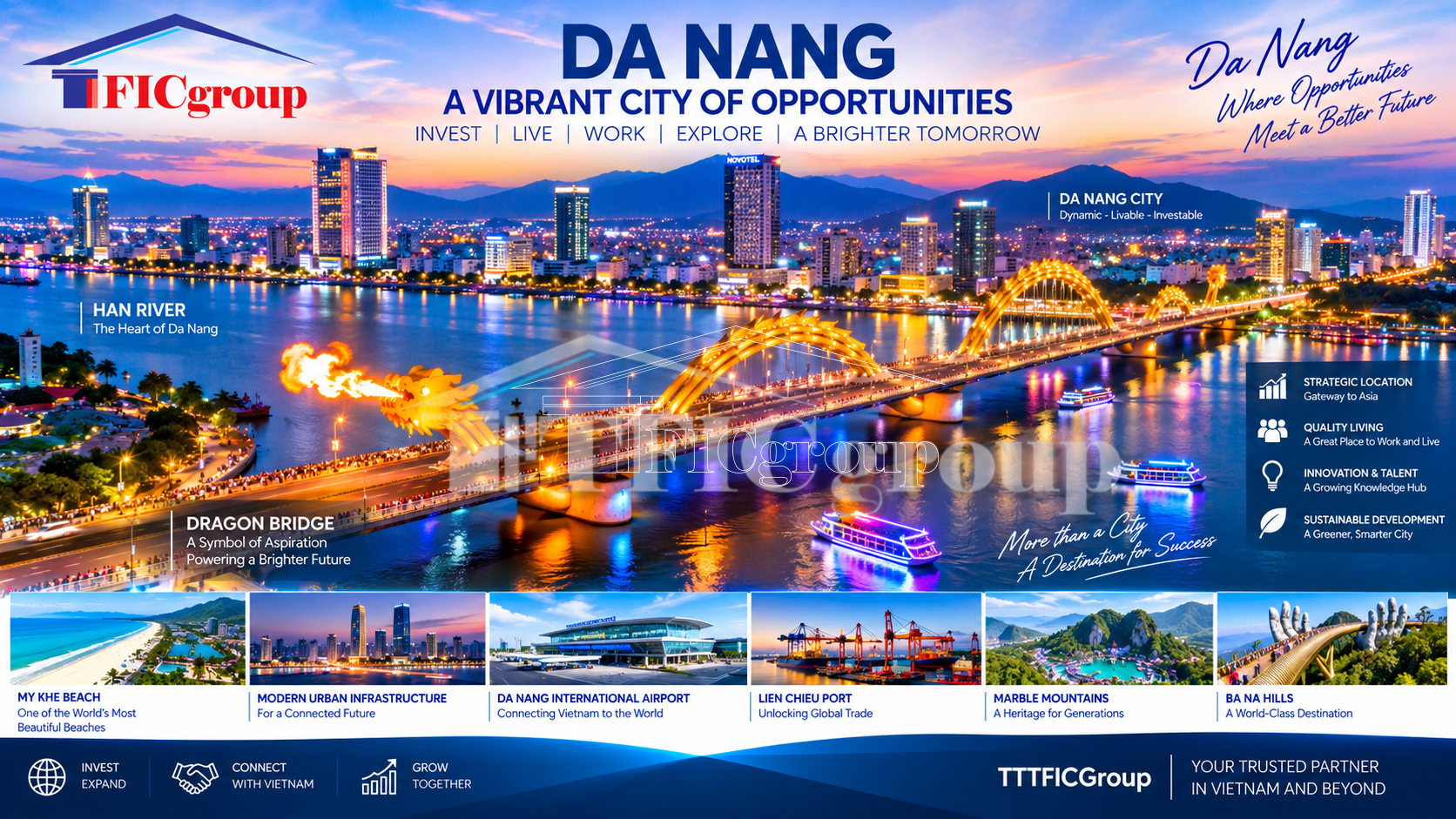
XIV – LIEN CHIEU PORT & NORTHERN MARITIME GATEWAY
Lien Chieu is central to Da Nang’s future industrial and logistics architecture.
The port development is strategically linked with:
FTZ
HIGH-TECH PARK
LIEN CHIEU IP
HOA KHANH INDUSTRIAL ECOSYSTEM
NORTH–SOUTH TRANSPORT
EAST–WEST ECONOMIC CORRIDOR.
The broader investment model is:
FACTORY
↓
LOGISTICS
↓
FTZ
↓
LIEN CHIEU PORT
↓
INTERNATIONAL MARKET.
Tien Sa remains an existing maritime gateway.
As Lien Chieu develops, the two port areas can increasingly perform differentiated roles within the metropolitan economy.
MASTER-PLANNED PORT CAPACITY ≠ CURRENT OPERATING CAPACITY.
Berth, channel, vessel-size and commissioning status must be verified for each logistics model.
XV – CHU LAI PORT & SOUTHERN MARITIME GATEWAY
Chu Lai provides the southern industrial economy with another maritime gateway.
It is particularly relevant to:
The planned Cua Lo navigation-channel development could materially improve maritime access.
Future planning has targeted vessel access toward approximately:
50,000 DWT,
subject to completion and commissioning of the relevant navigation infrastructure.
PLANNED CHANNEL CAPACITY ≠ CURRENT VESSEL CAPACITY.
XVI – TWO-AIRPORT SYSTEM
The enlarged city possesses two strategically different aviation gateways:
DA NANG INTERNATIONAL AIRPORT
and:
CHU LAI AIRPORT.
DA NANG INTERNATIONAL AIRPORT
Particularly relevant to:
Planning toward 2030 is approximately:
20 MILLION PASSENGERS PER YEAR
and:
100,000 TONNES OF CARGO PER YEAR.
CHU LAI AIRPORT
Chu Lai offers a fundamentally different proposition.
Its long-term orientation is toward:
LARGE-SCALE PASSENGER + CARGO + INDUSTRIAL LOGISTICS FUNCTIONS.
The development concept includes:
Its strategic equation is:
AIRPORT
CHU LAI EZ
INDUSTRIAL PARKS
AUTOMOTIVE
LOGISTICS.
FUTURE AIRPORT CAPACITY ≠ CURRENT OPERATING CAPACITY.
XVII – ROAD & EXPRESSWAY CONNECTIVITY
Da Nang occupies a strategic position on Vietnam’s North–South economic axis.
Major connections include:
The North–South industrial axis is:
HANOI / NORTHERN VIETNAM
↓
DA NANG
↓
DIEN BAN / VSIP
↓
TAM KY
↓
CHU LAI
↓
QUANG NGAI
↓
SOUTHERN VIETNAM.
The East–West international axis is:
DA NANG / PORT SYSTEM
↓
WESTERN DA NANG
↓
NAM GIANG
↓
LAOS
↓
NORTHEAST THAILAND
↓
GREATER MEKONG SUBREGION.
Da Nang therefore operates simultaneously as:
A NORTH–SOUTH GATEWAY
and:
AN EAST–WEST GATEWAY.
XVIII – RAILWAY & INLAND WATERWAY CONNECTIVITY
Da Nang lies on Vietnam’s North–South railway corridor.
Rail connectivity supports:
Long-term infrastructure planning also includes major national railway modernization and high-speed rail development.
However:
FUTURE RAILWAY ≠ OPERATING RAILWAY.
Investor logistics models should use current infrastructure unless future projects are explicitly treated as scenarios.
The enlarged city also contains important river systems including:
Potential functions include:
But:
PROXIMITY TO RIVER ≠ COMMERCIAL INDUSTRIAL WATERWAY LOGISTICS.
Channel depth, bridge clearance, terminals and vessel economics must be verified.
XIX – INTERNATIONAL FINANCE & HIGH-VALUE SERVICES
Da Nang’s investment proposition increasingly extends beyond conventional manufacturing.
The city is developing an ecosystem around:
INTERNATIONAL FINANCIAL SERVICES
FINTECH
DIGITAL FINANCE
PROFESSIONAL SERVICES
INNOVATION
CORPORATE HEADQUARTERS.
For international manufacturers this matters because a competitive investment environment requires more than industrial land.
It requires:
CAPITAL + PROFESSIONAL SERVICES + TALENT + TECHNOLOGY + LOGISTICS.
The combination of:
INTERNATIONAL FINANCIAL CENTER
FTZ
HIGH-TECH PARK
PORT
AIRPORT
could create a distinctive institutional investment ecosystem.
XX – MEDICINAL INDUSTRY & NGOC LINH GINSENG
The merger brings major mountainous biological resources into Da Nang’s investment geography.
Ngoc Linh ginseng and other medicinal resources create potential for:
The desired value chain is:
MEDICINAL RAW MATERIAL
↓
STANDARDIZED CULTIVATION
↓
EXTRACTION
↓
PHARMACEUTICAL / HEALTH PROCESSING
↓
BRANDING
↓
EXPORT.
This represents an economic sector that was largely absent from the traditional Da Nang investment narrative.
XXI – TOURISM, HOSPITALITY & GLOBAL LIVABILITY
Tourism remains a major pillar.
The enlarged Da Nang now integrates an exceptional destination geography including:
DA NANG
SON TRA
BA NA
HOI AN
MY SON
CHAM ISLANDS
COASTAL RESORT CORRIDORS
MOUNTAIN ECOLOGY
CULTURAL HERITAGE.
Investment opportunities include:
For FDI, tourism also performs another function.
A globally connected and livable city can improve the ability of companies to attract:
Therefore:
LIVABILITY IS ALSO AN INVESTMENT INFRASTRUCTURE.
XXII – HUMAN CAPITAL, UNIVERSITIES & R&D
Da Nang is one of Central Vietnam’s principal education and research centers.
Its talent ecosystem supports:
This is particularly relevant to:
SEMICONDUCTORS
SOFTWARE
AI
ELECTRONICS
HIGH-TECH MANUFACTURING
R&D.
However:
UNIVERSITY GRADUATES ≠ AVAILABLE PROJECT-SPECIFIC TALENT.
Investors must evaluate:
XXIII – KEY FDI INVESTMENT OPPORTUNITIES
TTTFIC identifies the following major investment themes.
Semiconductor & Electronics
IC design, electronics, packaging, testing, supporting industries and related R&D.
High-Tech Manufacturing
Precision engineering, automation, aerospace-related components, advanced materials and technology-intensive production.
Automotive & Mobility
Automotive components, mechanical engineering, EV-related systems and mobility technologies.
Supporting Industries
Metalworking, plastics, rubber, electronics, molds, components and industrial services.
Export Manufacturing
Particularly across established and emerging industrial corridors.
VSIP-Linked Future Manufacturing
Potential future opportunities associated with the new VSIP Da Nang platform after land clearance and infrastructure development.
Free Trade & International Distribution
FTZ-related production, logistics, distribution, e-commerce and trade services.
Logistics
Port logistics, air cargo, warehousing, distribution and multimodal logistics.
Software & AI
Software engineering, AI, digital services and R&D.
Data Infrastructure
Subject to power, telecommunications, cooling, land and regulatory feasibility.
Pharmaceuticals & Medicinal Products
Ngoc Linh ginseng and broader medicinal-resource processing.
Food & Agro-Processing
Processing connected with the enlarged agricultural, forestry and fisheries economy.
Tourism & Hospitality
High-quality tourism, MICE, wellness and international hospitality.
Financial & Professional Services
Fintech, investment services, corporate services and international financial activities.
XXIV – MASTER INVESTOR LOCATION MATRIX
Da Nang should not be marketed as one homogeneous investment location.
Different industries require different geographies.
SEMICONDUCTOR / ELECTRONICS / R&D
Priority screening:
DA NANG HIGH-TECH PARK
HIGH-TECH INDUSTRIAL PARK 2
THANG BINH HIGH-TECH INDUSTRIAL PARK
FTZ TECHNOLOGY LOCATIONS.
ADVANCED / CLEAN MANUFACTURING
Potential future screening:
VSIP DA NANG
HIGH-TECH PARK
HOA NINH
FTZ PRODUCTION LOCATIONS
subject to project eligibility and development status.
AUTOMOTIVE / MECHANICAL ENGINEERING
Priority screening:
CHU LAI–TRUONG HAI
THACO CHU LAI
TAM ANH
BAC CHU LAI
TAM HIEP.
GENERAL EXPORT MANUFACTURING
Potential screening:
HOA KHANH
LIEN CHIEU
HOA CAM
DIEN NAM–DIEN NGOC
TAM THANG
CHU LAI INDUSTRIAL SYSTEM.
LOGISTICS
Priority screening:
LIEN CHIEU
FTZ
DA NANG INTERNATIONAL AIRPORT
TAM HIEP
CHU LAI PORT
CHU LAI AIRPORT
NAM GIANG.
LARGE LAND-INTENSIVE INDUSTRY
Future screening may include:
TAY QUE SON — APPROX. 1,200 HA
THANG PHU–TAY HO — APPROX. 1,000 HA
BAC THANG BINH 2 — APPROX. 770 HA
DAI LOC — APPROX. 600 HA
BINH LAM–BINH LANH — APPROX. 490 HA
subject to establishment, land clearance, infrastructure, environmental capacity and industry eligibility.
MEDICINAL / BIOECONOMY
Priority screening:
TRA MY / NGOC LINH CORRIDOR
MEDICINAL-PRODUCT INDUSTRIAL CLUSTERS
HIGH-TECH PROCESSING / R&D LOCATIONS.
XXV – POST-MERGER ECONOMIC SYNERGY
The enlarged Da Nang can be understood through six complementary platforms.
PLATFORM 1 — METROPOLITAN KNOWLEDGE ECONOMY
FINANCE + SOFTWARE + AI + R&D + TOURISM + INTERNATIONAL SERVICES.
PLATFORM 2 — NORTHERN TECHNOLOGY & LOGISTICS ECONOMY
HIGH-TECH PARK + FTZ + LIEN CHIEU + INDUSTRY + PORT.
PLATFORM 3 — DIEN BAN / VSIP INDUSTRIAL BRIDGE
VSIP + DIEN NAM–DIEN NGOC + METROPOLITAN ACCESS + HOI AN CORRIDOR.
PLATFORM 4 — CENTRAL INDUSTRIAL EXPANSION
TAM KY + THANG BINH + INDUSTRIAL LAND + SUPPORTING INDUSTRIES.
PLATFORM 5 — CHU LAI INDUSTRIAL ENGINE
AUTOMOTIVE + MECHANICAL + PORT + AIRPORT + LOGISTICS + ENERGY.
PLATFORM 6 — WESTERN INTERNATIONAL & RESOURCE ECONOMY
NAM GIANG + LAOS + MEDICINAL RESOURCES + FORESTRY + GMS.
Together:
IDEA / CAPITAL / TECHNOLOGY
↓
R&D
↓
MANUFACTURING
↓
SUPPLY CHAIN
↓
FTZ / LOGISTICS
↓
PORT / AIRPORT / BORDER GATE
↓
GLOBAL MARKET.
XXVI – TTMS™ INVESTMENT CONTROL FRAMEWORK
1. CURRENT OPERATING ASSETS
Include:
2. NEWLY OPERATING / RAMP-UP ASSETS
Includes newly commissioned industrial, technology and logistics infrastructure subject to individual verification.
3. UNDER-CONSTRUCTION / INFRASTRUCTURE-DEVELOPMENT ASSETS
Includes relevant:
4. APPROVED / DEVELOPING ASSETS
Includes:
VSIP DA NANG
and other projects with approved investment or established legal development status that have not yet achieved full commercial operation.
5. STRATEGIC / FUTURE ASSETS
Includes:
6. INVESTABLE PROJECT / INVESTABLE SITE
TTTFIC only classifies an opportunity as genuinely investable after verification of:
LAND
PLANNING
LEGAL STATUS
LAND CLEARANCE
INFRASTRUCTURE
ELECTRICITY
WATER
WASTEWATER
ENVIRONMENTAL CAPACITY
FIRE SAFETY
FLOOD / TYPHOON / CLIMATE RISK
ROAD ACCESS
PORT ACCESS
AIRPORT ACCESS
LABOR
SUPPLY CHAIN
INDUSTRY ELIGIBILITY
INCENTIVE ELIGIBILITY
COMMERCIAL TERMS.
XXVII – INVESTMENT RISKS & EXECUTION CONSIDERATIONS
Da Nang’s expanded investment geography creates exceptional opportunity but also greater execution complexity.
Industrial Land Availability
Central Da Nang is not a conventional large-land-bank industrial market.
Large projects increasingly require evaluation of:
Planning Status
Da Nang has a large future industrial portfolio.
But:
PLANNING ≠ INVESTABLE LAND.
VSIP Timing
VSIP Da Nang is approved, but infrastructure development is still ahead.
Investors evaluating it must distinguish:
FUTURE OPPORTUNITY
from:
CURRENT READY LAND.
Typhoon & Flood Risk
Central Vietnam is exposed to:
Site-level hydrology and structural design are essential.
Mountainous Geography
Western areas can face:
Environmental Capacity
High technology, manufacturing, tourism and urban development share the same regional environmental system.
Wastewater and environmental capacity therefore require project-level verification.
Labor
Da Nang possesses a strong education base.
But advanced manufacturing projects may compete for specialized technical talent.
Logistics Transition
Lien Chieu, FTZ, Chu Lai, airport and navigation-channel investments could materially improve future logistics.
But:
FUTURE INFRASTRUCTURE ≠ CURRENT LOGISTICS CAPACITY.
XXVIII – WHY DA NANG MATTERS TO INTERNATIONAL INVESTORS
Da Nang’s proposition differs fundamentally from purely manufacturing-driven industrial provinces.
It combines:
INTERNATIONAL CITY
HIGH-TECH PARK
FREE TRADE ZONE
VSIP
AUTOMOTIVE INDUSTRIAL ECOSYSTEM
TWO ECONOMIC ZONES
TWO AIRPORTS
MULTIPLE MARITIME GATEWAYS
INTERNATIONAL LAND BORDER
UNIVERSITIES
FINANCIAL SERVICES
TOURISM & QUALITY OF LIFE.
For an international company, Da Nang can potentially support several corporate functions within one regional platform:
REGIONAL OFFICE
R&D
SOFTWARE
HIGH-TECH MANUFACTURING
INDUSTRIAL PRODUCTION
SUPPLY CHAIN
DISTRIBUTION
EXPORT
EXECUTIVE LIVING.
That combination is strategically important.
XXIX – TTTFIC INVESTMENT PERSPECTIVE
Historically, many international investors viewed Da Nang primarily as:
A BEAUTIFUL COASTAL CITY.
That interpretation is now incomplete.
The post-merger city contains several economic systems capable of reinforcing one another.
KNOWLEDGE ECONOMY
FINANCE + SOFTWARE + AI + R&D + PROFESSIONAL SERVICES.
HIGH-TECH ECONOMY
SEMICONDUCTORS + ELECTRONICS + HIGH-TECH PARK + ADVANCED MANUFACTURING.
INDUSTRIAL ECONOMY
VSIP + IPs + ICs + AUTOMOTIVE + MECHANICAL + SUPPORTING INDUSTRIES.
INTERNATIONAL TRADE ECONOMY
FTZ + LOGISTICS + PORTS + AIRPORTS.
INTERNATIONAL GATEWAY ECONOMY
EAST SEA + LAOS BORDER + GREATER MEKONG.
DESTINATION ECONOMY
TOURISM + HOSPITALITY + LIVABILITY + CULTURE.
The strategic opportunity is to connect all of them.
CAPITAL / IDEA / TECHNOLOGY
↓
R&D
↓
HIGH-TECH / INDUSTRIAL PRODUCTION
↓
SUPPLY CHAIN
↓
FTZ / LOGISTICS
↓
PORT / AIRPORT / BORDER
↓
GLOBAL MARKET.
For TTTFIC, this changes the fundamental site-selection question.
It is no longer:
“WHERE CAN I RENT A FACTORY IN DA NANG?”
The correct question is:
“WHICH PART OF THE NEW DA NANG ECONOMIC SYSTEM BEST FITS THE INVESTOR’S VALUE CHAIN?”
A semiconductor project may require the High-Tech Park.
An advanced clean-manufacturing investor may evaluate the emerging VSIP platform.
An automotive supplier may belong in Chu Lai.
A logistics operator may prioritize Lien Chieu, FTZ, Tam Hiep or Chu Lai.
A software or AI company may prioritize metropolitan Da Nang.
A pharmaceutical investor may need access to the medicinal-resource economy.
A regional headquarters may prioritize the urban core.
A company requiring access to Laos may evaluate the Nam Giang corridor.
The role of TTTFIC is therefore:
NOT MERELY FINDING LAND.
It is:
MATCHING THE INVESTOR’S VALUE CHAIN WITH THE CORRECT ECONOMIC GEOGRAPHY.
XXX – TTTFIC GROUP INVESTOR SUPPORT
TTTFIC Group | Vietnam Industrial Investment & Business Advisory
TTTFIC Group supports international investors throughout the enlarged Da Nang investment territory through:
TTTFIC can compare investment locations across:
CENTRAL DA NANG
LIEN CHIEU
DA NANG HIGH-TECH PARK
HOA KHANH
HOA CAM
BA NA
DIEN BAN
VSIP DA NANG
DIEN NAM–DIEN NGOC
TAM KY
THANG BINH
TAM THANG
CHU LAI
NUI THANH
NAM GIANG
according to the investor’s actual operational requirements.
The objective is not to recommend a location simply because land exists.
The objective is to determine:
WHICH LOCATION CREATES THE BEST OPERATING LOGIC FOR THE PROJECT.
XXXI – CONCLUSION
Da Nang 2026 should be reassessed from the beginning.
The city international investors knew before the administrative restructuring has fundamentally changed.
The new Da Nang combines:
A MAJOR COASTAL METROPOLIS
A HIGH-TECH ECONOMY
A FREE TRADE ZONE
VSIP DA NANG
A LARGE INDUSTRIAL ECONOMY
AN AUTOMOTIVE & MECHANICAL MANUFACTURING ECOSYSTEM
TWO ECONOMIC ZONES
TWO AIRPORTS
MULTIPLE SEAPORT GATEWAYS
AN INTERNATIONAL LAND BORDER
FINANCE
DIGITAL TECHNOLOGY
TOURISM.
Its economic geography now extends:
FROM THE LAOS BORDER
↓
THROUGH MOUNTAIN RESOURCE AREAS
↓
THROUGH INDUSTRIAL & URBAN CORRIDORS
↓
THROUGH DA NANG / DIEN BAN / TAM KY
↓
THROUGH CHU LAI
↓
TO THE EAST SEA
↓
AND GLOBAL MARKETS.
Da Nang’s proposition does not lie in one single advantage.
It lies in the integration of:
TECHNOLOGY
MANUFACTURING
AUTOMOTIVE
FREE TRADE
LOGISTICS
FINANCE
TOURISM
INTERNATIONAL CONNECTIVITY.
The arrival of an approved VSIP industrial platform adds another important layer to that transformation.
The industrial geography is becoming broader.
The logistics system is becoming deeper.
The technology ecosystem is becoming more sophisticated.
The international gateway function is becoming more diversified.
For FDI investors evaluating Central Vietnam, the correct conclusion is not simply that:
DA NANG HAS MORE INDUSTRIAL LAND.
The more important conclusion is that:
DA NANG NOW HAS A MUCH MORE COMPLETE INVESTMENT ECOSYSTEM.
And consequently:
ITS INVESTMENT THESIS HAS FUNDAMENTALLY CHANGED.
TTTFIC VIETNAM INVESTMENT INTELLIGENCE PLATFORM 2026
34 Provinces & Cities. One Updated Investment Intelligence Platform.
TTTFIC Group | Vietnam Industrial Investment & Business Advisory
Vietnam Nationwide + Thailand
Tel / WhatsApp: +84 936 431 788
Email: marketing@tttfic.com