Ha Binh Phuong Industrial Cluster - Ha Noi
- Investor: DIA Investment Joint Stock Company
- Price: 50 USD/m2
- Area: 41,6 Ha
TTTFIC GLOBAL INVESTMENT PROFILE 2026
Hanoi is the capital of the Socialist Republic of Vietnam and one of the country’s most strategically important destinations for foreign direct investment, high technology, research and development, advanced manufacturing, financial and professional services, logistics, and regional corporate operations.
Unlike conventional industrial locations that compete primarily on land availability and operating cost, Hanoi offers a fundamentally different investment proposition. Its value lies in the concentration of national decision-making institutions, universities and research organizations, skilled human capital, technology infrastructure, international aviation, sophisticated business services, and direct access to Northern Vietnam’s most important manufacturing and export corridors.
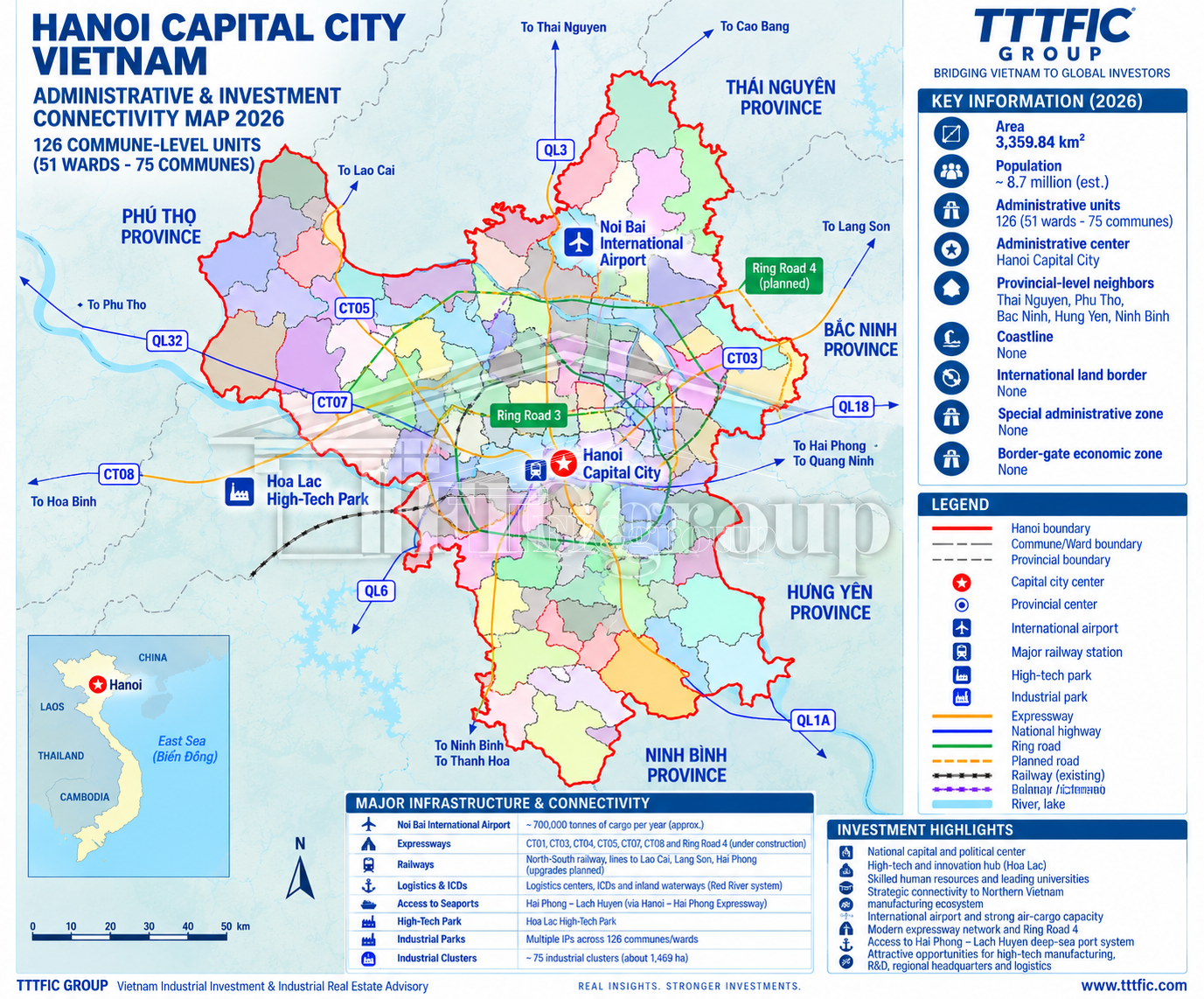
With an area of approximately 3,359.84 km², Hanoi remained unchanged at the provincial level following Vietnam’s 2025 administrative restructuring. From July 1, 2025, however, the capital transitioned to the new two-tier local government model and now comprises 126 commune-level administrative units, including 51 wards and 75 communes.
Hanoi’s strategic influence extends far beyond its administrative boundary. The capital sits at the center of a powerful Northern Vietnam production network connecting the electronics and semiconductor ecosystem of Bac Ninh and Thai Nguyen, the emerging industrial base of Phu Tho and Hung Yen, the manufacturing and deep-sea port economy of Hai Phong, and the port and border-trade infrastructure of Quang Ninh.
For international investors, Hanoi should therefore be viewed not simply as a city, but as the command center of Northern Vietnam’s high-value industrial economy.
Hanoi occupies a unique position within Vietnam’s national economic architecture.
It simultaneously functions as:
This combination creates an investment environment that is difficult to replicate elsewhere in Vietnam.
Hanoi is particularly suitable for investors whose location decisions depend not only on factory costs, but also on technology, engineering talent, R&D capability, government accessibility, international connectivity, supplier ecosystems, professional services, and long-term strategic positioning.
Official name: Hanoi Capital City
Country: Socialist Republic of Vietnam
Administrative level: Centrally governed municipality / national capital
Natural area: Approximately 3,359.84 km²
Current local administrative structure: 126 commune-level units
Wards: 51
Communes: 75
Special administrative zones: None
Hanoi did not merge with another province or centrally governed municipality during Vietnam’s 2025 provincial-level administrative restructuring.
Its internal administrative organization, however, changed fundamentally under the two-tier local government model. The former district-level structure is therefore no longer appropriate for describing Hanoi’s current administrative system.
Under Vietnam’s post-2025 34-province/city administrative structure, Hanoi borders:
Hanoi has no coastline, no international land border, no special administrative zone, and no border-gate economic zone.
This inland position does not isolate Hanoi from international trade. Instead, the capital operates as the central node of a broader multimodal logistics network linking Northern Vietnam’s manufacturing centers with airports, rail corridors, inland waterways, border gateways, and major seaports.
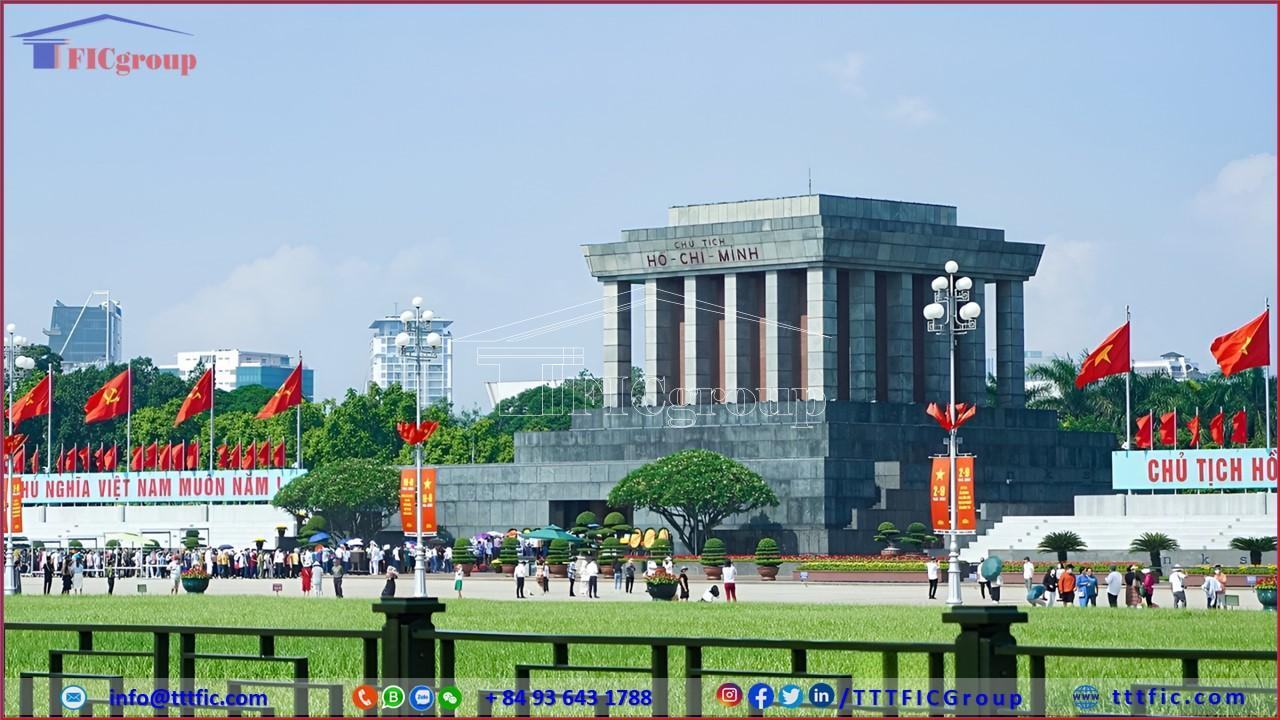
Hanoi should not be evaluated as a conventional low-cost manufacturing location.
As Vietnam’s capital and one of its largest economies, Hanoi represents the country’s highest concentration of government institutions, universities, research capabilities, corporate services, technology infrastructure, skilled professionals, and national-level connectivity.
Its strongest FDI proposition lies in activities where human capital, technology, speed, connectivity, R&D and access to decision-making ecosystems matter more than the lowest possible industrial land cost.
Priority investment profiles include:
Hanoi’s competitive advantage is therefore not based on being the cheapest place to manufacture.
It is based on being one of the most strategically connected places from which to manage, engineer, innovate and coordinate manufacturing across Northern Vietnam.
Hanoi remains one of Vietnam’s largest provincial-level economies and an essential contributor to national growth.
In 2025, Hanoi recorded GRDP growth of approximately 8.16%, demonstrating strong economic momentum despite an increasingly complex global trade and investment environment.
The city’s economic scale was estimated at approximately US$63.5 billion, supported by a diversified structure encompassing services, manufacturing, construction, technology, trade, finance, transportation, real estate, education, and other knowledge-intensive sectors.
Selected 2025 indicators included:
GRDP Growth: approximately 8.16%
Estimated GRDP: approximately US$63.5 billion
Registered FDI attracted: approximately US$4.44 billion
Total development investment: approximately VND 594.7 trillion
Total merchandise trade: approximately US$68.0 billion
Exports: approximately US$20.8 billion
Imports: approximately US$47.3 billion
State budget revenue: approximately VND 711.2 trillion
Hanoi’s services sector remains dominant, while industrial and construction activities continue to provide an important foundation for economic diversification.
For investors, this diversified economy reduces dependence on any single manufacturing industry and provides access to a broad network of banks, professional advisers, technology providers, universities, logistics companies, contractors, engineering firms and government institutions.
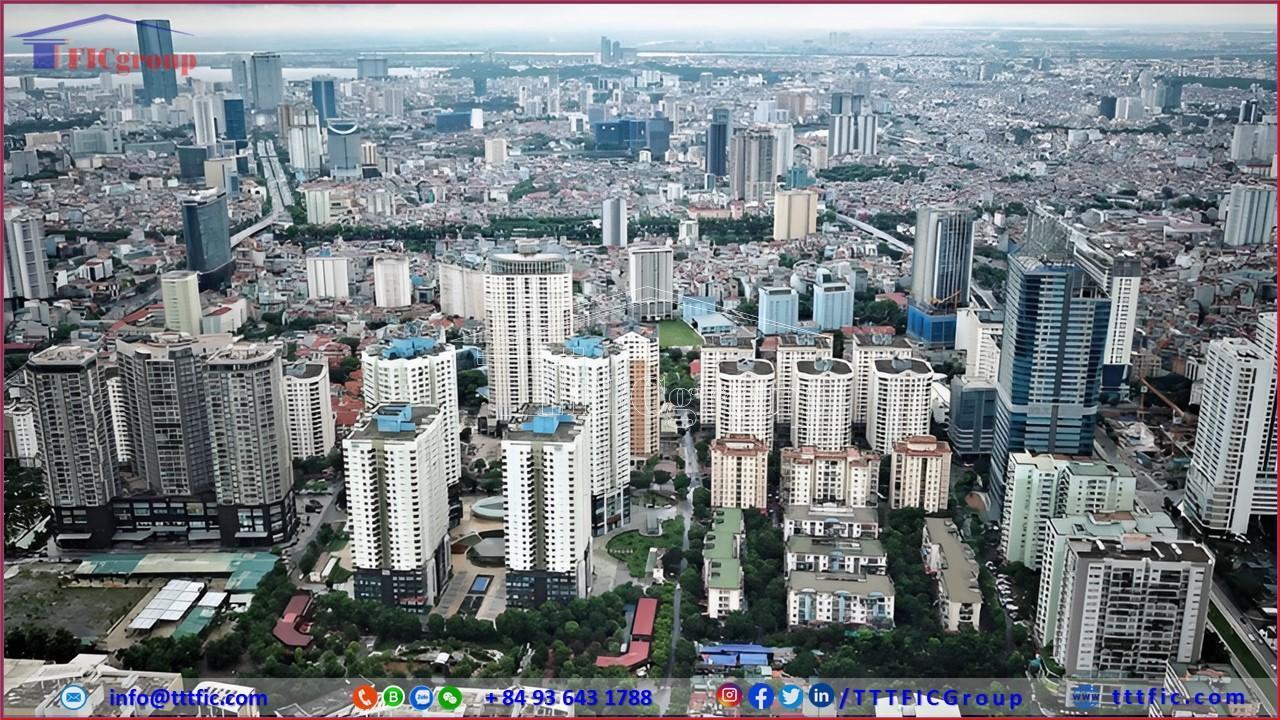
Hanoi has long been one of Vietnam’s leading destinations for international capital.
Its FDI proposition differs from manufacturing locations dominated by large-scale, labor-intensive production.
Foreign investors in Hanoi can combine industrial operations with:
This makes Hanoi particularly relevant for multinational corporations pursuing a multi-location Vietnam strategy.
A company may, for example, locate headquarters, engineering, R&D or supply-chain management functions in Hanoi while positioning large-scale manufacturing in surrounding industrial provinces.
This creates a powerful hub-and-spoke investment model, with Hanoi functioning as the strategic and knowledge-intensive hub and the surrounding Northern Vietnam industrial belt providing manufacturing scale.
Hanoi’s industrial landscape is undergoing a structural transition.
Rather than expanding conventional industrialization indefinitely, the capital is increasingly prioritizing high technology, cleaner production, innovation, advanced manufacturing, industrial modernization, digitalization and environmentally responsible development.
As of early 2026, the Hanoi High-Tech and Industrial Parks Management Board oversaw a platform comprising:
Among the industrial parks, existing projects are at different stages of operation, infrastructure development and planning.
Hanoi also has an extensive industrial-cluster network serving smaller and medium-sized manufacturers, supporting industries, specialized production and the modernization of traditional industrial activities.
As of 2026, approximately 75 industrial clusters covering around 1,469 hectares were in operation, while additional clusters were under development or planning.
For investors, the result is not a single industrial zone but a diversified industrial ecosystem ranging from high-technology research and production to supporting industries and specialized manufacturing.
Hoa Lac High-Tech Park is one of the most important components of Hanoi’s long-term investment strategy.
With a planned area of approximately 1,586 hectares, Hoa Lac is Vietnam’s first and largest high-tech park and is intended to become a national center for:
Within the broader park, the high-tech industrial zone provides dedicated space for high-technology manufacturing and related operations.
Hoa Lac’s strategic importance extends beyond available industrial land.
Its value comes from the potential concentration of research institutions, universities, laboratories, technology enterprises, manufacturing facilities and innovation infrastructure within a single ecosystem.
For multinational investors seeking to integrate R&D, engineering and advanced manufacturing in Vietnam, this makes Hoa Lac fundamentally different from a conventional industrial park.
Noi Bai International Airport is one of Hanoi’s most significant industrial and supply-chain assets.
Located north of the urban core, Noi Bai connects Hanoi directly with major regional and international markets and plays a critical role in Northern Vietnam’s high-value cargo network.
The airport has handled cargo volumes approaching 700,000 tonnes annually, reinforcing its importance to time-sensitive and high-value supply chains.
Its strategic value is particularly significant for:
Long-term aviation planning anticipates substantial expansion of Noi Bai’s passenger and cargo capabilities, strengthening Hanoi’s position as an international aviation gateway.
For industrial investors, this means Hanoi’s airport should not be considered merely passenger infrastructure.
Noi Bai is part of Northern Vietnam’s industrial logistics architecture.
Hanoi’s logistics advantage comes from network integration rather than direct access to the sea.
The capital combines:
International aviation + expressways + national highways + railway corridors + inland waterways + ICDs + regional logistics centers + access to deep-sea ports.
This enables Hanoi to function as an inland command and distribution center serving Northern Vietnam.
Major logistics planning includes strategic nodes in northern, southern, eastern and peripheral areas of the capital, with integration into airports, rail terminals, highways, inland waterways and industrial corridors.
Hanoi’s 2026–2030 logistics development strategy seeks to strengthen the capital’s position as a major logistics center for the Red River Delta and a leading Vietnamese e-logistics market.
This is particularly relevant for investors managing multi-factory supply chains across Northern Vietnam.
Hanoi has no seaport.
For international manufacturing, however, the more important question is not whether a factory lies within a coastal municipality, but how efficiently it can connect to international container gateways.
Hanoi is directly integrated with the Hai Phong–Lach Huyen port system through the Hanoi–Hai Phong expressway and the wider regional transportation network.
This corridor connects the capital and neighboring industrial provinces to one of Northern Vietnam’s principal maritime gateways.
The broader logistics network also provides access toward Quang Ninh and Cai Lan, creating alternative connections to the northeastern coastal economy.
Consequently, Hanoi can support international manufacturing and supply-chain management without attempting to function as a seaport city itself.
Hanoi is the central node of Northern Vietnam’s radial expressway system.
Major corridors connect the capital toward:
The continued development of Ring Road 4 – Capital Region is particularly significant.
Ring Road 4 is designed to redistribute traffic away from the urban core, improve interprovincial connectivity, unlock new development areas and strengthen integration among Hanoi and surrounding manufacturing provinces.
From an industrial perspective, this creates opportunities not only inside Hanoi but across the wider Capital Region logistics and manufacturing network.
Hanoi is Northern Vietnam’s principal railway hub.
The national rail network provides strategic connections toward:
Future development of railway infrastructure, freight terminals and multimodal logistics facilities has the potential to increase the role of rail in industrial transportation.
The planned development of major transport nodes such as Ngoc Hoi is particularly relevant to long-term passenger and freight integration.
For manufacturers considering China+1 strategies, Hanoi’s position between Vietnam’s northern manufacturing belt, international border corridors and maritime gateways provides significant strategic value.
One of Hanoi’s greatest investment advantages exists outside Hanoi itself.
Within the wider northern economic region, investors can access powerful manufacturing ecosystems in:
Bac Ninh — electronics, semiconductors, components and supporting industries.
Thai Nguyen — electronics and large-scale manufacturing.
Hung Yen — manufacturing, logistics and industrial real estate.
Phu Tho — emerging industrial development and connectivity toward northwestern Vietnam.
Hai Phong — manufacturing, logistics and international deep-sea ports.
Quang Ninh — ports, industrial development, border trade and China connectivity.
Hanoi sits near the center of this network.
This creates an important distinction:
Regional headquarters, R&D, engineering, procurement or management can be located in the capital while manufacturing operations are distributed across the surrounding industrial belt.
This is one of Northern Vietnam’s strongest location strategies for multinational companies.
Human capital is one of Hanoi’s strongest competitive advantages.
The capital contains one of Vietnam’s largest concentrations of universities, engineering institutions, research organizations, vocational education facilities and highly skilled professionals.
Its academic and research ecosystem supports disciplines including:
For technology-intensive manufacturers, access to engineers and technical professionals can be more strategically important than marginal differences in industrial rent.
This makes Hanoi particularly competitive for businesses requiring:
R&D + engineering + technology + management + manufacturing integration.
Hanoi continues to reinforce its electricity infrastructure to accommodate urban growth, digitalization, high-tech development and increasing industrial demand.
Investment priorities include reinforcement of the 500 kV, 220 kV and 110 kV networks, with particular attention to strategic growth areas including western Hanoi and the Hoa Lac technology corridor.
The city is also advancing:
For sophisticated manufacturers, these developments are increasingly important as global supply chains place greater emphasis on energy resilience, carbon performance and sustainable manufacturing.
Based on Hanoi’s economic structure, technology ecosystem, talent base and infrastructure strategy, TTTFIC identifies particularly strong potential in:
Integrated circuits, electronic components, sensors, advanced packaging, testing, supporting industries and precision electronics.
Automation equipment, robotics, intelligent machinery and technology-intensive production.
Corporate laboratories, engineering centers, product development and technology commercialization.
Software, cloud infrastructure, AI, digital platforms and enterprise technology.
Biotechnology, medical devices, diagnostics and high-value healthcare technologies.
New materials, specialized components and technology-intensive materials engineering.
High-value components, maintenance-related supply chains, airport logistics and time-sensitive manufacturing.
Air cargo, fulfillment, distribution, cold chain, express logistics and technology-enabled logistics.
Data centers and digital infrastructure, subject to site-specific power, planning, environmental and regulatory requirements.
Management, finance, procurement, engineering, legal, consulting and supply-chain coordination.
Hanoi’s industrial real estate market should be evaluated differently from lower-cost manufacturing provinces.
The investment opportunity increasingly centers on:
Land availability, infrastructure readiness, permitted industries and investment incentives vary significantly by location and project.
Investors should therefore conduct detailed site-selection and regulatory due diligence rather than relying solely on advertised industrial land prices.
Hanoi’s economic advantages are accompanied by challenges typical of a rapidly expanding megacity.
These include:
For industrial investors, these factors reinforce the importance of selecting locations based on operational requirements rather than administrative prestige alone.
Large-scale or land-intensive manufacturing may achieve greater efficiency in surrounding provinces, while high-value manufacturing, R&D, technology, logistics and corporate functions may benefit substantially from proximity to Hanoi.
This distinction is central to professional site-selection strategy.
Hanoi’s investment proposition can be summarized through seven strategic advantages:
1. National Capital Advantage
Direct proximity to Vietnam’s central government, national institutions and major regulatory bodies.
2. Technology & Innovation
Hoa Lac High-Tech Park and a growing high-tech ecosystem support advanced investment.
3. Human Capital
One of Vietnam’s deepest pools of engineers, researchers, managers and skilled professionals.
4. Noi Bai International Airport
Direct international passenger and high-value cargo connectivity.
5. Northern Manufacturing Ecosystem
Immediate access to major industrial centers across Bac Ninh, Thai Nguyen, Hung Yen, Phu Tho, Hai Phong and Quang Ninh.
6. Multimodal Logistics
Expressways, railways, inland waterways, ICDs, air cargo and access to international seaports.
7. High-Value Investment Positioning
A strong environment for businesses competing through technology, engineering, innovation and supply-chain sophistication rather than labor cost alone.
For global investors evaluating Vietnam, Hanoi should not be considered in isolation.
Its true investment value emerges when the capital is viewed together with the wider Northern Vietnam industrial ecosystem.
A sophisticated investment strategy may combine:
Hanoi
for headquarters, management, R&D, engineering and technology;
Bac Ninh / Thai Nguyen
for electronics and high-tech supply chains;
Hung Yen / Phu Tho and other regional locations
for industrial expansion and manufacturing;
Hai Phong / Quang Ninh
for maritime logistics and export infrastructure;
and
Northern border corridors
for supply-chain connectivity with China.
This regional approach allows investors to optimize talent, land, logistics, suppliers, infrastructure, costs and market access simultaneously.
That is the strategic role Hanoi can play in an international manufacturer’s Vietnam footprint.
TTTFIC Group supports foreign investors throughout the industrial investment lifecycle in Hanoi and across Vietnam.
Our services include:
TTTFIC’s role is not simply to identify available industrial property.
Our objective is to help investors determine where a project should be located, why that location makes strategic sense, what risks must be evaluated, and how the investment can be implemented efficiently in Vietnam.
Investment Positioning:
Vietnam’s national capital and Northern Vietnam’s high-value technology, talent and supply-chain command center.
Best Suited For:
High-tech manufacturing, semiconductors, electronics, R&D, precision engineering, biotechnology, medical technology, digital industries, aviation-linked businesses, sophisticated logistics, regional headquarters and knowledge-intensive operations.
Core Infrastructure Advantages:
Noi Bai International Airport, Hoa Lac High-Tech Park, Northern Vietnam expressway network, Capital Region Ring Road 4, national railway system, inland waterways, regional logistics infrastructure and access to the Hai Phong–Lach Huyen deep-sea port system.
Administrative Structure:
126 commune-level administrative units — 51 wards and 75 communes.
Provincial-Level Neighbors:
Thai Nguyen, Phu Tho, Bac Ninh, Hung Yen and Ninh Binh.
International Land Border:
None.
Coastline:
None.
Economic Zone:
None.
Border-Gate Economic Zone:
None.
Special Administrative Zone:
None.
TTTFIC Investment Thesis:
Hanoi is not competing to become Vietnam’s cheapest manufacturing destination.
It is building something more strategically valuable:
a high-value investment ecosystem where government, technology, talent, R&D, international aviation, advanced manufacturing and Northern Vietnam’s industrial supply chains converge.
For multinational companies seeking not simply a factory, but a long-term strategic platform in Vietnam and Southeast Asia, Hanoi deserves consideration at the highest level of the location decision.
Industrial Parks • Industrial Land • Ready-Built Factories • Warehouses • Build-to-Suit • Design & Build • Factory M&A • Site Selection • FDI Advisory • IRC/ERC • Legal & Regulatory Support • Environmental & Fire Safety Compliance • Investment Implementation
TTTFIC Global Investment Intelligence | Vietnam 2026
Data note: Administrative information reflects Vietnam’s post-2025 two-tier local government structure. Economic and investment indicators are based on the latest official or publicly available data identified for preparation of this 2026 profile. Industrial park status, infrastructure projects, incentives, land availability, utility capacity and regulatory eligibility may change and should be independently verified for each investment project before a final investment decision.
————————————
Team Marketing
Tel: + 84 274 633 6888
Email: marketing@tttfic.com
Phone: + 84 936431788
Table of contents