WHA 1 Industrial Zone - Nghe An
- Investor: WHA Industrial Development
- Price: 70 USD/m2
- Area: 498 ha
NGHE AN, VIETNAM 2026
Vietnam’s Emerging High-Tech Manufacturing, FDI & North-Central Logistics Platform
TTTFIC GLOBAL INVESTMENT PROFILE 2026
Nghe An is undergoing one of the most important industrial transformations in North Central Vietnam.
For decades, the province was principally associated with:
agriculture, forestry, a large population base, Vinh, Cua Lo and the western mountainous region.
That description is no longer sufficient.
Over the past several years, Nghe An has successfully attracted a new generation of global manufacturers and industrial developers including:
Luxshare-ICT
Goertek
Foxconn
Everwin
JuTeng
Sunny
VSIP
and:
WHA Industrial Development.
The result is the emergence of a significantly more sophisticated investment platform based on:
ELECTRONICS
Nghe An is therefore no longer simply one of Vietnam’s largest provinces.
It is becoming one of the country’s most important second-wave FDI manufacturing locations.
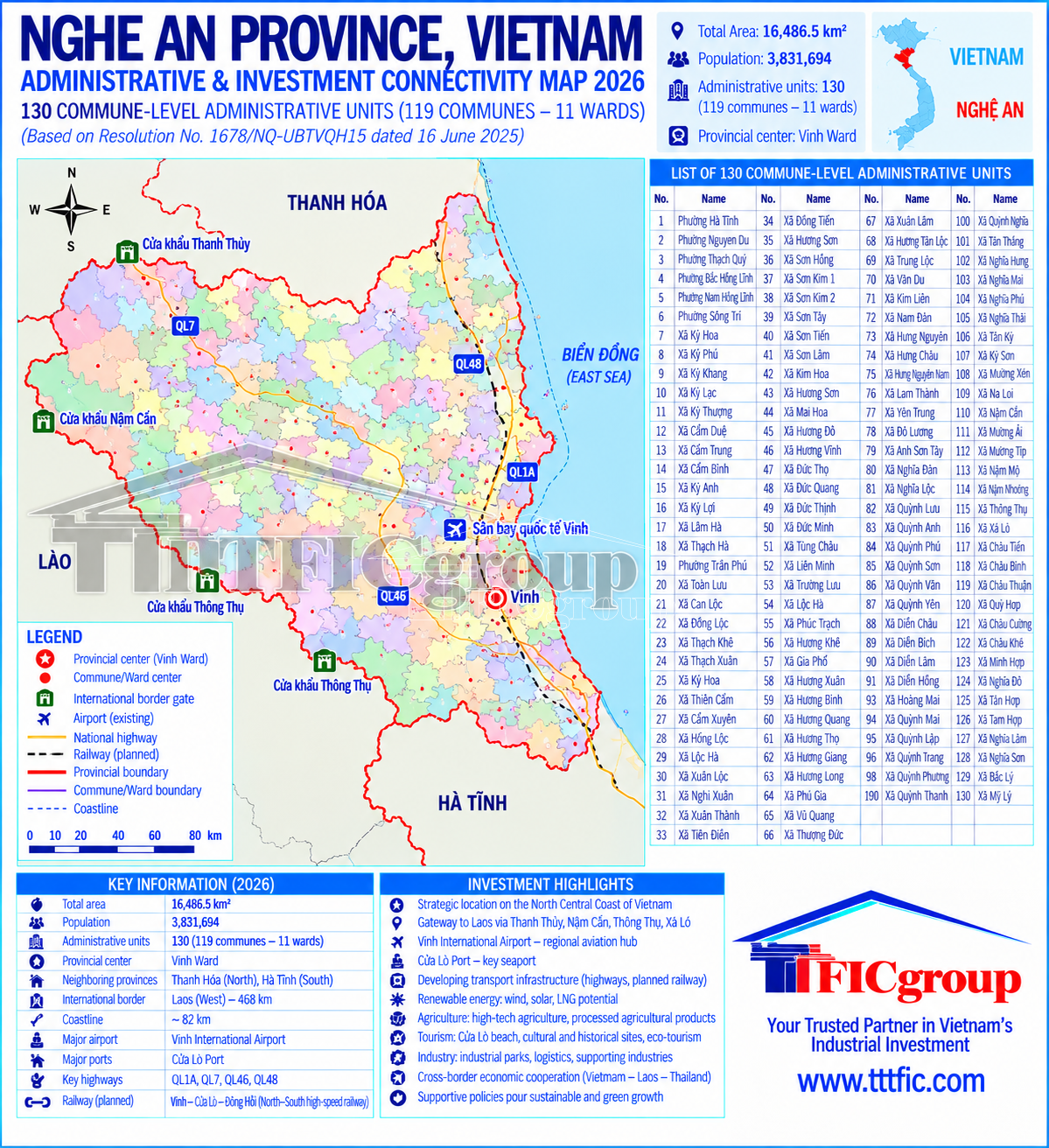
Nghe An remained an independent province during Vietnam’s 2025 provincial-level administrative restructuring.
It was not merged with another province.
However, its local administrative structure changed fundamentally under Vietnam’s transition to the two-tier local-government model.
Under Resolution No. 1678/NQ-UBTVQH15, Nghe An now has:
including:
119 communes
and:
11 wards.
Of these, 110 communes and all 11 wards were formed through restructuring, while nine communes remained unchanged.
The province has approximately:
of natural area and a population exceeding:
This combination gives Nghe An an asset that is increasingly important to manufacturers:
SCALE.
The province has:
land
labor
urban population
industrial corridors
airport infrastructure
seaport access
a 419-km Laos border
and:
an 82-km coastline.
Its administrative and economic center remains the greater Vinh urban area.
Nghe An occupies a central position within North Central Vietnam.
It borders:
Thanh Hoa Province
to the north;
Ha Tinh Province
to the south;
Laos
to the west;
and:
the East Sea
to the east.
Its western border connects directly with the Lao provinces of:
Houaphanh
Xieng Khouang
and:
Bolikhamxay.
The province has historically managed approximately:
and:
This creates three different geographic economies inside one province.
Vinh – Hung Nguyen – Nghi Loc – Cua Lo – Dien Chau – Hoang Mai.
Forestry – agriculture – hydropower – biodiversity – Laos connectivity.
Expressway – National Highway 1 – railway – airport – industrial parks.
The challenge is not lack of economic assets.
The opportunity is to connect them.
Nghe An continued to expand strongly in 2025.
Official provincial statistics reported:
ranking:
and:
Current-price GRDP reached approximately:
equivalent to approximately:
GRDP per capita reached approximately:
The 2025 economic structure was:
Agriculture, forestry & fisheries: 20.90%
Industry & construction: 30.89%
Services: 43.70%
Product taxes less subsidies: 4.51%.
This structure highlights an important difference between Nghe An and neighboring Ha Tinh.
Ha Tinh is already highly industrialized around a concentrated heavy-industry ecosystem.
Nghe An is more diversified:
This provides both resilience and multiple investment pathways.
Nghe An’s most important structural change is occurring in manufacturing.
The province’s:
Processing and manufacturing remained among the principal growth drivers.
This growth is increasingly connected to FDI manufacturing rather than only traditional sectors such as:
cement
construction materials
sugar
food
and:
basic processing.
A new industrial economy has emerged involving:
That transition is central to the 2026 investment profile.
Nghe An has undergone one of Vietnam’s most notable recent FDI transformations.
At the end of 2024, the province recorded approximately:
with total registered investment of about:
Investors came from approximately 14 countries and territories.
During 2025 alone, Nghe An approved:
with registered capital of approximately:
Another 16 projects increased registered capital by approximately:
Total newly registered and additional FDI capital therefore reached approximately:
USD 1.003 BILLION IN 2025.
This followed the province’s record 2024 FDI performance of approximately:
The direction is more important than any single year.
Nghe An has now demonstrated that global manufacturers are prepared to locate large-scale production in North Central Vietnam.
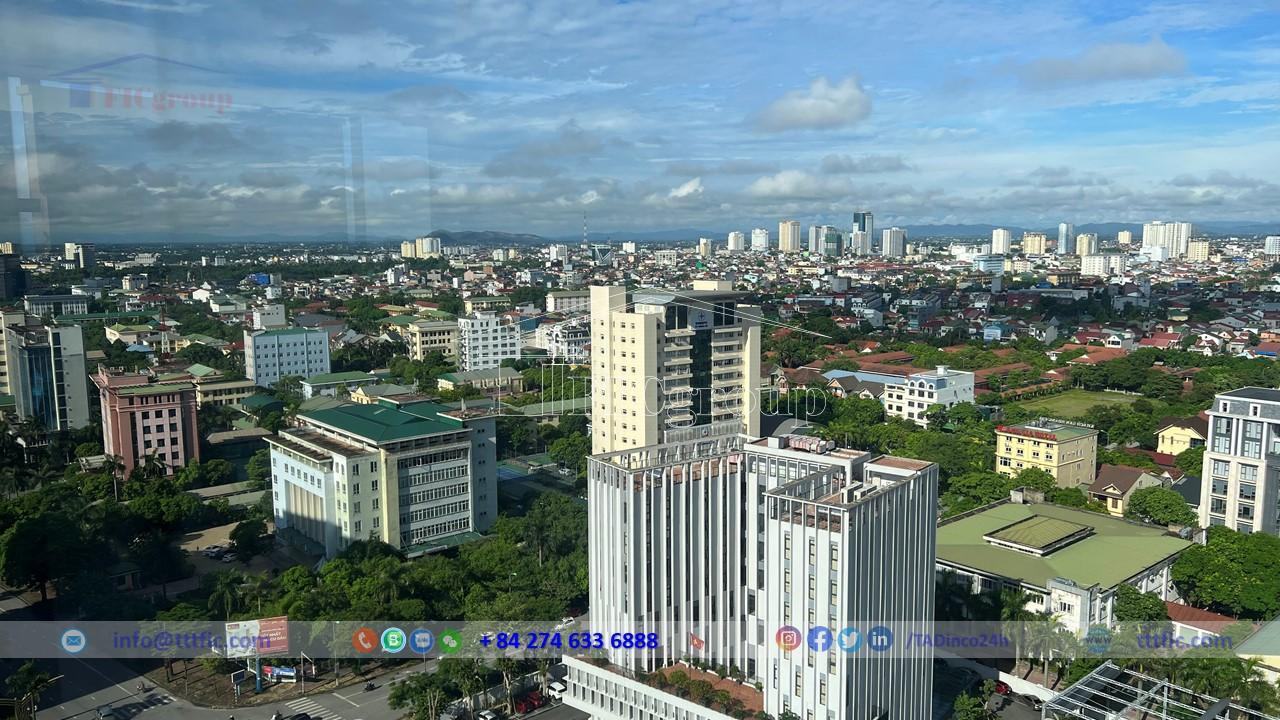
Several major international manufacturing groups have established operations in Nghe An.
These include:
Official 2025 provincial statistics specifically identify Foxconn, Luxshare, Goertek, Everwin, JuTeng and Sunny among major FDI projects contributing to provincial production and employment.
This matters because investors increasingly evaluate industrial locations based not only on land price but on:
One electronics investor attracts:
suppliers
tooling
precision engineering
packaging
plastic injection
metal parts
automation
logistics
and:
technical labor.
That creates the possibility of cumulative industrial development.
Luxshare has become one of the most important international manufacturing groups operating in Nghe An.
By 2026, Luxshare’s presence in VSIP Nghe An included:
through:
with total investment approaching:
Its operations employed approximately:
This is a major labor-market and industrial-supply-chain anchor.
For prospective investors, Luxshare’s presence demonstrates that Nghe An is capable of supporting:
large electronics facilities
large-scale recruitment
export manufacturing
multi-project expansion
and:
international supplier operations.
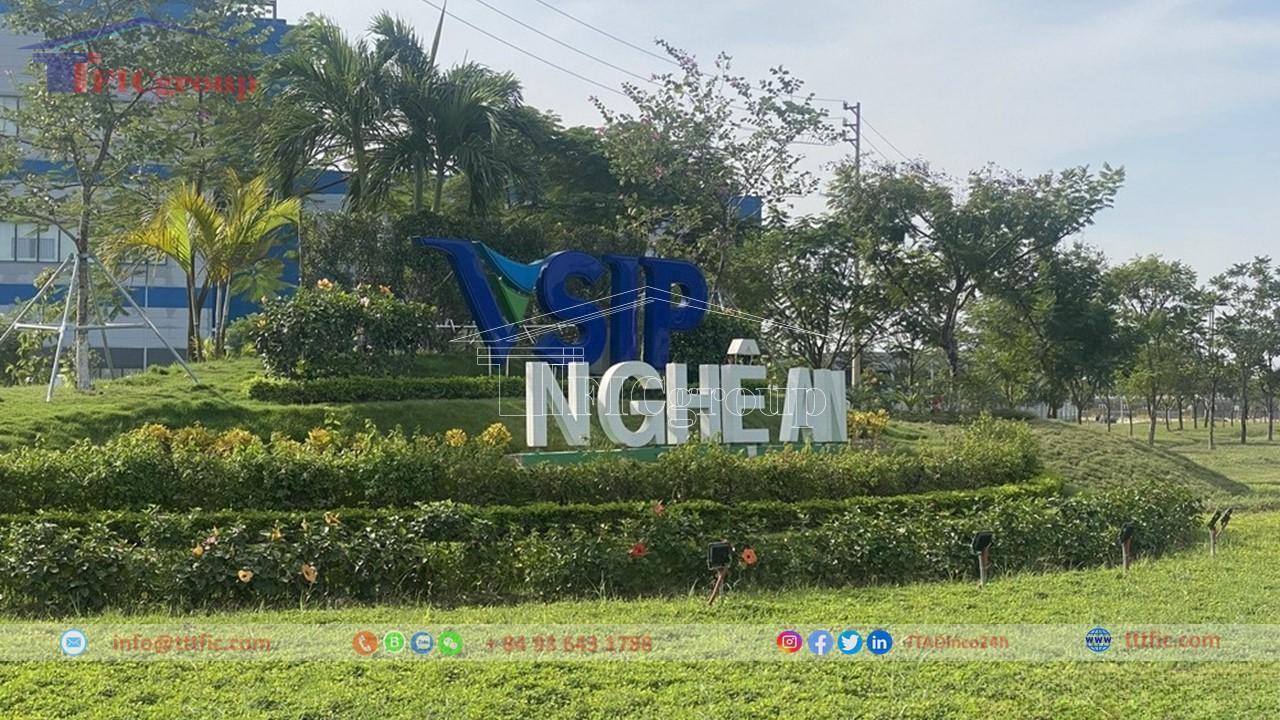
VSIP is one of the principal foundations of Nghe An’s modern industrial growth.
By 2026, VSIP was developing:
in the province with combined area of approximately:
Projects within the VSIP system had attracted more than:
of registered investment across:
Approximately:
were already operational, creating more than:
VSIP is therefore not a future industrial concept.
It is an established operating industrial ecosystem.
Importantly, investment policy for:
VSIP NGHE AN 3
was formally approved in March 2025, further extending the VSIP development platform.
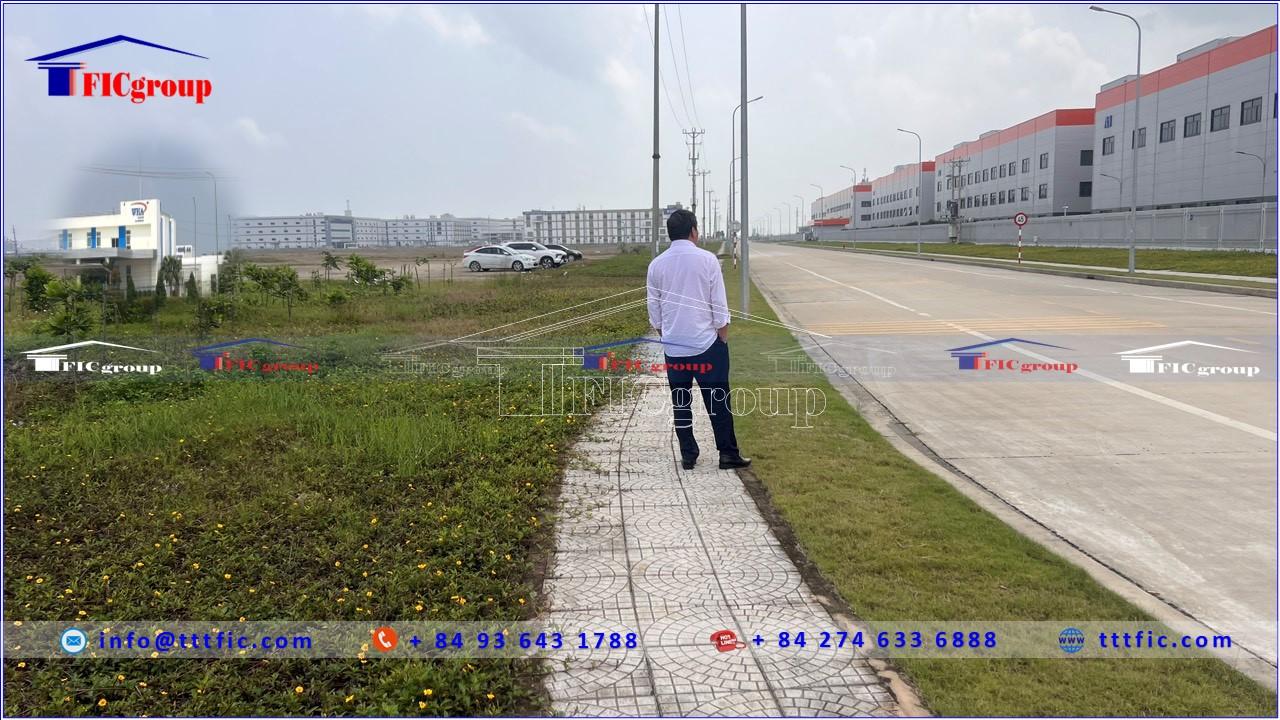
Thailand’s WHA Group has become another major industrial-infrastructure investor in Nghe An.
WHA Industrial Zone 1 has developed progressively through multiple phases.
Phase 2 alone covers approximately:
More importantly, in January 2025 Nghe An granted the Investment Registration Certificate for:
WHA INDUSTRIAL ZONE 2 – NGHE AN.
The significance is strategic.
Nghe An is no longer dependent on a single international industrial-park developer.
The province now has competition and expansion involving:
and:
That improves the industrial-land offering available to global manufacturers.
The Southeast Nghe An Economic Zone and its associated industrial parks have become the core institutional geography for foreign-investment attraction.
During the 2020–2025 period, the economic-zone system approved or licensed:
and processed:
Combined newly registered and additional investment reached approximately:
of which FDI represented approximately:
Major global manufacturers attracted to this system include:
Luxshare
Goertek
Foxconn
JuTeng
Everwin
and:
Radiant.
This represents a fundamental transformation of Nghe An’s investment geography.
The northern part of Nghe An is developing into a second important industrial pole.
Hoang Mai benefits from:
National Highway 1
North–South Expressway
railway
coastal access
and proximity to:
Thanh Hoa Province.
Hoang Mai II Industrial Park continued its land and infrastructure implementation in 2025.
Other industrial-development plans in the corridor include Hoang Mai I and additional industrial infrastructure.
The strategic value is that Nghe An’s industrial system can increasingly become:
rather than concentrated entirely around Vinh–Nghi Loc.
Nghe An has abundant land by national standards.
But:
International manufacturers should distinguish carefully between:
provincial territory
planned industrial land
established industrial park
land-cleared site
infrastructure-ready site
and:
immediately leasable plot.
TTTFIC therefore evaluates every industrial location against:
legal status
land availability
developer readiness
power
water
wastewater
labor
fire protection
environmental acceptance
expressway access
airport access
and:
port connectivity.
Nghe An’s export economy accelerated dramatically in 2025.
Provincial reporting placed merchandise exports at approximately:
USD 4.52 BILLION
representing growth of approximately:
over 2024.
Industrial processed goods accounted for the dominant share of export value.
This is one of the clearest indicators of structural change.
Historically, Nghe An’s economy was more dependent on domestic agriculture, construction materials and local consumption.
Today, export manufacturing is becoming one of the principal economic engines.
The province is increasingly connected to:
A major infrastructure upgrade was completed at Vinh International Airport in 2025.
The airport temporarily closed on July 1, 2025 for runway, taxiway, apron and terminal works.
It officially reopened for commercial operations at:
The upgrade included:
runway and taxiway rehabilitation
expanded aircraft apron
and:
passenger-terminal improvements.
The apron was expanded from approximately six to:
while terminal improvements were designed to increase annual passenger handling from approximately 2.5 million toward:
This is a meaningful advantage for manufacturers.
Senior management, engineers, suppliers and international business partners can reach Vinh directly by domestic aviation rather than relying exclusively on long-distance road travel.
Cua Lo is Nghe An’s primary existing seaport platform.
The port already handles:
containers
general cargo
bulk cargo
and industrial shipments.
Its strategic value is enhanced by proximity to:
Vinh
Southeast Nghe An Economic Zone
industrial parks
North–South transport infrastructure
and:
major manufacturing investments.
The growing electronics and export-manufacturing economy increases the strategic importance of efficient port services.
Nghe An’s long-term competitiveness therefore depends not simply on attracting factories but on reducing:
Nghe An is also developing a major deep-water port expansion at Cua Lo.
This project should be distinguished from the existing operating Cua Lo port.
The future deep-water development is intended to provide:
larger vessel access
additional container handling
higher throughput
modern storage
and:
more competitive maritime logistics.
As of 2026, however, this remains a development project rather than fully delivered deep-water capacity.
Provincial authorities were still actively addressing implementation and site issues during 2026.
Therefore:
This distinction is essential under TTMS™ status control.
Nghe An now benefits directly from Vietnam’s expanding:
NORTH–SOUTH EXPRESSWAY.
The route has materially improved access between Nghe An and:
Thanh Hoa
Hanoi
Ha Tinh
and the wider national road system.
For manufacturers, this improves:
truck travel time
supplier access
management mobility
labor movement
and:
connection to northern industrial centers.
The impact becomes even stronger when combined with:
This four-component system is one of Nghe An’s strongest location advantages.
Nghe An is also pursuing stronger east–west connectivity between:
the coastal industrial region
and:
the Laos border.
The proposed:
VINH–THANH THUY EXPRESSWAY
remained among the province’s priority infrastructure projects in 2026.
Its strategic concept is important.
A high-capacity east–west road could eventually connect:
→ WESTERN NGHE AN
→ LAOS.
However:
Investors should continue to model cross-border logistics using the currently available road network until new infrastructure is physically delivered.
Nghe An’s principal international land gateway to Laos is:
NAM CAN INTERNATIONAL BORDER GATE.
The province’s long Laos border also contains additional border crossings and local gateways.
Historically, Nghe An has maintained one international border gate together with several subordinate border crossings and access points.
This creates potential for:
Vietnam–Laos trade
agricultural commerce
construction materials
regional distribution
tourism
and:
cross-border services.
However, unlike Ha Tinh’s Cau Treo or Quang Tri’s Lao Bao, Nghe An’s international-investment thesis should not currently be built primarily around border logistics.
The China-facing electronics-industrial platform and coastal infrastructure are stronger immediate investment drivers.
With a population exceeding 3.8 million, Nghe An has one of the largest labor pools among Vietnam’s provinces.
This is especially important as manufacturers in more mature industrial provinces increasingly face:
labor competition
higher wages
worker turnover
and:
limited expansion space.
Nghe An offers an alternative.
The rapidly expanding electronics ecosystem demonstrates both the strength and challenge of the labor market.
In early 2025 alone, businesses in VSIP Nghe An were reporting demand for more than:
including approximately:
for Luxshare-ICT.
This indicates strong demand—but it also signals that future investors must evaluate recruitment capacity carefully.
Nghe An has successfully attracted anchor manufacturers.
The next phase should be:
SUPPLIERS.
Potential supporting-industry opportunities include:
precision metal components
plastic injection molding
molds and tooling
connectors
cables
packaging
electronic components
industrial automation
clean-room services
industrial maintenance
surface treatment
and:
specialized logistics.
The economic progression should become:
→ SUPPLIERS
→ LOCALIZATION
→ INDUSTRIAL DEPTH
→ HIGHER VALUE ADDED.
That is the transition from attracting FDI to building an industrial ecosystem.
Nghe An also possesses one of the largest agricultural and forestry territories in Vietnam.
Important sectors include:
dairy
sugarcane
tea
livestock
fruit
timber
forest products
aquaculture
and:
seafood.
This creates investment opportunities in:
The opportunity should increasingly move from:
toward:
Western Nghe An contains one of Vietnam’s largest mountain and forest landscapes.
It includes:
PU MAT NATIONAL PARK
and the:
WESTERN NGHE AN BIOSPHERE RESERVE.
The region combines:
forests
biodiversity
ethnic communities
agricultural land
medicinal resources
hydropower
and:
eco-tourism.
The investment opportunity is very different from the eastern industrial corridor.
Suitable sectors may include:
sustainable forestry
agro-processing
medicinal plants
eco-tourism
community tourism
and:
nature-based economic activities.
But resource potential must remain subordinate to:
Nghe An also has a substantial tourism market.
In 2025, the province received approximately:
9.9 MILLION VISITORS,
including:
and approximately:
Total visitor spending was approximately:
while direct tourism revenue reached approximately:
The major tourism pillars are:
Tourism is therefore a meaningful diversification sector rather than a decorative addition to the industrial profile.
Nghe An possesses a cultural identity with national significance.
Major assets include:
the homeland associated with President Ho Chi Minh;
recognized by UNESCO as Intangible Cultural Heritage;
one of North Central Vietnam’s largest coastal tourism destinations;
and:
In 2025 alone, Cua Lo attracted approximately:
with tourism revenue exceeding:
Tourism development should increasingly focus on:
quality
length of stay
MICE
premium accommodation
culture
eco-tourism
and:
year-round products
rather than simply increasing seasonal beach visitor numbers.
TTTFIC identifies the following strategic opportunity clusters.
Suppliers serving Luxshare, Goertek, Foxconn and related manufacturers.
Metal, plastic, connectors, structural components and tooling.
Industrial land, ready-built factories, warehouses and built-to-suit facilities.
Factory logistics, bonded services, distribution and freight forwarding.
Cua Lo-related shipping, depots, warehouses and supporting infrastructure.
Robotics, maintenance, engineering and manufacturing-support services.
Dairy, livestock, tea, fruit, sugar and agricultural products.
Engineered wood, furniture components, biomass and certified products.
Cua Lo, Vinh, Kim Lien and eco-tourism destinations.
Selective border-trade, warehousing and regional distribution opportunities.
Power infrastructure, industrial utility services and future energy projects.
Housing, healthcare, education, retail and services serving expanding industrial employment.
Nghe An presents a mixture of mature assets and major future infrastructure projects.
TTTFIC therefore classifies opportunity by status.
VSIP industrial facilities
WHA Industrial Zone 1
Luxshare
Goertek
Foxconn-related manufacturing
Everwin
existing Cua Lo Port
Vinh International Airport
North–South Expressway
Nam Can International Border Gate.
VSIP Nghe An expansion
VSIP Nghe An 3
WHA expansion
Hoang Mai industrial development
and new supplier projects.
Cua Lo deep-water port
and other planned transport and logistics investments.
Vinh–Thanh Thuy Expressway
LNG Quynh Lap
and other major infrastructure concepts under planning or project-development processes.
Only where the investor has confirmed:
legal land status
planning
industry acceptance
utilities
environmental capacity
labor
logistics
construction conditions
and:
commercial feasibility.
PLANNED ≠ APPROVED
APPROVED ≠ UNDER CONSTRUCTION
UNDER CONSTRUCTION ≠ OPERATING
OPERATING INFRASTRUCTURE ≠ SITE-SPECIFIC CAPACITY.
Rapid electronics-sector expansion is creating significant recruitment demand.
A large provincial population does not automatically mean unlimited immediately available industrial labor.
Nghe An’s supporting-industry ecosystem is improving rapidly but remains less mature than Bac Ninh, Hai Phong or the Southeast industrial corridor.
Existing Cua Lo facilities are operating, while deep-water expansion remains in development.
Some exporters may still rely on larger external port systems depending on cargo and shipping requirements.
Electronics manufacturing has become an important growth driver, creating exposure to global electronics cycles and anchor-investor strategies.
Future expressways, LNG facilities and deep-water infrastructure should not be modeled as currently available capacity.
Rapid industrial growth can increase pressure on local power and utility networks.
Site-level verification is essential.
Much of Nghe An is mountainous and remote.
The province’s large total area should not be confused with uniformly accessible industrial land.
The province is exposed to:
typhoons
heavy rainfall
flooding
landslides
and:
extreme heat.
Large industrial projects require careful assessment of:
wastewater
air emissions
waste management
worker housing
traffic
and:
community impacts.
These risks do not weaken the province’s investment thesis.
They determine how investment must be executed.
More than 3.8 million people provide exceptional demographic scale for North Central Vietnam.
GRDP increased approximately 8.44%, with a current-price economy of approximately VND 236.5 trillion.
New and additional FDI investment reached approximately USD 1.003 billion in 2025 after the record 2024 performance.
Luxshare, Goertek, Foxconn, JuTeng, Everwin and other manufacturers provide real supply-chain anchors.
VSIP and WHA provide institutional-quality industrial platforms.
Exports reached approximately USD 4.52 billion in 2025.
Vinh International Airport reopened after major upgrades on December 19, 2025.
North–South Expressway access improves links to Hanoi and the national industrial system.
Cua Lo provides an operating maritime gateway, with deeper-water capacity under development.
Nghe An provides direct international land connectivity into Laos.
The province combines manufacturing with substantial agriculture, forestry and food-processing opportunities.
Approximately 9.9 million visitors in 2025 provide another major economic pillar.

For years, Vietnam’s FDI manufacturing geography was dominated by a relatively small number of locations:
Bac Ninh
Hai Phong
Hanoi region
Dong Nai
Binh Duong
and:
Ho Chi Minh City’s industrial belt.
Those locations remain extremely important.
But cost, labor competition, land availability and supply-chain diversification are pushing manufacturers to evaluate new locations.
Nghe An is benefiting from this shift.
The evidence is no longer theoretical.
This is the point at which investment geography can begin to become self-reinforcing.
The next manufacturer does not arrive in an empty market.
It arrives where other global manufacturers already operate.
That changes the risk equation.
The opportunity now is to transform:
FDI PROJECTS
into:
AN FDI ECOSYSTEM.
The next phase should therefore emphasize:
Nghe An’s emerging competitive equation can be expressed as:
LABOR
The future logistics equation is:
→ EXPRESSWAY
→ CUA LO / NORTHERN PORT SYSTEM
→ GLOBAL MARKET.
The future supporting-industry equation is:
→ TIER-1 SUPPLIER
→ TIER-2 SUPPLIER
→ LOCAL INDUSTRIAL ECOSYSTEM.
And the broader provincial equation is:
That is the real 2026 Nghe An story.
TTTFIC Group supports international investors evaluating Nghe An through a structured, evidence-based and risk-controlled investment process.
Comparison of Nghe An with alternative locations across northern, central and southern Vietnam.
Assessment of VSIP, WHA, Hoang Mai and other industrial locations.
Industrial land, ready-built factories, warehouses and built-to-suit solutions.
Location analysis for suppliers serving existing global manufacturers.
Review of workforce scale, recruitment competition and employee-access requirements.
Cua Lo, road logistics and alternative maritime-routing assessment.
Vinh International Airport and management-mobility evaluation.
IRC, ERC and related investment procedures.
Planning, infrastructure, legal status and development-condition review.
Industrial, manufacturing and project-specific compliance support.
Electricity, water, wastewater and industrial utility review.
Land, factory, warehouse and development solutions.
Purpose-built industrial facility support.
Commercial negotiation, documentation and transaction-management support.
Support from establishment through construction, commissioning and operations.
Nghe An should no longer be evaluated primarily through the lens of:
large land area
low-cost labor
or:
agriculture.
Those remain important advantages.
But the investment story has changed.
The province now has:
GLOBAL ELECTRONICS MANUFACTURERS.
It has:
INTERNATIONAL INDUSTRIAL DEVELOPERS.
It has:
AN OPERATING INTERNATIONAL AIRPORT.
It has:
NORTH–SOUTH EXPRESSWAY CONNECTIVITY.
It has:
AN OPERATING SEAPORT WITH DEEP-WATER EXPANSION UNDER DEVELOPMENT.
And it has:
ONE OF VIETNAM’S LARGEST PROVINCIAL LABOR MARKETS.
The decisive strategic shift is:
to:
And from:
to:
Nghe An therefore has the potential to become one of Vietnam’s strongest alternatives for manufacturers seeking expansion beyond the country’s mature industrial centers.
The next investment cycle will determine whether it remains primarily a destination for large anchor factories—
or develops into a deeper network of:
If that transition is successfully executed, Nghe An can move from being an emerging FDI destination to becoming:
ONE OF VIETNAM’S LEADING SECOND-GENERATION MANUFACTURING & SUPPLY-CHAIN PLATFORMS.
NGHE AN, VIETNAM 2026
TTTFIC GROUP
TTTFIC Group supports international manufacturers, electronics suppliers, industrial developers, logistics operators, agricultural processors and institutional investors evaluating opportunities in Nghe An Province and across Vietnam.
Our approach combines:
Explore Vietnam. Compare Locations. Invest with Intelligence.
34 Provinces & Cities. One Updated Investment Intelligence Platform.
Table of contents