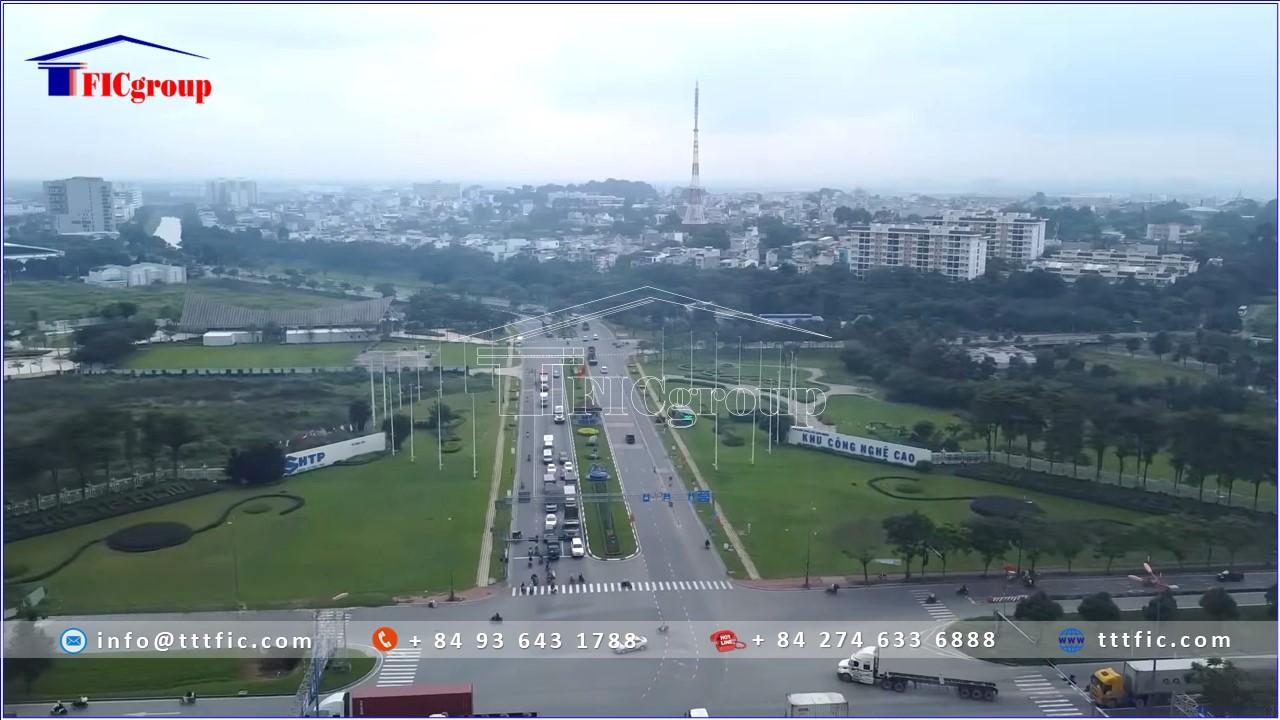
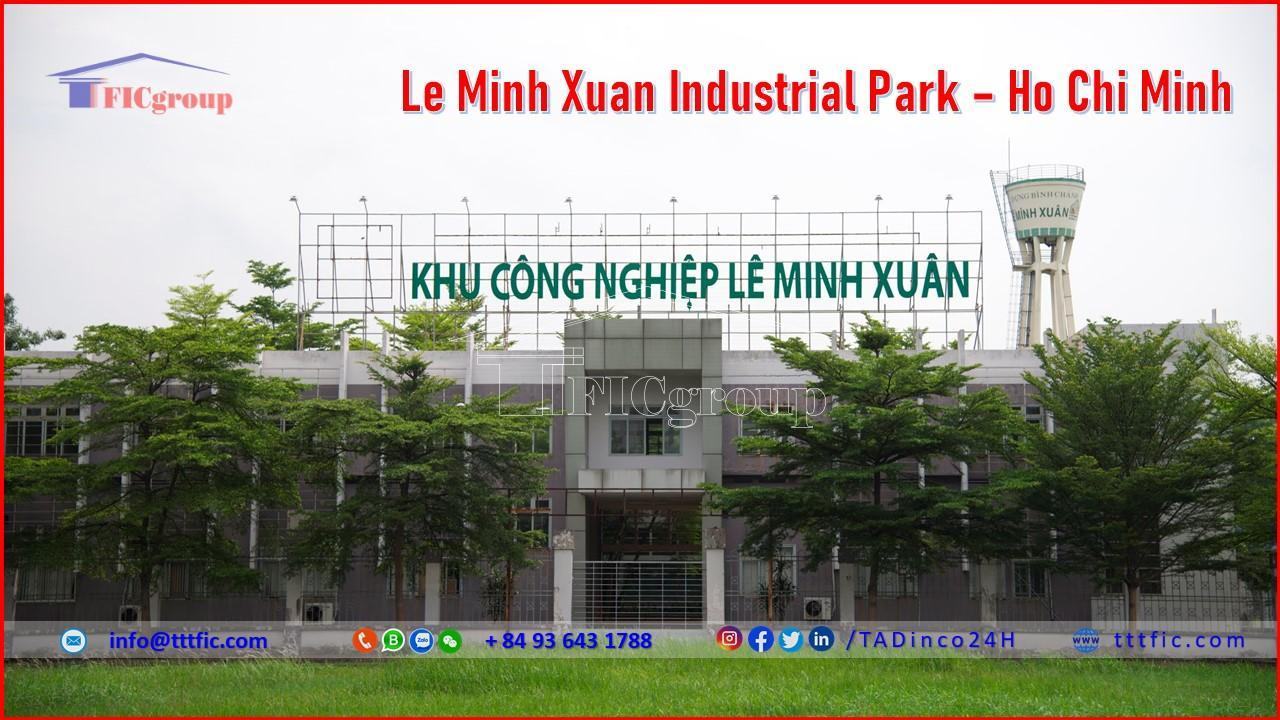
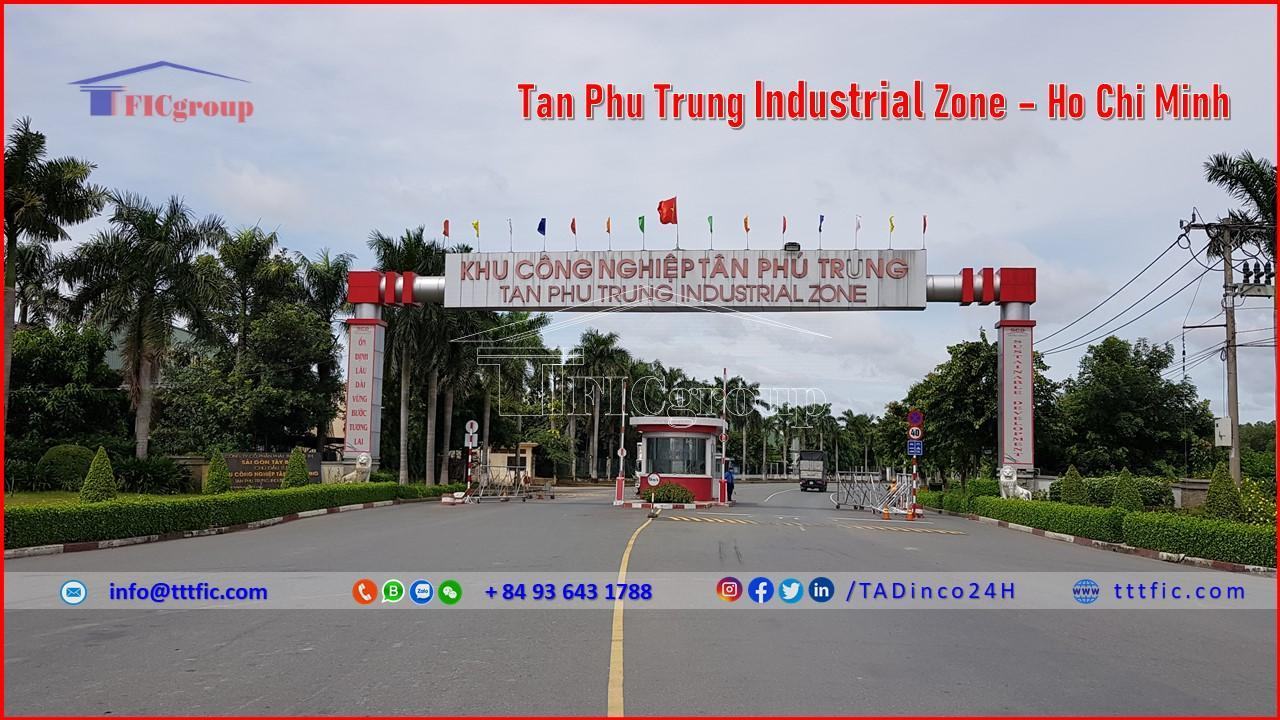
Le Minh Xuan 3 Industrial Park
- Investor: Saigon VRG Investment Corporation
- Price: $320
- Area: 300 Ha
TTTFIC GLOBAL INVESTMENT PROFILE 2026 — PROFILE #01
TTTFIC ORIGINAL INVESTMENT INTELLIGENCE™ | ULTIMATE FLAGSHIP EDITION
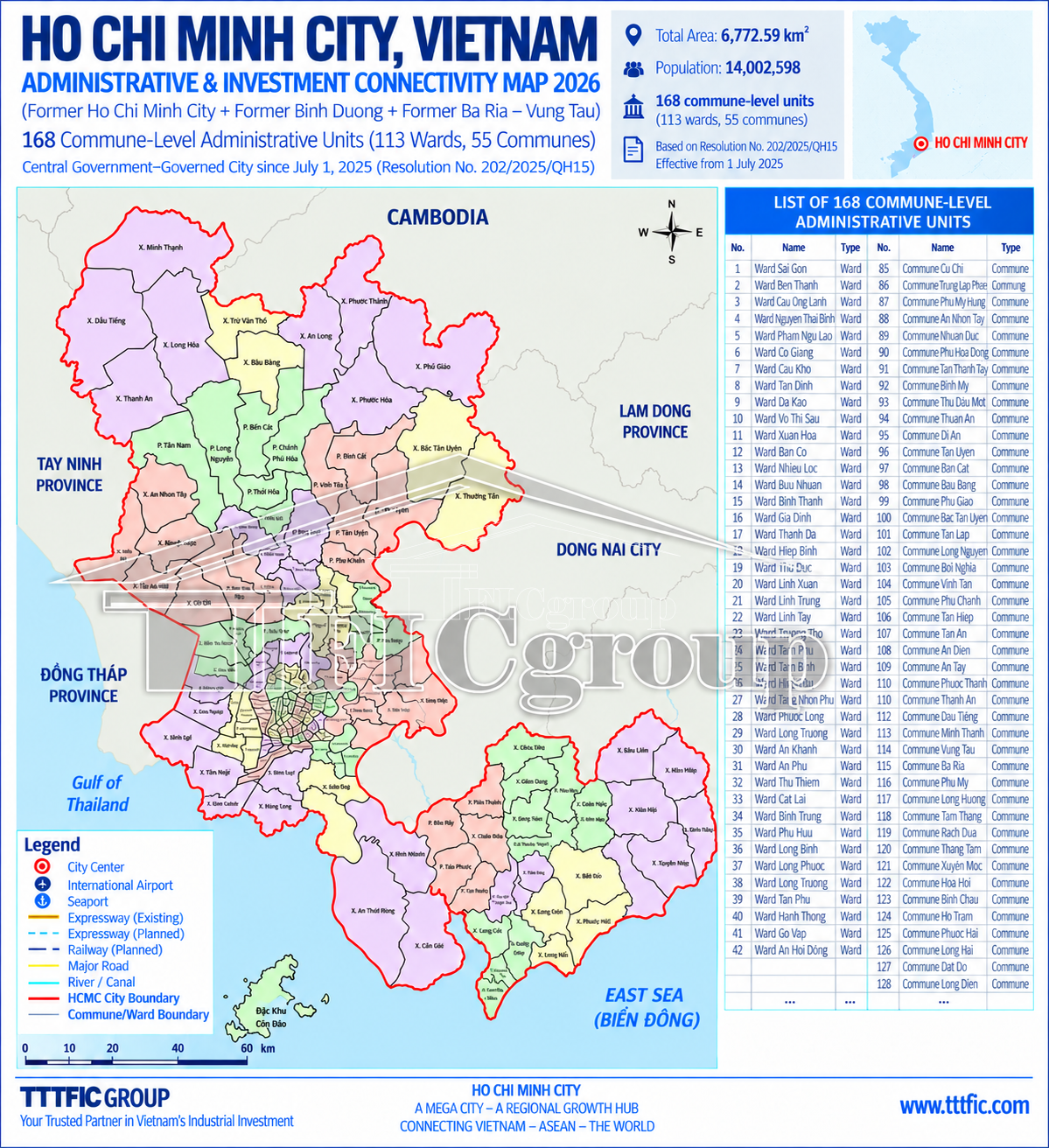
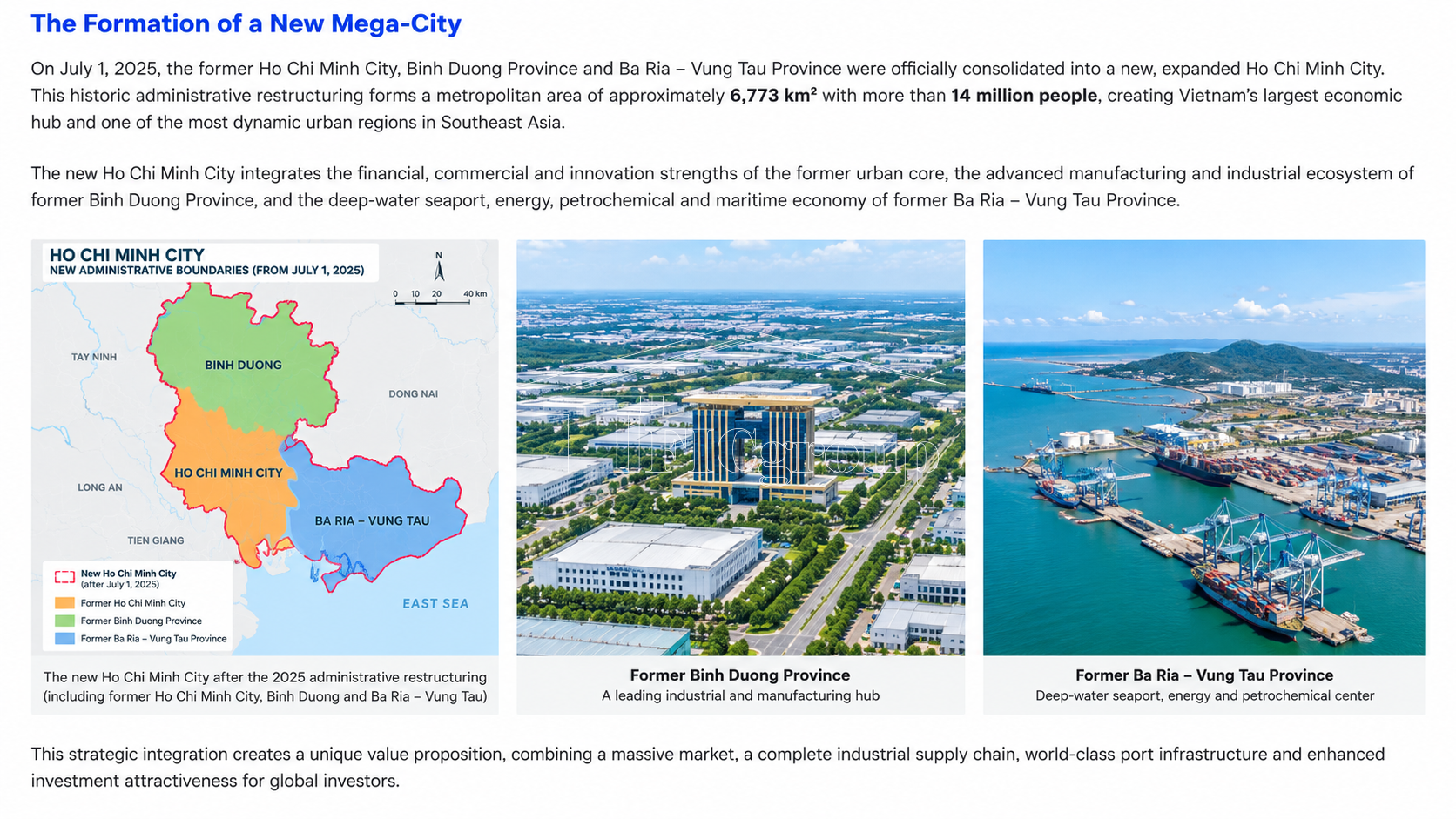
Former Ho Chi Minh City + Former Binh Duong Province + Former Ba Ria–Vung Tau Province
There are cities built around finance.
There are cities built around manufacturing.
There are port cities, technology cities, tourism cities and energy cities.
The new Ho Chi Minh City is increasingly becoming all of them at once.
The historic consolidation of former Ho Chi Minh City, former Binh Duong Province and former Ba Ria–Vung Tau Province has brought together three of Vietnam’s most powerful but fundamentally different economic systems within one metropolitan territory.
Former Ho Chi Minh City contributes finance, international commerce, technology, universities, research, high-tech manufacturing, professional services and Vietnam’s largest urban economy.
Former Binh Duong contributes one of Vietnam’s most mature industrial ecosystems, large-scale manufacturing, the Becamex–VSIP development legacy, industrial–urban infrastructure, logistics and an emerging science-and-technology growth pole.
Former Ba Ria–Vung Tau contributes deep-water ports, oil and gas, petrochemicals, energy, steel, metallurgy, mechanical engineering, heavy industry, maritime services and a major coastal economy.
The result is not simply a larger Ho Chi Minh City.
Capital can meet technology.
Technology can meet research.
Research can meet manufacturing.
Manufacturing can connect with supporting industries.
Industry can connect with energy and petrochemicals.
Factories can connect with logistics and free-trade infrastructure.
And deep-water ports can connect Vietnamese production directly with global markets.
Around this economic machine is another ecosystem equally important to long-term foreign investment:
workers, engineers, executives, universities, international education, hospitals, international healthcare, housing, professional services, international commerce, tourism, culture and metropolitan quality of life.
For international investors evaluating Vietnam in 2026 and beyond, Ho Chi Minh City should therefore no longer be assessed simply as a city.
It should increasingly be understood as:
Administrative Status: Centrally Governed Municipality
Metropolitan Area: approximately 6,770+ km²
Population: more than 14 million
2025 Economic Scale: approximately VND 3.03 quadrillion
Share of Vietnam’s GDP: approximately 23.5%
Industrial Platform: approximately 78 Industrial Parks and 25 Industrial Clusters across the consolidated metropolitan territory
Technology Anchors: Saigon Hi-Tech Park + Long Phuoc expansion + Northern Science & Technology Urban Area
Major Manufacturing Platforms: VSIP • Song Than • My Phuoc • Bau Bang • Nam Tan Uyen • Rach Bap • Phu My • My Xuan • Chau Duc
Global Trade Infrastructure: Cat Lai • Hiep Phuoc • Cai Mep–Thi Vai • Cai Mep Ha Free Trade Zone • Can Gio International Transshipment Port
Energy & Heavy Industry: Oil & Gas • Petrochemicals • Steel • Metallurgy • Mechanical Engineering • Marine Services
Financial Platform: Viet Nam International Financial Centre in Ho Chi Minh City
Aviation: Tan Son Nhat International Airport + strategic connectivity with Long Thanh International Airport
Strategic Character: Finance + Technology + Manufacturing + Energy + Logistics + Ports + Human Capital + International Living Environment
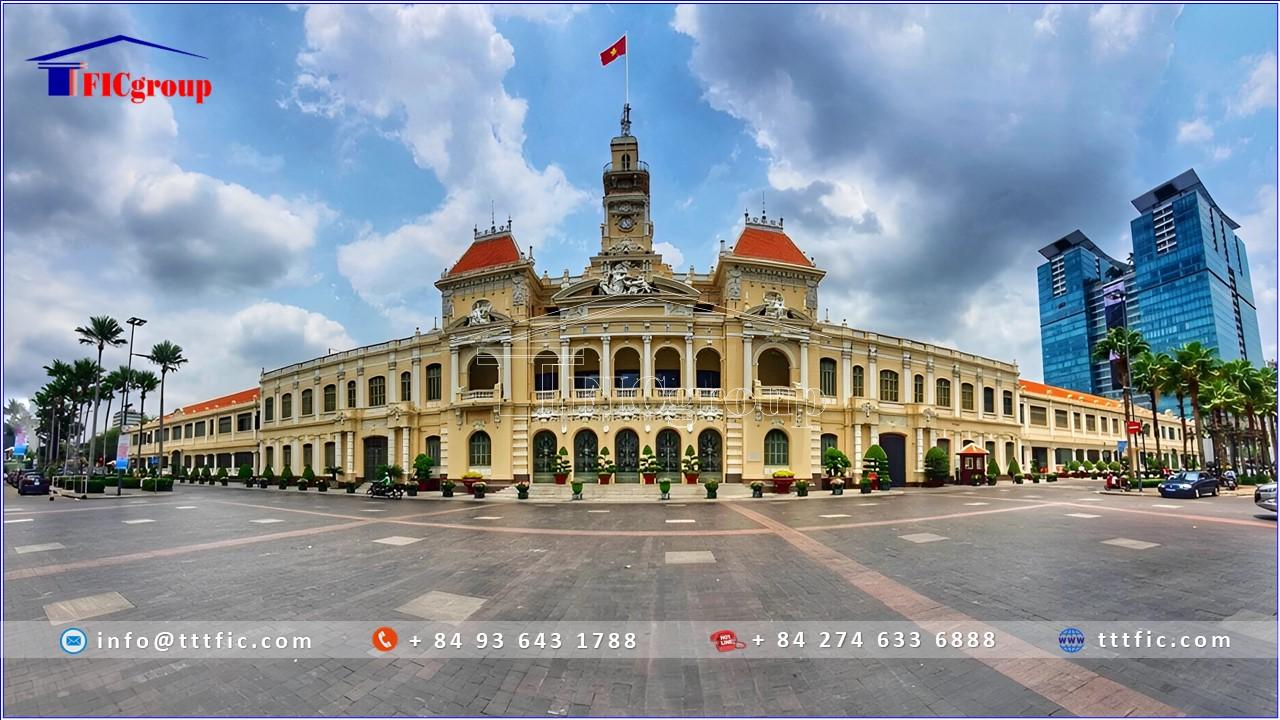
The defining characteristic of the new Ho Chi Minh City is not merely scale.
It is economic complementarity.
Former Ho Chi Minh City was predominantly Vietnam’s center of finance, commerce, technology, professional services and international business.
Former Binh Duong became one of Vietnam’s most successful manufacturing and industrial–urban economies.
Former Ba Ria–Vung Tau developed into a strategic maritime, energy, petrochemical and deep-water port economy.
Their integration places:
FINANCE + TECHNOLOGY + MANUFACTURING + ENERGY + LOGISTICS + DEEP-WATER PORTS + TOURISM
inside one metropolitan economic system.
TTTFIC Investment Perspective™: the consolidation should therefore be understood not simply as an administrative enlargement, but as the integration potential of three complementary economic value chains.
The consolidated city covers more than 6,770 km² and has a population exceeding 14 million.
Its combined 2025 economic scale reached approximately VND 3.03 quadrillion, equivalent to around 23.5% of Vietnam’s GDP.
Scale creates simultaneous concentration of:
production • consumption • capital • labor • infrastructure • services • knowledge.
For investors, this creates market depth that few locations in Vietnam can replicate.
Ho Chi Minh City’s importance extends far beyond its administrative boundary.
Manufacturing supply chains, banking, logistics, professional services, technology, consumer demand and international trade radiate throughout Southern Vietnam.
The city functions simultaneously as a production center, service center, capital center and gateway economy.
A population exceeding 14 million creates enormous demand across retail, e-commerce, food and beverage, healthcare, education, automobiles, electronics, housing, financial services, tourism, hospitality and entertainment.
Ho Chi Minh City therefore possesses an important dual advantage:
The future Ho Chi Minh City will increasingly operate through multiple economic poles rather than one traditional central business district.
The historic urban core, Thu Thiem, eastern technology corridor, northern industrial–science corridor, Can Gio, Vung Tau–Long Son, Phu My–Cai Mep–Thi Vai and Con Dao perform different economic functions.
The investment question therefore becomes:
not simply whether to invest in Ho Chi Minh City — but where within Ho Chi Minh City the investor’s industry fits best.
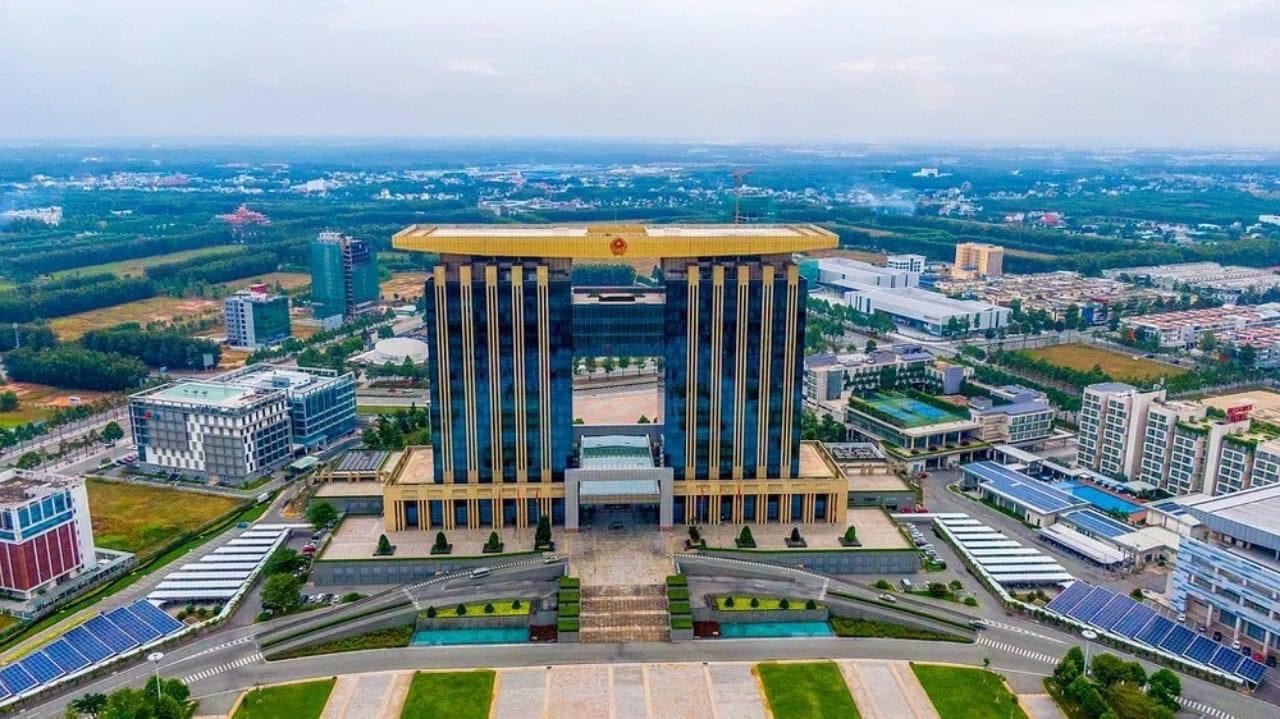
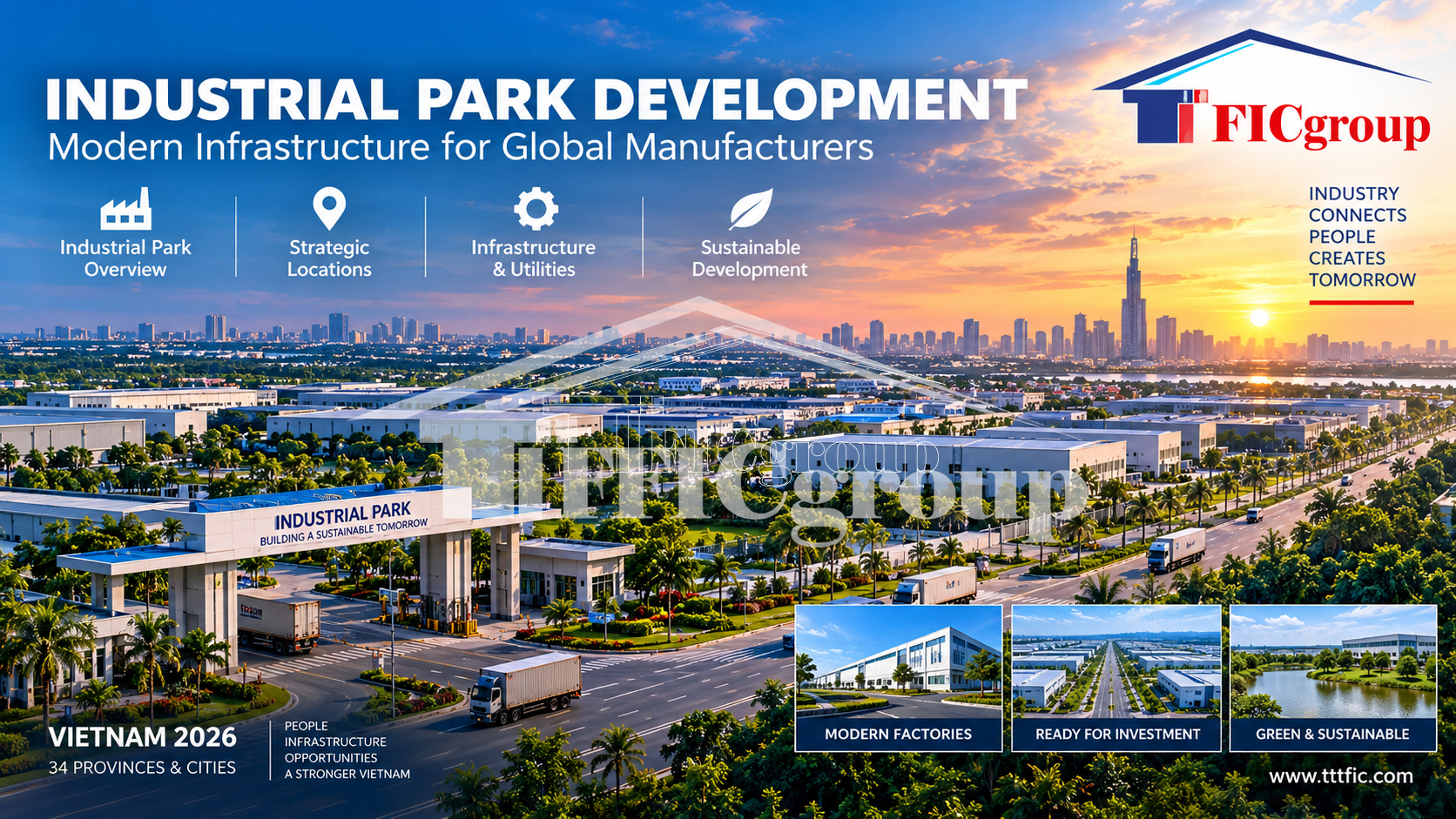
The enlarged Ho Chi Minh City inherits approximately 78 Industrial Parks and 25 Industrial Clusters across its consolidated territory.
But the strategic value lies not simply in quantity.
The metropolitan industrial system spans several generations and several fundamentally different industrial models:
export processing
general manufacturing
supporting industries
high technology
industrial–urban development
port-oriented industry
petrochemicals
heavy industry
and increasingly:
green + digital + smart manufacturing.
This is no longer a single industrial geography.
It is a portfolio of industrial geographies.
The traditional Ho Chi Minh City industrial core includes a mature network of Export Processing Zones, Industrial Parks and technology locations.
Representative names include:
Tan Thuan Export Processing Zone (Tan Thuan EPZ)
Linh Trung I Export Processing Zone (Linh Trung I EPZ)
Linh Trung II Export Processing Zone (Linh Trung II EPZ)
Tan Tao Industrial Park
Tan Binh Industrial Park
Vinh Loc Industrial Park
Hiep Phuoc Industrial Park
Le Minh Xuan Industrial Park
Le Minh Xuan II Industrial Park
Le Minh Xuan III Industrial Park
Tan Phu Trung Industrial Park
Dong Nam Industrial Park
Tay Bac Cu Chi Industrial Park
Binh Chieu Industrial Park
Cat Lai II Industrial Park
Tan Thoi Hiep Industrial Park
An Ha Industrial Park
Saigon Hi-Tech Park.
These locations benefit from varying combinations of proximity to the urban market, Cat Lai, Tan Son Nhat International Airport, universities, technology companies, professional services and metropolitan labor.
The former Binh Duong territory brings one of Vietnam’s best-known concentrations of industrial estates into the new Ho Chi Minh City.
Representative industrial locations include:
Vietnam–Singapore Industrial Park I (VSIP I)
Vietnam–Singapore Industrial Park II (VSIP II)
VSIP II-A
Song Than I Industrial Park
Song Than II Industrial Park
Song Than III Industrial Park
My Phuoc I Industrial Park
My Phuoc II Industrial Park
My Phuoc III Industrial Park
Bau Bang Industrial Park
Bau Bang Expansion
Nam Tan Uyen Industrial Park
Nam Tan Uyen Expansion
Rach Bap Industrial Park
Dong An Industrial Park
Dong An II Industrial Park
Viet Huong Industrial Park
Viet Huong II Industrial Park
Protrade International Tech Park
Dat Cuoc Industrial Park
Tan Dong Hiep Industrial Park.
Together these locations form an extensive manufacturing belt supporting electronics, mechanical engineering, furniture, consumer goods, supporting industries, packaging, logistics and export manufacturing.
The former Ba Ria–Vung Tau territory adds a completely different industrial geography.
Representative industrial locations include:
Phu My I Industrial Park
Phu My II Industrial Park
Phu My II Expansion Industrial Park
Cai Mep Industrial Zone
Chau Duc Industrial Park
My Xuan A Industrial Park
My Xuan A2 Industrial Park
My Xuan B1–Conac Industrial Park
My Xuan B1–Tien Hung Industrial Park
My Xuan B1–Dai Duong Industrial Park
Dong Xuyen Industrial Park
Dat Do I Industrial Park
Long Son Petroleum Industrial Zone.
This belt has particular relevance to:
petrochemicals • energy • steel • metallurgy • mechanical engineering • chemicals • port logistics • marine services • heavy industry • export manufacturing.
For investors whose operations depend on large cargo volumes, gas, port access, heavy-industry suppliers or maritime infrastructure, this part of Ho Chi Minh City offers a fundamentally different site-selection proposition from the inner metropolitan industrial core.
Former Binh Duong represents one of Vietnam’s most important modern industrialization stories.
The Becamex ecosystem helped demonstrate that industrial development does not need to end at the factory gate.
Industrial parks could be integrated with:
wide transport corridors → urban centers → housing → education → healthcare → commercial services → logistics.
This industrial–urban–service model became one of the foundations of Binh Duong’s transformation.
That capability now forms part of the new Ho Chi Minh City.
The Vietnam Singapore Industrial Park story is deeply associated with Binh Duong’s industrialization.
VSIP I became one of the early landmarks of Vietnam–Singapore industrial cooperation.
The model subsequently expanded beyond Binh Duong and across Vietnam.
Its importance is therefore larger than the physical industrial parks themselves.
VSIP represents international industrial cooperation, infrastructure standards, manufacturing ecosystems and a model connecting global manufacturers with Vietnam.
TTMS™ Status Control: any future additional VSIP development discussed under an MOU, research agreement or investment study must be distinguished from a legally approved and operating Industrial Park.
Song Than I, Song Than II and Song Than III form another recognizable industrial cluster inherited from former Binh Duong.
Their proximity to the traditional Ho Chi Minh City urban core helped create a dense manufacturing, warehousing and logistics ecosystem.
The Song Than industrial geography demonstrates the importance of mature supplier networks and metropolitan proximity in industrial site selection.
My Phuoc I, My Phuoc II, My Phuoc III and Bau Bang represent a progressive expansion of industrial development northward.
Large industrial land reserves, modern road systems, industrial parks, urban development and logistics infrastructure created room for manufacturing beyond increasingly dense inner areas.
Its next transformation is likely to involve stronger connections between conventional manufacturing and:
automation + digital infrastructure + science + R&D + advanced manufacturing.
Nam Tan Uyen and Rach Bap add further depth to the northern manufacturing system.
They demonstrate why the metropolitan industrial economy cannot be understood through a handful of famous parks alone.
Factories operate inside broader supplier and labor ecosystems that extend across multiple industrial locations.
Industrial scale creates another advantage that is often underestimated: supplier density.
Large concentrations of factories generate surrounding ecosystems of:
components, packaging, plastics, chemicals, engineering, maintenance, machinery, logistics, warehousing, industrial construction and professional services.
For manufacturers, this can reduce procurement time, inventory requirements and supply-chain friction.
This is one reason mature industrial ecosystems are difficult to reproduce quickly.
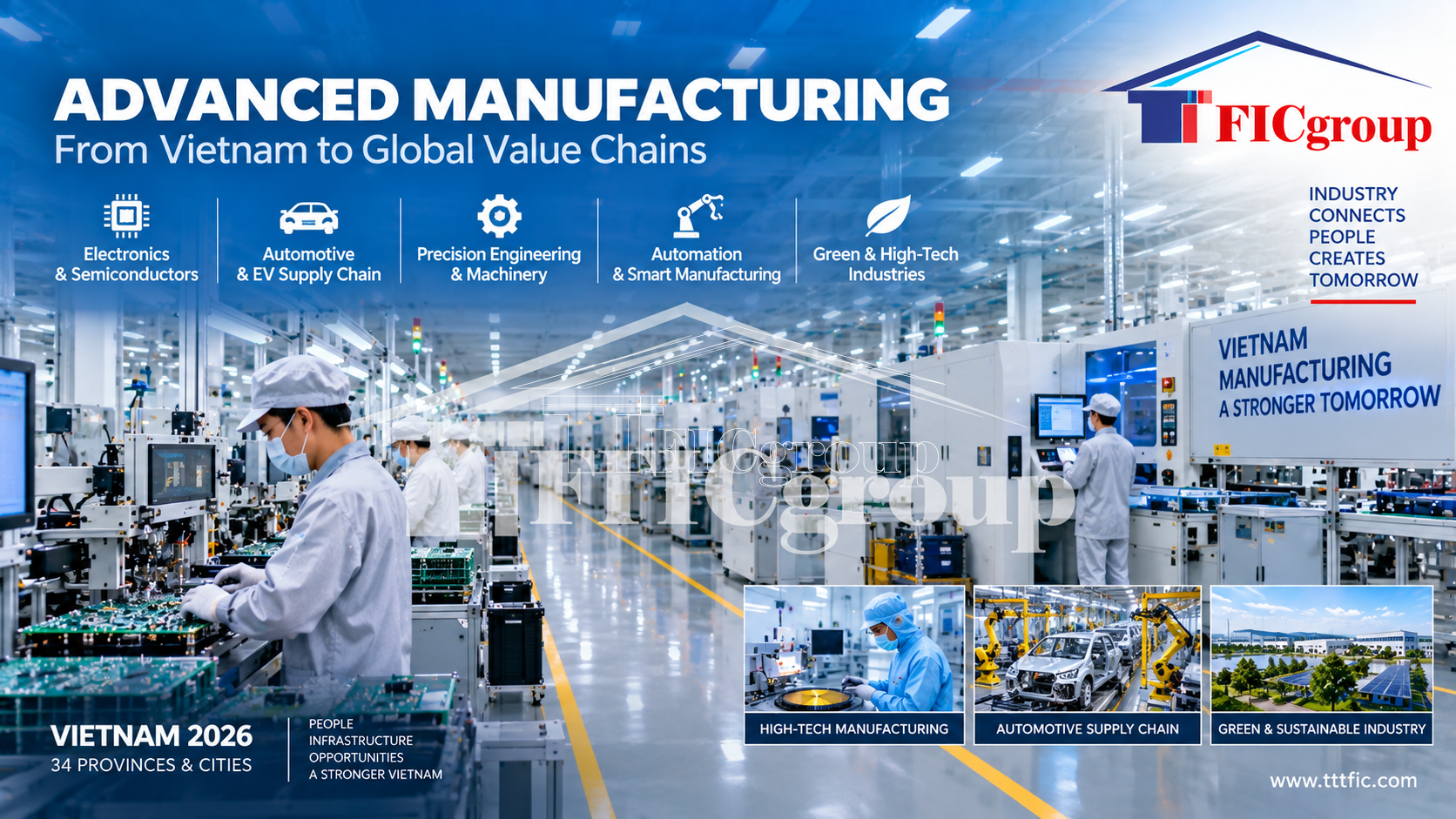
The next stage of Ho Chi Minh City’s industrial development cannot depend solely on labor and land.
The city is increasingly targeting:
automation, advanced electronics, precision manufacturing, data-driven factories, green production, strategic technologies and higher-value supporting industries.
The transition is:
MADE IN VIETNAM
→
ENGINEERED, AUTOMATED & INNOVATED IN VIETNAM.
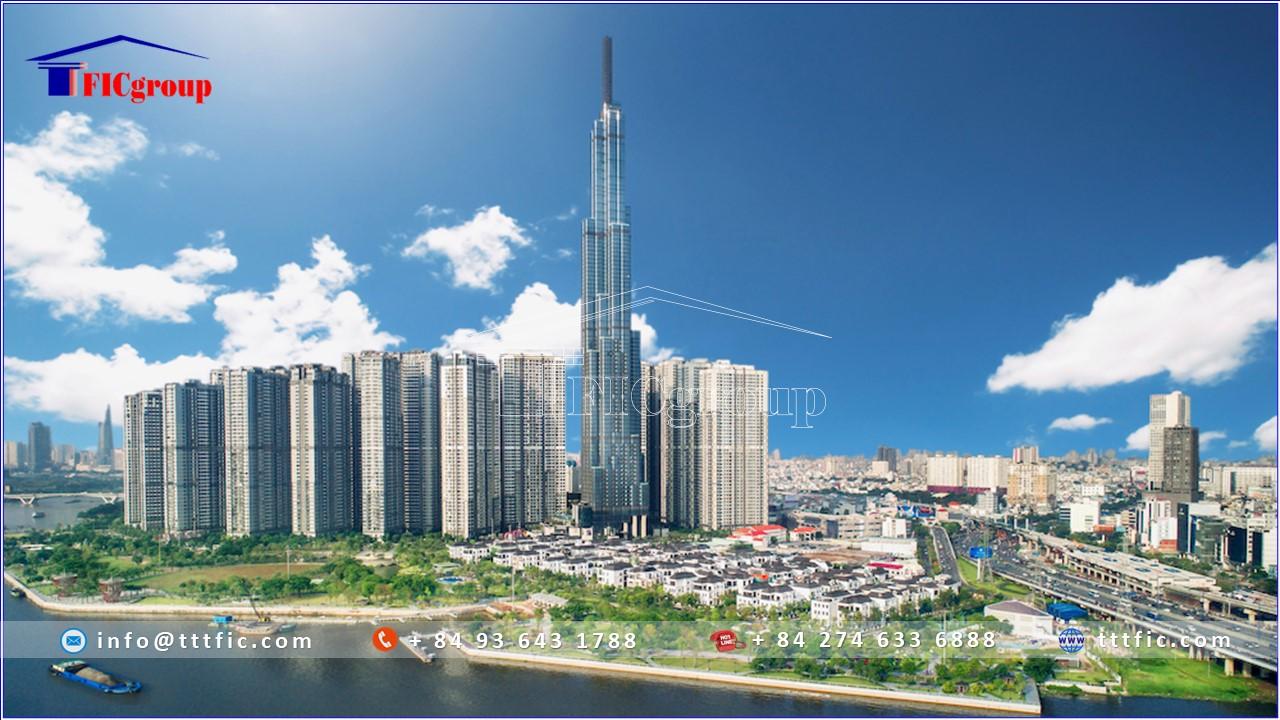
Saigon Hi-Tech Park is one of the central anchors of Ho Chi Minh City’s technology economy.
Its strategic function extends beyond factory space.
It connects:
HIGH-TECH MANUFACTURING + R&D + TECHNOLOGY TRANSFER + TALENT + INNOVATION.
The ecosystem is increasingly relevant to semiconductors, electronics, smart manufacturing, biotechnology, data infrastructure and advanced technologies.
The 194.84-hectare Long Phuoc expansion marks another stage in the city’s technology development.
For site selectors, the signal is important:
Ho Chi Minh City is not merely protecting its existing technology position.
It is creating additional physical capacity for the next generation of technology investment.
The former Binh Duong industrial heartland is moving toward a more knowledge-intensive development model.
The emerging Northern Ho Chi Minh City Science & Technology Urban Area creates the possibility of linking:
manufacturing scale + universities + R&D + technology companies + smart infrastructure.
This can gradually transform northern Ho Chi Minh City from primarily a manufacturing base into an advanced manufacturing and innovation ecosystem.
Semiconductors are not a standalone industry.
They require talent, design capability, electronics manufacturing, supporting industries, clean infrastructure, R&D, global customers and sophisticated logistics.
Ho Chi Minh City increasingly possesses several of these components simultaneously.
The opportunity therefore lies in developing a broader:
The industrial infrastructure of the next decade will include far more than roads, electricity and water.
Data centers, cloud infrastructure, AI computing and high-capacity digital connectivity are becoming essential economic infrastructure.
The future factory may depend as much on computing capacity and data connectivity as on its physical industrial estate.
Advanced connectivity supports:
smart factories, autonomous logistics, IoT, digital twins, real-time industrial monitoring and AI-enabled production.
The future industrial city will be both:
PHYSICALLY CONNECTED
and
DIGITALLY CONNECTED.
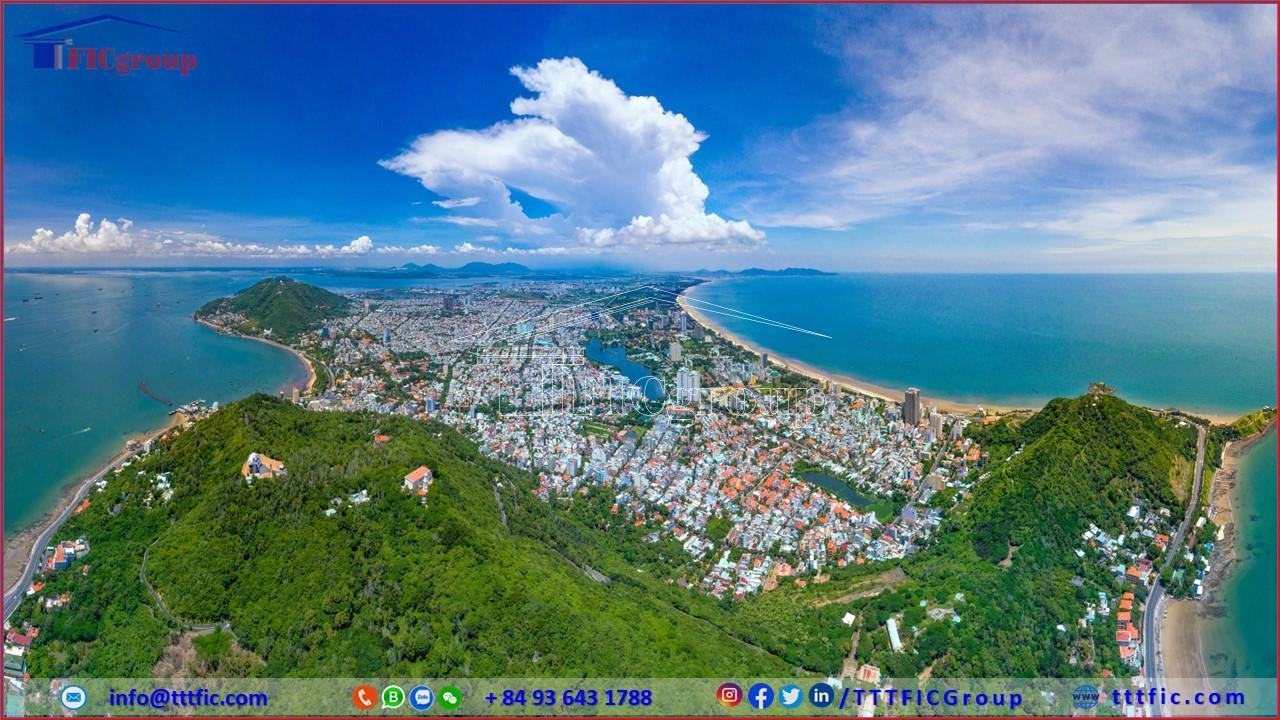
The integration of former Ba Ria–Vung Tau fundamentally changes Ho Chi Minh City’s industrial identity.
The city now incorporates a major Vietnamese oil-and-gas ecosystem, including offshore-related activities, engineering, technical services and industrial support.
This adds an energy dimension that conventional manufacturing centers do not possess.
Natural gas and associated infrastructure support power generation, industrial production and downstream chemical activities.
The resulting value chain becomes:
ENERGY → MATERIALS → INDUSTRY → EXPORTS.
Long Son adds petrochemical depth to the metropolitan industrial economy.
Petrochemical products sit upstream of numerous downstream manufacturing industries, including plastics, packaging, chemicals and industrial components.
The surrounding Long Son Petroleum Industrial Zone reinforces the strategic relationship between energy, petrochemicals, industrial land and maritime access.
Phu My I, Phu My II and Phu My II Expansion represent one of the most distinctive heavy-industrial concentrations in the enlarged metropolitan economy.
The area combines:
power + gas + steel + chemicals + mechanical industry + port connectivity.
This is an industrial proposition fundamentally different from electronics-oriented or light-manufacturing parks.
Steel, metallurgy and industrial-material capabilities support infrastructure, mechanical engineering, industrial fabrication, construction and marine-related activities.
Together with petrochemicals and energy, they give Ho Chi Minh City a deeper industrial base than a conventional service-oriented megacity.
Ports, energy, petrochemicals and heavy industry generate sophisticated engineering demand.
Mechanical fabrication, industrial equipment, steel structures, ship services, maintenance, offshore support and engineering services form an important layer between raw materials and finished industrial systems.
The establishment of VIFC-HCMC adds another strategic layer to the metropolitan economy.
A sophisticated financial center can help connect international capital with:
infrastructure, industrial development, technology, energy, logistics and trade.
The long-term proposition is:
GLOBAL CAPITAL → REAL ECONOMY → GLOBAL TRADE.
The combination of finance and one of Vietnam’s most important maritime systems creates opportunities extending beyond conventional banking.
Potential areas include:
fintech, trade finance, infrastructure finance, shipping finance, insurance, green finance and supply-chain finance.
World Trade Center Binh Duong New City adds an international business and trade platform inside the northern manufacturing ecosystem.
Its value lies in connecting factories and industrial companies with:
international exhibitions, MICE, investment promotion, business matching, customers and global networks.
Manufacturing capability alone is not enough.
Companies must also reach markets.
A major metropolitan economy requires more than factories.
It requires:
banks, lawyers, consultants, accountants, recruitment firms, engineering companies, technology providers, logistics operators and international business services.
This professional-services density strengthens Ho Chi Minh City’s relevance for regional headquarters and corporate management functions.
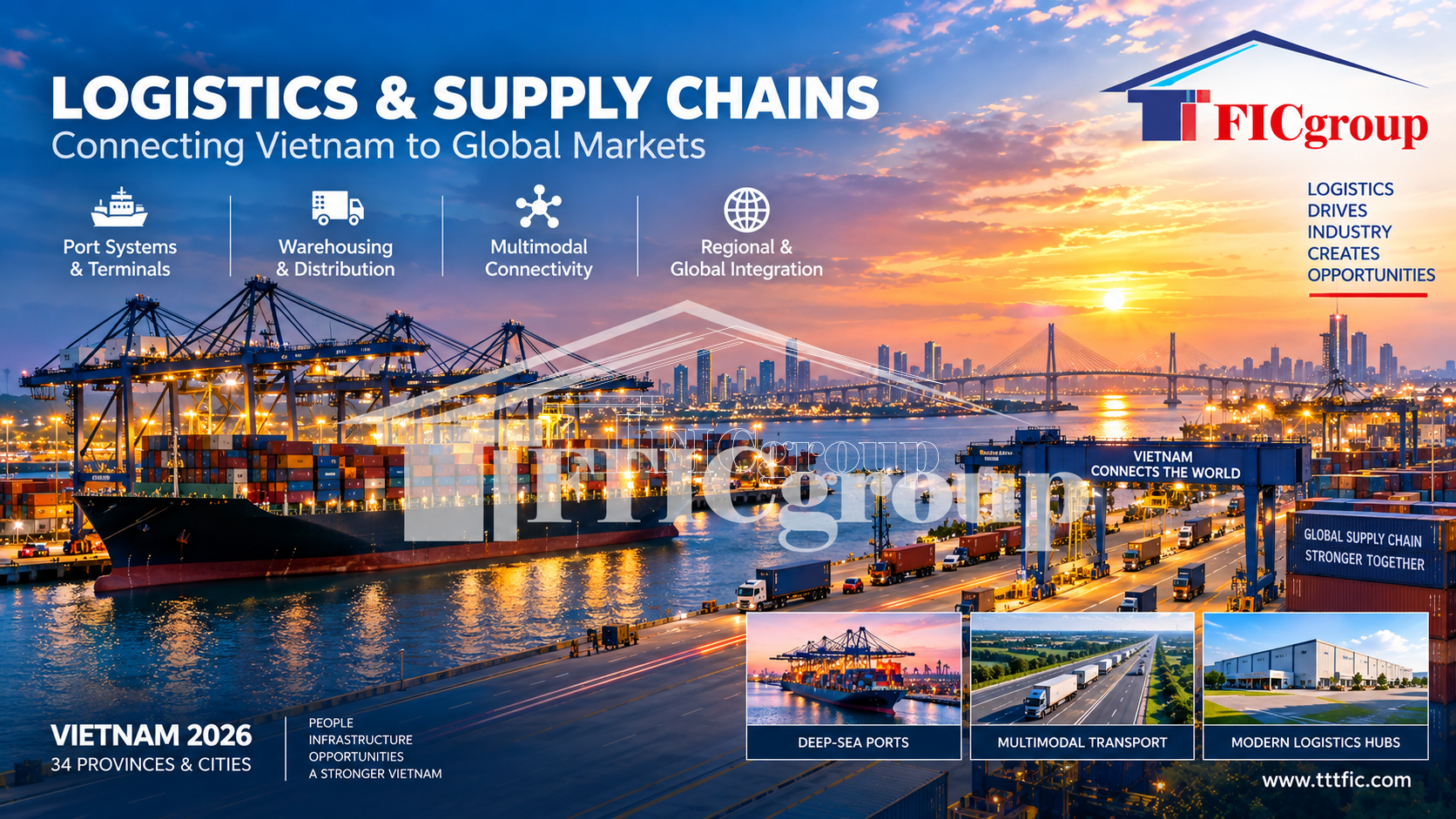
The enlarged city inherits something extraordinarily valuable:
an urban container gateway, river ports, deep-water international terminals and future transshipment infrastructure within one metropolitan economic geography.
This creates a maritime system extending from the traditional city toward the East Sea.
Tan Cang–Cat Lai is a critical container gateway serving Southern Vietnam’s enormous manufacturing and consumer economy.
Its importance is amplified by connections to industrial areas, ICDs, river transport and the wider Saigon Newport logistics ecosystem.
For many manufacturers, Cat Lai remains one of the names most directly associated with containerized import and export activity in Southern Vietnam.
Tan Cang Sai Gon — Saigon Newport Corporation — should not be understood as a single port.
It represents a broader port and logistics operating ecosystem.
Within the new Ho Chi Minh City investment geography, important names associated with this network include:
Tan Cang–Cat Lai
Tan Cang–Hiep Phuoc
Tan Cang–Cai Mep International Terminal (TCIT)
and other logistics and terminal assets.
This distinction matters for international investors evaluating operators, terminals and port systems.
Hiep Phuoc adds another strategic maritime and logistics area south of the traditional urban core.
Its industrial and port geography connects manufacturing, warehousing, waterways and the southern metropolitan growth corridor.
Together with Cat Lai, Can Gio and Cai Mep–Thi Vai, it forms part of a broader multi-gateway logistics system.
Cai Mep–Thi Vai gives Ho Chi Minh City access to one of Vietnam’s most strategically important deep-water port systems.
Its importance is not one terminal.
It is an entire cluster.
Representative deep-water terminal names include:
Tan Cang–Cai Mep International Terminal (TCIT)
Cai Mep International Terminal (CMIT)
Gemalink International Port
SP-SSA International Terminal (SSIT)
alongside other facilities within the wider Cai Mep–Thi Vai maritime ecosystem.
For export manufacturers, the essential value proposition is:
TCIT is a major deep-water container terminal within the Cai Mep–Thi Vai system.
Its international shipping role illustrates why the new Ho Chi Minh City can no longer be analyzed only through the traditional urban port system.
The industrial hinterland and deep-water gateway are increasingly part of the same metropolitan investment geography.
Cai Mep’s strength comes from terminal depth and operator diversity.
CMIT, Gemalink and SSIT add international-standard deep-water infrastructure to the metropolitan logistics proposition.
This creates competition, capacity and connectivity for manufacturers and shipping lines.
For investors, the relevant question is therefore not simply:
“How far is the factory from a port?”
It is:
“Which terminal, shipping service and logistics corridor best serves the factory’s target markets?”
The Cai Mep Ha Free Trade Zone adds a new layer to the maritime economy.
The development framework links:
seaports + logistics + industrial activity + inland waterways + services + innovation + international trade.
Its strategic potential extends beyond cargo handling.
It can become a platform connecting manufacturing with high-value logistics, maritime services, international trade and multinational regional operations.
TTMS™ Status Control: FTZ development phases, infrastructure delivery and individual investment projects should always be distinguished according to their actual legal and implementation status.
The Can Gio International Transshipment Port represents another potentially transformative component of Ho Chi Minh City’s maritime future.
Its strategic role differs from a conventional domestic container port.
The objective is international transshipment and deeper participation in global maritime networks.
Together:
CAT LAI + HIEP PHUOC + CAN GIO + CAI MEP–THI VAI
create a maritime proposition of exceptional scale.
Ho Chi Minh City possesses another logistics asset that is sometimes underestimated: waterways.
River transport can connect industrial zones, ICDs, warehouses and seaports while reducing dependence on roads.
The metropolitan logistics system can therefore combine:
Around those modes develops another investment layer:
warehousing, distribution centers, fulfillment, cold chain and logistics technology.
This is one of the central concepts of the TTTFIC Investment Intelligence™ framework:
GLOBAL CAPITAL
→ R&D
→ INDUSTRIAL LAND
→ FACTORY
→ SUPPLIERS
→ WAREHOUSING
→ LOGISTICS
→ FREE TRADE ZONE
→ DEEP-WATER PORT
→ GLOBAL SHIPPING
→ GLOBAL MARKET.
The competitive advantage does not come from any single element.
It comes from the ability to connect the entire chain.
Ring Roads 2, 3 and 4 are more than transportation projects.
They connect industrial zones, residential areas, logistics centers, ports and expressways.
As connectivity improves, administrative consolidation can increasingly become economic integration.
Strategic corridors include connections involving:
Ho Chi Minh City–Long Thanh–Dau Giay
Ben Luc–Long Thanh
Bien Hoa–Vung Tau
Ho Chi Minh City–Moc Bai
Ho Chi Minh City–Thu Dau Mot–Chon Thanh
and the wider regional expressway system.
For industrial investors, expressways expand the practical radius within which a factory can access labor, suppliers, airports, ports and logistics centers.
Metro Line 1 represents the beginning rather than the end of Ho Chi Minh City’s rail transformation.
Future urban railway development can gradually connect financial, residential, technology and industrial growth centers.
Metro should therefore increasingly be understood not only as passenger transport, but as metropolitan economic infrastructure.
Transit-Oriented Development can transform transport stations into concentrations of:
housing, offices, retail, universities and services.
Infrastructure therefore does more than connect existing economic nodes.
It can create new ones.
Tan Son Nhat remains the city’s principal aviation gateway, while Long Thanh International Airport provides a major regional aviation platform adjacent to the metropolitan economy.
Long Thanh is outside Ho Chi Minh City’s administrative territory, but its proximity makes it highly relevant to HCMC investment and logistics planning.
The combined aviation geography supports:
executives + tourism + international business + high-value cargo.
Future direct connectivity between Can Gio and Vung Tau could have strategic significance far beyond travel time.
It can strengthen a continuous coastal economic axis:
CAN GIO → VUNG TAU → LONG SON → PHU MY → CAI MEP–THI VAI.
Ports, tourism, logistics, petrochemicals, energy and urban development increasingly interact along this corridor.
Can Gio is shifting from metropolitan periphery toward a strategic coastal frontier.
Major urban development, international port infrastructure and transport connectivity can fundamentally change its economic role.
The important proposition is the combination of:
COASTAL URBAN DEVELOPMENT + TOURISM + MARITIME INFRASTRUCTURE + INTERNATIONAL PORT + ECOLOGICAL VALUE.
Environmental protection remains critical because Can Gio’s ecological assets are themselves part of its long-term value.
This southeastern corridor adds another identity to the city.
Here:
ports meet energy
energy meets petrochemicals
petrochemicals meet materials
materials meet manufacturing
and
industry meets the sea.
This gives Ho Chi Minh City a genuine maritime-industrial dimension.
Con Dao extends the metropolitan tourism proposition beyond business travel and urban entertainment.
Its history, ecology, beaches and island environment support a differentiated tourism model.
Ho Chi Minh City can therefore offer:
BUSINESS CITY → MICE → COAST → RESORT → ECOLOGY → ISLAND TOURISM.
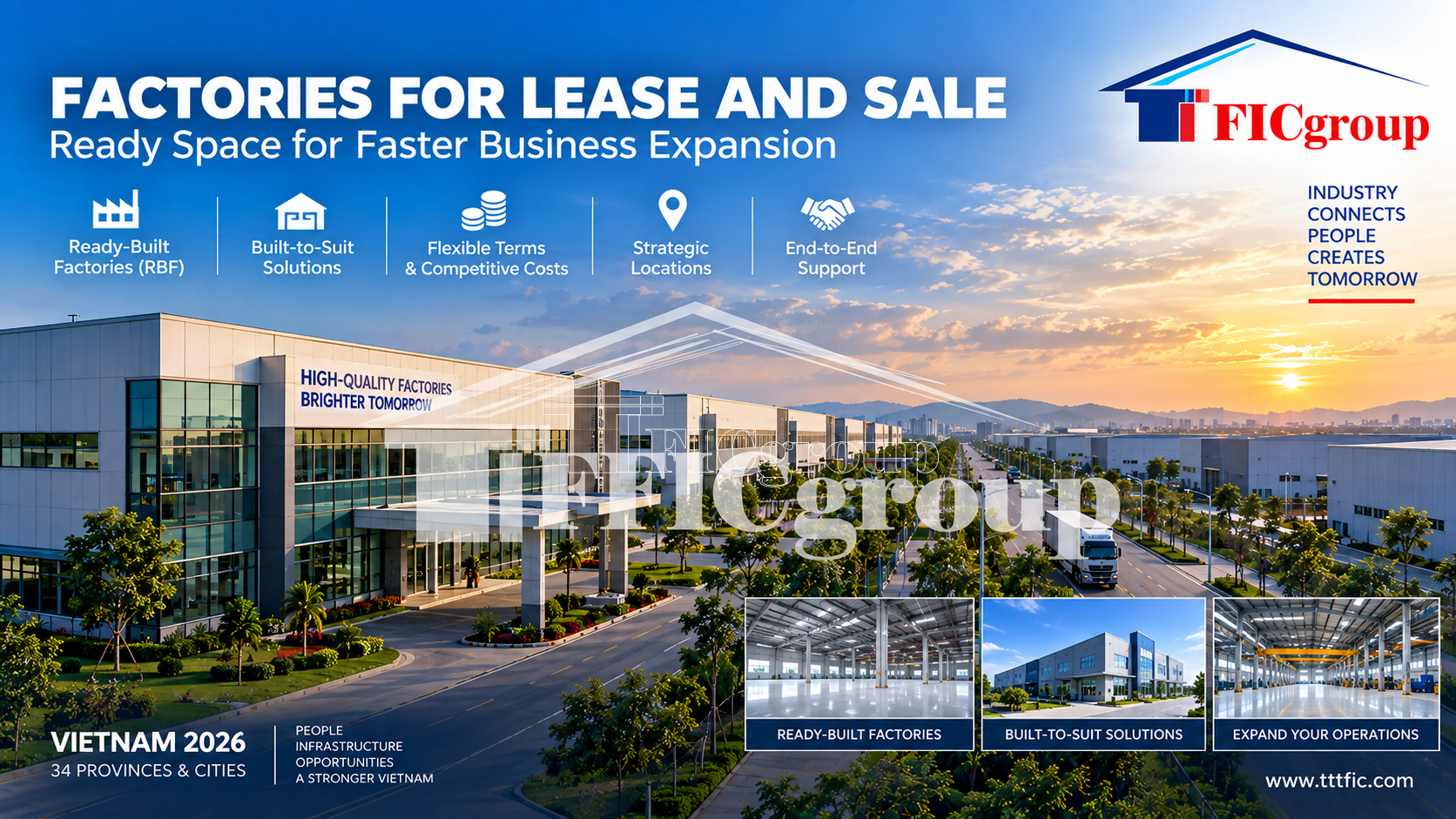
Industrial land can be developed.
Roads can be constructed.
Factories can be built.
But mature human capital takes decades.
Ho Chi Minh City contains an enormous concentration of workers, engineers, managers, researchers, entrepreneurs and professional specialists.
For advanced manufacturing and technology investors, this increasingly matters more than headline land prices.
The metropolitan area contains a deep university, college and vocational-training ecosystem.
Important institutions include major public universities, Vietnam National University Ho Chi Minh City, technical and engineering institutions, medical universities, economics and management universities, RMIT Vietnam, Eastern International University and numerous vocational-training institutions.
The relationship is direct:
FDI site selection does not stop at the factory gate.
When multinational corporations relocate senior managers, engineers and specialists, their families must also relocate.
Ho Chi Minh City’s international education ecosystem includes British, American, IB and other international curricula.
For long-term expatriate assignments, access to high-quality education materially affects talent attraction and retention.
Ho Chi Minh City offers a dense ecosystem of public hospitals, specialist hospitals, university hospitals, private healthcare and international-standard medical services.
For executives and expatriate families, access to reliable healthcare reduces relocation friction and supports long-term assignments.
Healthcare is therefore not merely a social service.
It is part of:
Housing, serviced apartments, restaurants, retail, culture, sports, golf, entertainment, beaches, international education and healthcare collectively affect where global talent chooses to live.
This gives Ho Chi Minh City another important advantage.
A company can establish operations within a major manufacturing economy without asking international management teams to live outside a sophisticated metropolitan environment.
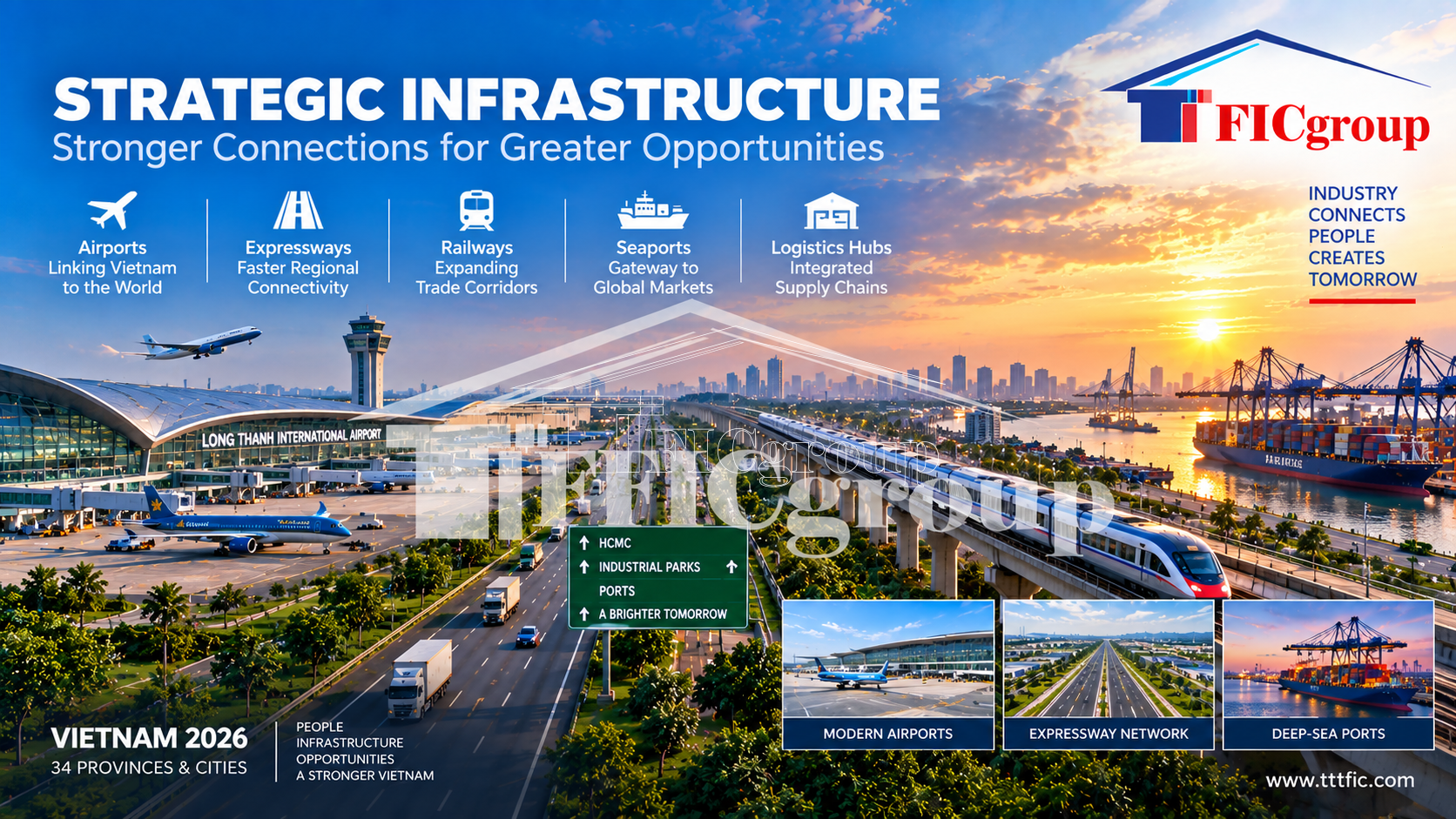
Some competitive advantages are difficult to capture in statistical tables.
One is the physical quality and organization of the investment environment.
In many modern industrial and urban corridors, investors encounter:
wide roads
planned industrial estates
modern urban centers
commercial services
universities
healthcare
logistics infrastructure
and increasingly sophisticated digital infrastructure.
Infrastructure is not valuable simply because it exists.
A sophisticated economy places many capabilities within practical reach of one another.
Manufacturers.
Suppliers.
Banks.
Lawyers.
Engineers.
Universities.
Hospitals.
Technology companies.
International schools.
Logistics operators.
Professional services.
The greater this density becomes, the less friction companies face in daily operations.
That is an economic advantage that cannot be reproduced simply by opening another Industrial Park.
Ho Chi Minh City has another characteristic investors often experience before they can quantify it.
The pace of economic activity.
People move.
Capital moves.
Information moves.
Goods move.
Companies meet suppliers.
Factories recruit workers.
Executives find professional services.
Products move toward ports.
This creates what TTTFIC Investment Intelligence™ defines as:
The ability of an economic ecosystem to convert connections into commercial activity quickly.
The industrial model becomes even more powerful when manufacturing is connected with urban life.
INDUSTRIAL PARK
→ WIDE TRANSPORT CORRIDOR
→ URBAN CENTER
→ HOUSING
→ UNIVERSITY
→ HOSPITAL
→ COMMERCIAL CENTER
→ WORLD TRADE CENTER
→ LOGISTICS
→ SCIENCE & TECHNOLOGY
→ GLOBAL CONNECTIVITY.
This is more than industrial development.
It is:
Thu Thiem → Saigon Hi-Tech Park → Long Phuoc → Long Thanh Connectivity
Target opportunities:
Semiconductors • Electronics • AI • R&D • Data Infrastructure • Precision Manufacturing • Technology Headquarters.
Binh Duong New City → VSIP → Song Than → My Phuoc → Bau Bang → Northern Science & Technology Urban Area
Target opportunities:
Advanced Manufacturing • Smart Factories • Automation • Supporting Industries • Data Centers • Industrial R&D.
Cat Lai → Hiep Phuoc → Can Gio → Cai Mep–Thi Vai → Cai Mep Ha FTZ
Target opportunities:
Logistics • Warehousing • Cold Chain • Distribution • Export Manufacturing • Maritime Services • International Trade.
Vung Tau → Long Son → Phu My → My Xuan → Cai Mep–Thi Vai
Target opportunities:
Oil & Gas • Petrochemicals • Energy • Steel • Metallurgy • Mechanical Engineering • Marine Engineering • Heavy Industry.
Historic CBD → Thu Thiem → VIFC-HCMC
Target opportunities:
Finance • Fintech • Trade Finance • Maritime Finance • Regional Headquarters • Professional Services • Global Business.
Former Ho Chi Minh City contributes:
FINANCE + TECHNOLOGY + UNIVERSITIES + INTERNATIONAL BUSINESS.
Former Binh Duong contributes:
INDUSTRIAL PARKS + MANUFACTURING + SUPPLY CHAINS + VSIP + BECAMEX + INDUSTRIAL URBANISM.
Former Ba Ria–Vung Tau contributes:
DEEP-WATER PORTS + ENERGY + PETROCHEMICALS + HEAVY INDUSTRY + MARITIME ECONOMY.
Connect them together and a much larger value chain emerges:
↓
Running alongside that economic chain is the human ecosystem:
The question for an international investor should no longer simply be:
“Should we invest in Ho Chi Minh City?”
The more useful question is:
A semiconductor investor does not require the same ecosystem as a petrochemical company.
A logistics operator does not require the same location as a regional financial headquarters.
A large manufacturer may prioritize industrial land, labor, utilities, suppliers and port connectivity.
A technology company may prioritize R&D, universities and high-tech infrastructure.
A regional headquarters may prioritize airports, finance, international education, healthcare and executive quality of life.
Professional site selection should therefore evaluate:
INDUSTRY → LOCATION → LAND → LEGAL STATUS → INFRASTRUCTURE → UTILITIES → LABOR → SUPPLIERS → LOGISTICS → PORT/AIRPORT → MARKET → TALENT → LIFESTYLE → FUTURE EXPANSION.
For investors, researchers and international site-selection teams, representative entities across the new Ho Chi Minh City investment ecosystem include:
Industrial & Export Manufacturing: Tan Thuan EPZ • Linh Trung I EPZ • Linh Trung II EPZ • Tan Tao IP • Tan Binh IP • Vinh Loc IP • Hiep Phuoc IP • Le Minh Xuan IP • Le Minh Xuan II IP • Le Minh Xuan III IP • Tan Phu Trung IP • Dong Nam IP • Tay Bac Cu Chi IP • Binh Chieu IP • Cat Lai II IP • Tan Thoi Hiep IP • An Ha IP.
Binh Duong Manufacturing Ecosystem: VSIP I • VSIP II • VSIP II-A • Song Than I • Song Than II • Song Than III • My Phuoc I • My Phuoc II • My Phuoc III • Bau Bang • Nam Tan Uyen • Rach Bap • Dong An • Dong An II • Viet Huong • Viet Huong II • Protrade International Tech Park • Dat Cuoc • Tan Dong Hiep.
Maritime & Heavy-Industry Ecosystem: Phu My I • Phu My II • Phu My II Expansion • Cai Mep Industrial Park • Chau Duc Industrial Park • My Xuan A • My Xuan A2 • My Xuan B1–Conac • My Xuan B1–Tien Hung • My Xuan B1–Dai Duong • Dong Xuyen • Dat Do I • Long Son Petroleum Industrial Zone.
Technology: Saigon Hi-Tech Park • Long Phuoc High-Tech Expansion • Northern Ho Chi Minh City Science & Technology Urban Area.
Ports & Maritime Gateways: Tan Cang–Cat Lai • Tan Cang–Hiep Phuoc • Cai Mep–Thi Vai Port System • TCIT • CMIT • Gemalink • SSIT • Cai Mep Ha • Can Gio International Transshipment Port.
Air & Regional Connectivity: Tan Son Nhat International Airport • Long Thanh International Airport connectivity • Ring Roads 2–3–4 • Ho Chi Minh City–Long Thanh–Dau Giay Expressway • Ben Luc–Long Thanh Expressway • Bien Hoa–Vung Tau Expressway • Ho Chi Minh City–Moc Bai corridor.
This index is designed as an investor-navigation layer rather than a substitute for individual project due diligence.
TTMS™ Status Control applies: Operating ≠ Under Construction ≠ Approved ≠ Planned ≠ Proposed ≠ MOU/Research.
Ho Chi Minh City’s competitive advantage is not defined by one Industrial Park.
It is not defined by one expressway.
It is not defined by one port.
It is not defined by one financial center.
And it is not defined by one headline FDI number.
Its deeper advantage comes from the:
of the entire ecosystem.
Few investment locations can simultaneously bring together this breadth of:
finance
high technology
manufacturing
oil & gas
petrochemicals
heavy industry
deep-water ports
international logistics
universities
international education
healthcare
tourism
and
metropolitan quality of life.
The transformation is not complete.
Infrastructure must still be delivered.
Transport bottlenecks must be reduced.
Administrative integration must become operational integration.
Environmental assets must be protected.
Technology and productivity must continue rising.
Future projects must be distinguished carefully from projects already operating.
But this is precisely why the current period matters.
Investors are not looking only at the Ho Chi Minh City that already exists.
They are positioning themselves for:
For global manufacturers, technology companies, infrastructure developers, logistics operators, financial institutions and long-term investors:
Not simply because it is larger than before.
But because the economic system itself has changed.
This profile forms part of the TTTFIC Global Investment Profile 2026 research program covering Vietnam’s 34 provinces and centrally governed cities.
TTTFIC combines industrial market research, investment intelligence, field experience and site-selection analysis to help international investors understand not only where industrial opportunities exist, but also how infrastructure, labor, supply chains, logistics, technology and future development affect location decisions.
Vietnam Nationwide + Thailand
Industrial Land • Ready-Built Factories • Existing Factory M&A • Industrial Site Selection • Design & Build • FDI Legal Support • Investment Intelligence
Tel / WhatsApp: +84 936 431 788
Email: marketing@tttfic.com
Table of contents